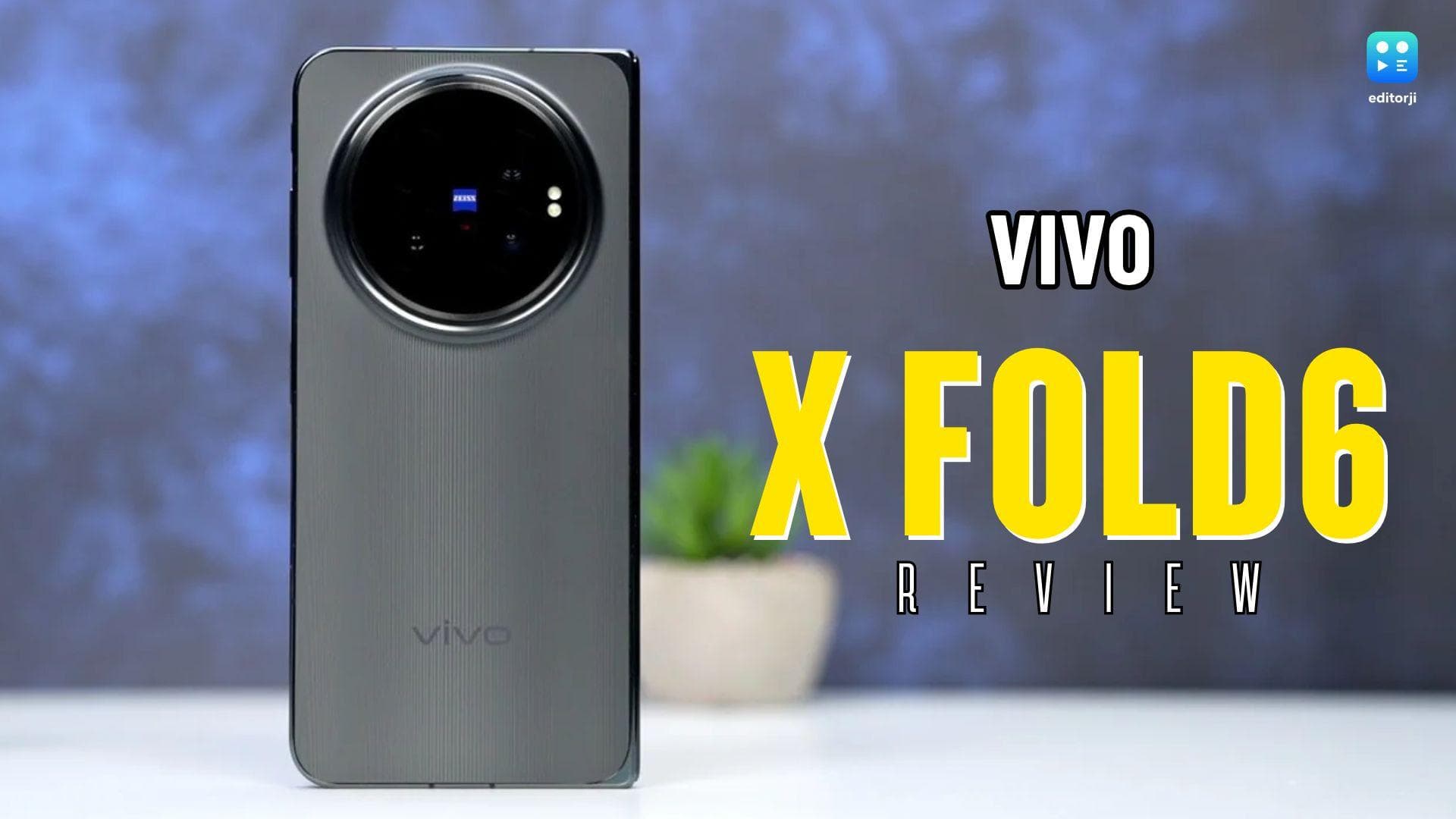
The Vivo X Fold6 brings plenty to the table for a foldable smartphone in 2026, at least on paper. It gets a powerful Dimensity 9500 Super Edition processor, ZEISS cameras, OriginOS 7, AI-driven tools, and a massive 6,900mAh battery. It looks promising, but its price tag of ₹2,19,999, surely does complicate things a bit.
In 2026, we are at a stage where foldable smartphones need to offer more than just a large display to make its premium price worthwhile.
For me, it should simplify multitasking, deliver dependable camera performance, and last long enough to get through a busy day without reaching for the charger. It has to have a real impact on my life. Having used it for about two weeks, I will tell you in this review, where I stand.
Vivo X Fold6 Design: Slim, Sophisticated and Built to Impress
The Vivo X Fold6 has a design that grows on you without relying on flashy details to make a statement. Its flat metal frame, rounded corners and large circular camera module give it a distinctive look, while the two colour options cater to different tastes. Nebula Teal adds some personality, but I prefer the Prism Black variant I tested. It looks clean, understated and right at home on a premium device.
At 228g, with a folded thickness of 9.4mm, the X Fold6 isn't exactly lightweight and does not just easily slip in and out of a pocket. That said, the curved edges help it sit comfortably in my hand, and its proportions didn't take long to get used to.
Unfold it, though, and the experience changes completely. At just 4.4mm thick, the inner half feels remarkably slim, making the phone look almost unreal from certain angles.
The hinge deserves credit, too. It feels reassuringly sturdy and opens the phone flat without much fuss. The crease down the middle is noticeable, both visually and to the touch, but it gradually fades into the background during regular use. Whether I was scrolling through articles, watching videos or juggling multiple apps, it rarely distracted me from what I was doing.
Vivo hasn't overlooked durability either. The X Fold6 comes with IP58, IP59, IPX8 and IPX9 ratings, offering protection against dust and water under specified conditions.
A side-mounted fingerprint sensor handles unlocking, while the programmable Shortcut Button on the left can be set up for quick actions, including launching the camera or turning on the torch.
Connectivity is equally well covered, with dual nano-SIM 5G, Wi-Fi 6, Bluetooth 6.0, USB 3.2, and NFC. Overall, the X Fold6 strikes a convincing balance between elegant styling, practical features and the sturdiness you'd expect from a flagship foldable.
Vivo X Fold6 Displays: Excellent Visuals, Inside and Out
The displays are among the biggest reasons to consider the Vivo X Fold6. Open the phone, and you're greeted by an 8.02-inch panel with a 2504 × 2312 resolution and 424 PPI. There's enough room to read comfortably, work on documents or run several apps side by side. Text looks crisp, images retain plenty of detail, and the extra space makes multitasking feel far less cramped than it does on a conventional smartphone.
Vivo has paired Samsung Display's M14 panel with an LTPO 8T backplane, enabling the refresh rate to scale between 1Hz and 120Hz depending on what's happening on screen. In everyday use, this translates into fluid scrolling, responsive animations and smooth transitions when switching between applications. You don't have to think about the technology behind it; you simply notice how polished everything feels.
The inner screen is equally enjoyable for entertainment. Videos may not always occupy the entire panel because of its aspect ratio, but there's still a noticeable advantage when watching YouTube, streaming shows or catching a live cricket match. Colours appear rich without sacrificing detail, contrast is impressive, and photographs look particularly good on the larger canvas.
What's even better is that the outer display doesn't feel like an afterthought. Its 6.51-inch size, 2528 × 1120 resolution, 424 PPI density and adaptive 120Hz refresh rate make it perfectly capable of handling everyday smartphone duties. I could reply to messages, browse the web and check notifications without constantly opening the device.
Both panels also support local peak brightness of up to 5,000 nits and can drop as low as 1 nit. This helps with visibility outdoors while making late-night scrolling easier on the eyes. After using both screens, I found little reason to complain about either one. The X Fold6 delivers a consistently premium viewing experience, regardless of how you use it.
Vivo X Fold6 Software: Multitasking Is the Real Star
A foldable's success depends as much on its software as its hardware. A massive display doesn't mean much if all it does is stretch the usual smartphone experience across a bigger canvas. With OriginOS 7 Fold, based on Android 17, the Vivo X Fold6 attempts to make that extra space count, particularly for people who need to manage work, communication and everyday tasks on the move.
One feature I found genuinely useful was Origin Workbench. It provides quick access to frequently used apps and ongoing activities, reducing the need to keep navigating through menus. It's a small change, but it makes the phone feel more organised and better suited to handling several things at once.
Multi-Split Screen pushes this idea further by letting you use up to five applications simultaneously. That might sound excessive on paper, but there are situations where it makes sense. You could research a topic in Chrome, jot down important points in Notes, respond to WhatsApp messages and keep an email conversation handy, all without repeatedly jumping between apps. The inner display has enough room to make this arrangement surprisingly workable.
OriginOS also makes moving information between compatible apps more convenient. You can drag supported text, images and files from one application to another rather than relying on the usual copy-and-paste routine. When you're collecting information, planning a trip or putting together a presentation, these shortcuts can save time and reduce unnecessary steps.
There's also a Desktop Mode for those moments when the phone needs to do a little more. Connect an external display over USB-C or wirelessly, and the interface switches to a desktop-style layout with resizable windows. It isn't going to replace a laptop for every demanding task, but it's a useful option when you're travelling or need a larger workspace during a meeting.
The Office Kit extends these capabilities to compatible computers, offering features such as file sharing, task continuity and camera integration. The X Fold6 can even double as a webcam with supported third-party applications, including on MacBooks.
What I like most is that Vivo has given the X Fold6 a practical reason to exist beyond its folding screen. The multitasking tools and desktop features make the inner display feel like a workspace you can actually use, rather than a novelty reserved for watching videos. There's still a learning curve, but the software makes a convincing case for choosing a foldable for productivity.
Vivo X Fold6 Performance: Fast, Fluid and Ready for Anything
Under the hood, the Vivo X Fold6 gets MediaTek's Dimensity 9500 Super Edition, a flagship 3nm chipset designed to handle demanding workloads. Its CPU combines a 4.21GHz prime core with three performance cores clocked at 3.5GHz and four efficiency cores running at 2.7GHz. Vivo also includes its V3+ Imaging Chip to assist with camera processing, giving the device dedicated hardware for imaging tasks.
The rest of the hardware is just as capable. You get 12GB of LPDDR5X Ultra RAM and 512GB of UFS 4.1 storage, which translates into quick app launches, responsive navigation and smooth transitions between tasks. There's also an Extended RAM feature that can allocate up to 24GB of additional virtual memory from internal storage. Since there's no microSD card slot, however, the built-in 512GB is all the storage you'll have to work with.
What impressed me most was how comfortably the phone handled the demands of its foldable form factor. Running multiple applications, rearranging windows and moving between the inner and outer displays didn't make the experience feel cumbersome. The hardware and OriginOS 7 Fold seem well suited to one another, particularly when using productivity features such as Origin Workbench.
Gaming was another highlight during my time with the device. I played BGMI on the unfolded screen, and the additional viewing area made it easier to follow the action and keep an eye on the map. The experience felt closer to playing on a compact tablet than a regular smartphone, which is one of the more tangible benefits of having a foldable.
The benchmark results are impressive, too. The X Fold6 recorded 3,458,352 points on AnTuTu, while Geekbench 7 delivered scores of 1,552 in single-core and 5,456 in multi-core tests.
Numbers alone don't tell the whole story, but they reinforce what I experienced during everyday use. The X Fold6 has the processing power to tackle intensive multitasking, productivity applications and demanding games without feeling out of its depth. For a premium foldable, that's exactly the kind of performance I want to see.
Vivo X Fold6 Cameras: Finally, a Foldable That Takes Photography Seriously
Foldable phones have often asked buyers to accept a few camera compromises in exchange for that fancy folding display. The Vivo X Fold6 makes a convincing attempt to change that perception. Its ZEISS-engineered triple-camera setup looks every bit as ambitious as you'd expect from a premium flagship, with a versatile combination of high-resolution hardware and specialised shooting features.
The main camera uses a 200MP Samsung HPB sensor measuring 1/1.4 inches, paired with an f/1.68 aperture and optical image stabilisation. Vivo claims a CIPA 4.5 stabilisation rating, while ZEISS T* coating is designed to reduce reflections and ghosting in difficult lighting. Of course, impressive specifications don't automatically translate into better pictures, but there's plenty of promising hardware here.
The telephoto camera is arguably the more interesting addition. It features a 50MP Sony LYT-602 sensor with a 70mm-equivalent focal length and 3x optical zoom, with digital zoom reaching up to 100x. It also supports telephoto macro photography at up to 20x magnification, opening up opportunities to capture intricate details from a distance. Its ZEISS APO certification is intended to minimise colour fringing around contrasting edges, helping maintain image clarity.
Completing the rear setup is a 50MP ultra-wide camera with a 15mm-equivalent focal length and autofocus. That combination makes it useful for everything from sweeping landscapes to closer subjects. Selfie duties are handled by separate 20MP cameras on the cover and inner displays, so you aren't stuck with a basic front-facing camera regardless of how you hold the phone.
Vivo has added several software tools to make photography more flexible. Motion Portrait 2.0 is designed for moving subjects, Night Flash Portrait targets low-light shots, and AI Reflection Erase can help clean up pictures taken through glass. Refined Color and Color Palette options offer additional control over the final look.
The folding design also creates some useful shooting possibilities. Subjects can check their appearance using the cover display, which is particularly handy when photographing kids or pets, while the unfolded screen provides a much larger viewfinder for framing shots.
Video recording gets plenty of attention, too. The V3+ Imaging Chip enables 4K recording at 60fps with Dolby Vision, along with 4K 60fps portrait video. On paper, the X Fold6 offers a remarkably comprehensive camera package, suggesting that Vivo wants its foldable to compete on photography as seriously as it does on productivity and performance.
Vivo X Fold6 Battery & Charging: Plenty of Stamina
Battery life turned out to be one of the Vivo X Fold6’s biggest strengths. Its 6,900mAh cell easily got me through roughly a day and a half, even with a mix of work, video streaming, navigation, social media scrolling and gaming. Considering it has two large displays and flagship-grade hardware to power, that kind of endurance is genuinely reassuring.
When it’s time to recharge, the phone supports 80W wired FlashCharge and 40W wireless charging. It also offers reverse wireless charging, letting you top up compatible accessories without carrying an extra charger.
Vivo X Fold6 Verdict
Priced at ₹2,19,999, the Vivo X Fold6 has some big expectations to live up to, and it manages to deliver on most fronts. Beyond the folding form factor, you get a polished design, two excellent displays, powerful hardware and battery life that genuinely works in your favour. In my experience, getting roughly a day and a half out of a single charge, even with gaming and regular social media use, was a definite highlight.
What makes this phone stand apart is how well its software takes advantage of the larger screen. OriginOS 7 Fold brings tools such as Workbench, Multi-Split Screen, AI Cross-App Drag and Desktop Mode, turning the device into something more useful than a conventional smartphone. The versatile ZEISS camera system, featuring a 200MP primary shooter, 3x periscope telephoto and ultra-wide camera, adds further appeal.
Of course, the asking price is steep, and a foldable won't suit everyone's needs. But if you're after a flagship that doubles as a practical productivity device, the Vivo X Fold6 is worth considering.