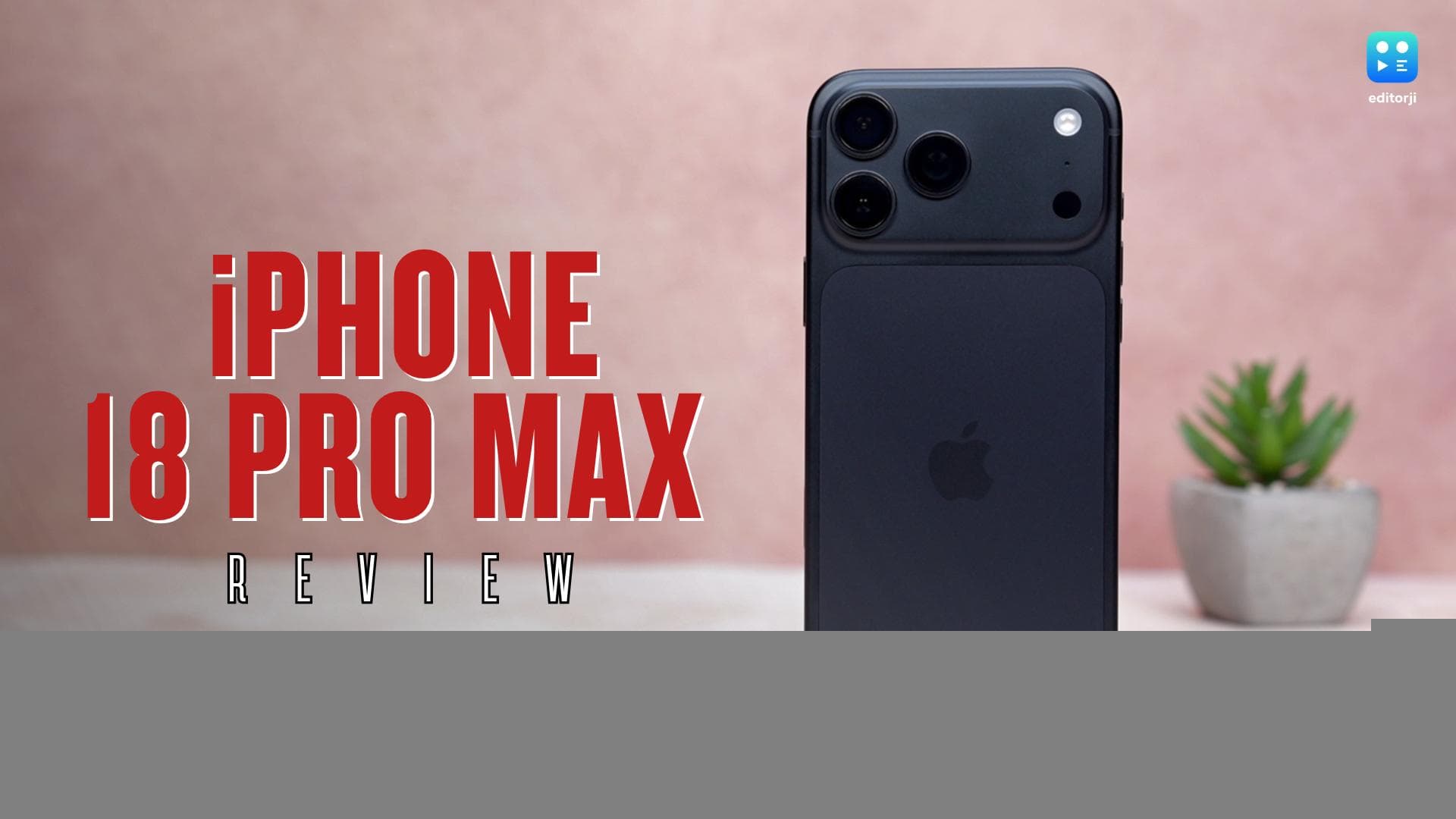
Apple’s iPhone 18 Pro Max arrives at a peculiar moment for the company. Apple is adjusting to life after Tim Cook, with John Ternus now at the helm; component prices, particularly for memory and storage, have climbed sharply; and the company has launched the iPhone Duo, its first foldable, which has understandably become the conversation starter.
That leaves the 18 Pro Max in an unusual position. It is arguably Apple’s most capable handset yet, but its biggest achievement is not its headline. The Duo is the bold new direction. The Pro Max is the phone that does the serious work.
For buyers who demand one device for shooting, editing, gaming, travel, work and everything in between, this remains the iPhone I would choose. It starts at ₹1,79,900 for 256GB, ₹20,000 above last year’s entry point, so the price needs a real case behind it.
Thankfully, Apple has not relied on a faster chip alone. A reworked camera system, better heat management, a larger battery and more useful Siri AI give it genuine substance. The 18 Pro Max remains a large, weighty and very expensive phone. But it feels like a Pro model designed for people who will actually push it.
iPhone 18 Pro Max Review: Design
Apple has not redesigned the iPhone 18 Pro Max, nor was I expecting it to. The current Pro shape is set to stay for another cycle or two, so anyone waiting for a fresh silhouette will need to hold out for the iPhone 20.
What you notice immediately is the size of the thing. With a 6.9-inch screen, 8.8mm body and a 249g weight, this is the largest and heaviest iPhone Apple has made. Even with large hands, I found it unwieldy at times.
Put it in a sturdy third-party case and it comes alarmingly close to 300g. You notice that weight in a pocket, during long calls and, eventually, on your wrist. Unless the larger screen is essential, I would suggest smaller-handed buyers go for the standard iPhone 18 Pro.
Some of the weight has a purpose. The larger battery and vapour chamber, which is roughly three times bigger than before, need space. I am happy to make that trade-off.
The in-hand feel of the phone though, however, is superb. Apple continues with an aluminium unibody, pairing Ceramic Shield 2 on the front with a matching Ceramic Shield rear panel over the MagSafe area. The familiar controls remain well placed: Action button, volume keys and SIM tray sit on the left, while the Side button and Camera Control are on the right. IP68 protection covers six metres of water for 30 minutes.
Burgundy is of course the colour of the year, but Black would be my pick. It is wonderfully deep and makes the phone look almost monolithic. Do keep in mind, both it and Burgundy are fingerprint magnets, though. All in all, the 18 Pro Max is beautifully built and undeniably premium.
iPhone 18 Pro Max Review: Display And Audio
The iPhone 18 Pro Max retains the 6.9-inch LTPO Super Retina XDR OLED panel from its predecessor. In practice, it remains a fantastic screen: 460ppi sharpness, adaptive refresh from 1Hz to 120Hz and enough brightness to stay comfortably visible when Delhi’s afternoon sun is at its worst.
There are Android flagships with flashier refresh figures, higher claimed peak brightness and resolution or a wider colour gamut. That does not make this display any less convincing. After a month of using the phone, I have no real complaint with it. It is among the best because it gets the basics right, every time.
Colours have plenty of richness without appearing artificially boosted. Netflix shows in Dolby Vision look excellent, with controlled highlights and enough detail in darker scenes that they do not collapse into grey mush. The anti-reflective treatment is genuinely useful outdoors too. It may not be the most attention-grabbing panel in the category, but it is consistently brilliant.
Apple has reduced the Dynamic Island on the 18 Pro models by roughly 35%. Part of the Face ID hardware now sits under the display and slightly to the left. If you look closely, there is a tiny reduction in pixel density around that area. But it is invisible in ordinary use. I could only find it by angling the phone precisely under the right light. Apple has done an impressive job masking the change.
The stereo speakers are excellent as well. They are loud, stay clear at higher volumes and deliver more bass than expected. Whether I was watching YouTube at my desk or an episode in bed, I rarely felt the need to reach for earphones.
iPhone 18 Pro Max Review: Performance
The A20 Pro gives the iPhone 18 Pro Max more than a routine annual speed bump. Built on 2nm, it is also much better at sustaining its performance under load.
The chip combines a six-core CPU and seven-core GPU with a Neural Engine that has double the core count of the A19 Pro. It has 12GB of LPDDR5X RAM and 50% more memory bandwidth. A vapour chamber around three times larger than the one in the iPhone 17 Pro Max also manages heat better.
It feels exceptionally responsive. Apps launch immediately, the camera opens without hesitation and iOS 27’s more demanding visual effects do not cause stutters. In my tests, AnTuTu returned 3,527,133. Geekbench 7 produced 4,031 in single-core and 11,481 in multi-core testing. Those are laptop-class figures, closer to a MacBook Air than a conventional phone.
Graphics performance is equally emphatic. In 3DMark Wild Life Extreme Stress Test, the phone managed 79.2% stability, dropping from 8,202 points to 6,499. The more relevant result is that it never felt strained afterwards, even after a demanding stress test.
That becomes obvious with AAA console ports. Resident Evil Village and Death Stranding both ran brilliantly, with rapid loading, excellent image quality and reliably smooth performance at high settings. If the 18 Pro Max can manage games of that scope so comfortably, BGMI and Call of Duty Mobile are hardly going to worry it.
The phone will become warm under sustained pressure, but its thermal control is far better than the iPhone 17 Pro Max’s. I never felt serious throttling or the uncomfortable heat that suggests a device is overworking.
The A20 Pro should also have plenty left in reserve for future Apple Intelligence features. Geekbench AI returned 6,942 in single precision, 40,080 in half precision and 52,864 in quantised tests for the NPU. The GPU was faster again, but the NPU numbers point to robust on-device AI capability for years to come.
iPhone 18 Pro Max Review: Cameras
Apple has made one meaningful change to the iPhone 18 Pro Max camera system. The primary 48MP Fusion camera now has a six-blade variable aperture, adjustable from f/1.48 to f/4.0. It gives the photographer greater say over incoming light and depth of field.
The remaining hardware is familiar: a 48MP ultra-wide, 48MP 4x telephoto and an 18MP Centre Stage front camera. Do not expect a wholesale leap in raw image quality from the main camera. Instead, the new aperture changes the mood of an image or clip. Auto works for most, but it is worth taking manual control and experimenting.
Apple’s image science remains a major strength. Shots of people, flowers and close subjects came out beautifully, while background separation appears more believable even before Portrait mode is involved. The 13mm ultra-wide is dependable for sweeping views and tight interiors, including after dark. I found myself returning most often to the telephoto, though. It delivers excellent portraits, useful reach and an 8x optical-quality crop that is far more usable than I expected. Centre Stage continues to be excellent for selfies, group frames and front-facing video.
The overall processing is also pleasingly restrained. HDR is controlled, colours lean warm, and shadows avoid the aggressively bright look that has become common on rival flagships. Personally, I prefer this approach to Oppo and Vivo’s processing.
Photographic Styles have grown into a genuinely useful creative tool. Beyond changing colour, they let you adjust tone, warmth, contrast, texture and grain, making it possible to create an individual look without making every photo resemble a forced vintage filter.
Video remains Apple’s clearest camera advantage. It is sharp, stabilised exceptionally well and consistent across the lenses. Tracking is notably better this year, while 4K at 120fps from the main camera and proper manual controls make this one of the most capable phones for creators working right now.
iPhone 18 Pro Max Review: Software
iOS 27 is not a dramatic visual departure if you have used iOS 26. Apple showed off most of its new ideas at WWDC. Liquid Glass now lets you adjust its transparency, which I prefer keeping low.
The Dynamic Island can now display three Live Activities simultaneously, up from two. Apple has also built more provenance into its imaging tools. SynthID will identify AI-generated or AI-edited images, while Reference Image mode keeps a sensor-level, tamper-proof original alongside the finished photograph in Photos. One helps identify altered imagery; the other records what the camera actually captured.
But Siri AI is the reason this release feels important. This is the version of Apple Intelligence I had been waiting for. Siri is faster, more natural in conversation and much more aware of what is on-screen. It can draw context from Messages, Mail, Photos and other apps, understand a follow-up question and retain the thread instead of forcing you to repeat yourself.
You can speak to it naturally, ask it to interpret the screen, search the web or continue an interaction from another device. For once, Siri feels genuinely useful rather than a fragile voice-command shortcut.
The A20 Pro plays an important role here. Straightforward requests are handled on the phone, while more complex work is routed through Private Cloud Compute. Apple has also expanded its photo-edit.
iPhone 18 Pro Max Review: Battery
The iPhone 18 Pro Max needs a few days to settle. Mine spent four to five days learning my habits, indexing apps and settling Apple Intelligence.
This is the best endurance I have seen from an iPhone in years. Even with an Indian model that retains its SIM tray, it comfortably covered demanding workdays involving calls, navigation, camera use, social media, email and gaming, often leaving enough charge to skip an overnight top-up. Lighter weekends easily extended into a second day.
Wired charging is much quicker too. Using a compatible 60W adapter, I reached 50% in 15 minutes, about 80% in 30 minutes and full charge in roughly 50 minutes. MagSafe remains a great convenience: 25W Qi2 reaches 50% in around half an hour.
iPhone 18 Pro Max Review: Verdict
Priced at ₹1,79,900 for the 256GB model, the iPhone 18 Pro Max asks for ₹20,000 more than the previous generation did. That is a serious increase, even for Apple. Yet flagship prices have climbed this year, often without delivering a persuasive upgrade.
This is not a phone I would recommend indiscriminately. It is enormous, heavy and much happier in two hands. Unless you specifically want the larger display and endurance, the standard iPhone 18 Pro is the sensible choice for most buyers.
But the Pro Max is the one I would choose. Its screen is superb, the battery life is exceptional, the cameras are excellent, and video remains hard to beat. More importantly, the A20 Pro has performance to spare, while the improved cooling lets it maintain that advantage when pushed.
The variable-aperture camera adds creative control, and Siri AI finally seems worthy of Apple’s promise. Add the ecosystem and long support, and the iPhone 18 Pro Max is the serious iPhone to get. It is expensive, but unusually good at making its price feel earned.