Poco’s M series has been a massive hit among users who want to have a taste of the upper mid-range experience, but at a budget price, often under ₹20,000. Their latest addition to the series, the Poco M8 comes with a new design language and features that are dependable without stretching into higher price brackets.
Before getting into the finer details of the hardware, performance, and cameras, it’s worth talking about pricing. The Poco M8 starts at ₹18,999 for the base variant which is a slight increase from the price of Poco M7. But, is that price increase worth it? More importantly though, is the M8 competitively priced against its competitors?
Design
The phone arrives in Poco’s unmistakable yellow box with classic black branding. Interestingly, I received the Poco M8 alongside the Redmi Note 15 5G, and placing them side by side makes it obvious how closely related these two devices are.
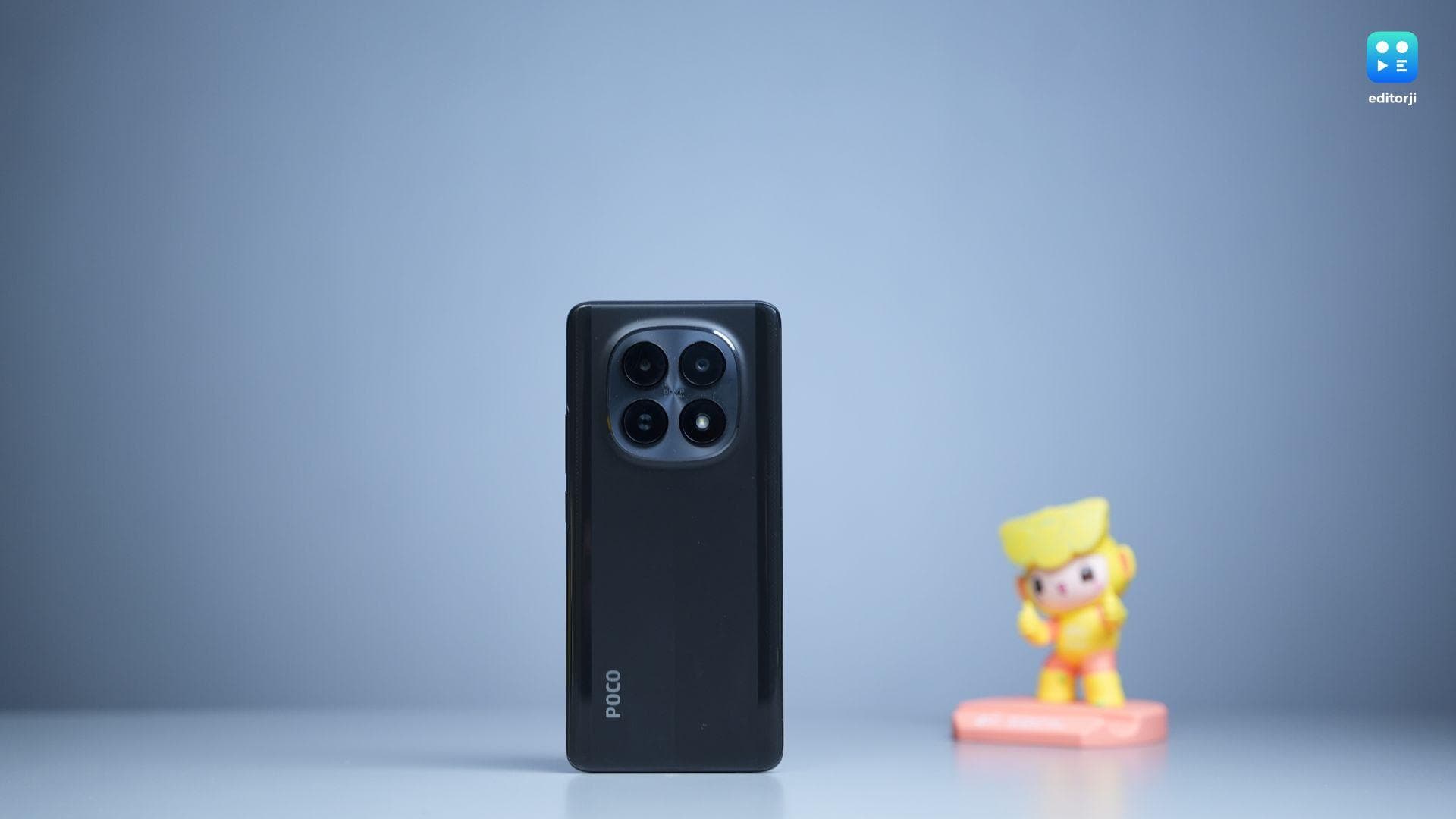
At first glance, they look very similar, but the biggest differentiator is the striped pattern on the back of the Poco M8. The design gives a youthful and sporty vibe. This similarity isn’t necessarily a bad thing.
The Poco M8 features a matte-finished plastic back with a bold, eye-catching camera module that has a silver stripe protruding from the back panel and genuinely doesn’t come across as budget-focused.
The three colour options - green, silver and black make it look cool. I am using the black model, which has enough character to stand out without trying too hard.
Along the sides, you’ll find the usual power button and volume rocker, while the bottom houses a USB-C 2.0 port, a speaker grille, and the nano SIM tray. Unfortunately, there is no headphone jack, which was present on the Poco M7.
It’s also pretty solid, as it gets an durability rating of IP 66. You also get an IR blaster and NFC for connectivity.
In everyday use, the phone feels comfortable and well-balanced in the hand. The ergonomics are thoughtfully done, making it easy to get accustomed to the device during day-to-day tasks. Whether it’s scrolling for long sessions, typing out long emails, or gaming, the Poco M8 feels intuitive and easy to live with.
Comparing it to the Poco M7 5G, which has a comparatively different design, it was a big phone and because of that, I struggled with the grip at times. However, this one is quite ergonomic.
Display
Moving on to the display, this is where the Poco M8 really starts to impress. It features a 6.77-inch curved FHD+ AMOLED panel with a 120Hz refresh rate. Watching videos, scrolling through social media, or even just navigating the UI feels more immersive than you’d expect at this price point.
It’s a 12-bit panel as well, which means colours look rich. And because it’s an AMOLED panel, the blacks look deeper, highlights pop nicely, and overall colour reproduction feels rich without being overly saturated.
The previous generation packs an IPS LCD panel, so switching to AMOLED here feels like a meaningful step forward rather than a minor spec bump. You also get a set of stereo speakers with Dolby Atmos. They are not that big on bass but are loud enough for your average content watching and reel-scrolling sessions. For me, the 3200 nits of peak brightness of the Poco M8 is easily one of the strongest aspects. However, you get 800 nits of typical brightness, which works fine indoors, although I would have loved to see it get brighter when outdoors.
Moving on to the durability of the phone. The Poco M8 is protected by glass at the front, and there is an IP66 rating, which means it is protected from water splashes and dust.
The Poco M8 comes with an optical in-display fingerprint sensor, and in terms of reliability, it does its job well. That said, I often found myself relying more on Face Unlock. It’s simply faster and more convenient in day-to-day scenarios, especially when you’re picking up your phone frequently.
Performance
Under the hood, the Poco M8 is powered by the Snapdragon 6 Gen 3 chipset, which is a mid-range chipset. Poco M8 is configured with up to 8GB of LPDDR4X RAM and 128 GB of UFS2.2 storage. On paper this combination looks like a decent pair; in real life it performed well in day-to-day usage, multitasking and longer-term usage without feeling immediately outdated.
To get a sense of raw performance, I ran a couple of standard benchmarks. AnTuTu did complete its test cycle on the device, but for some reason, it failed to generate a final score on my unit.
Geekbench, however, ran without any issues and gave a clearer idea of where the Snapdragon 6 Gen 3 stands. The scores reflect what you’d expect from a mid-range processor strong enough for everyday tasks.
In day-to-day scenarios, the Poco M8 feels responsive and dependable. App launches are quick, switching between multiple apps is smooth, and routine tasks like browsing, social media, messaging, and video streaming run without hiccups. The phone doesn’t stutter or struggle during regular use, which is exactly what most users in this category care about.
When it comes to gaming, Call of Duty: Mobile runs up at 60 FPS. During sessions lasting 30 minutes, gameplay remained smooth with no frame drops, and thermals were well managed too. But once you push past the half-hour mark, the phone does start to warm up. Nothing uncomfortable, but good enough to remind you that it’s a Poco phone at the end.
Overall, the performance of the Poco M8 feels well-tuned for its target audience. It may not be a phone for hardcore gamers or those who chase top scores in benchmarks, but for everyday use, light to moderate gaming, and multitasking, it delivers a consistently smooth experience.
Software
The Poco M8 ships with HyperOS 2 layered on top of Android 15. Compared to Poco M7, which came with Android 14 and promised 2 Android updates and 4 years of security patches, Poco has committed to four major Android OS updates and six years of security patches this year, which is reassuring, especially in this price segment. Also, this means the phone should receive Android 16 after an immediate update.
Living with HyperOS 2 on a daily basis, the overall experience is smooth and mostly fuss-free. The interface responds quickly to inputs, and nothing feels sluggish.
That said, HyperOS still isn’t without its annoyances. The biggest one, at least for me, continues to be the app drawer. It feels cluttered and unintuitive, making it harder than necessary to find apps quickly.
This has been a long-standing issue across Xiaomi and Poco devices, and it’s disappointing to see it persist even in newer versions of the software. If Poco can finally address this in a future update, HyperOS would be far more pleasant to live with overall.
Coming to the AI, there are no wow features; there are some pre-existing AI features like AI eraser, AI scene detection, and more. However, Gemini integration in a budget phone like Poco M8 is an appreciable addition too.
Talking about the bloatware, there are some preinstalled apps like Netflix, Spotify, Swiggy, etc., but they can be uninstalled. There are hot games and hot apps, but they can be removed too.
With HyperOS 2 I can definitely say that the software experience has improved as compared to the last one.
Battery
Despite the sleek, curved form factor, the Poco M8 manages to house a sizeable 5,520mAh silicon-carbon battery, paired with 45W fast charging and 18W wired reverse charging; however, there are other phones in the same category that offer a 6,000mAh battery comfortably.
Poco claims about two days of usage under moderate conditions.
In real-world use, their claim does hold up fairly well. The phone comfortably lasted more than a full day on a single charge with mixed usage that included social media, calls, and occasional gaming. Battery drain remained consistent, with no sudden drops during heavy apps or background activity.
They also claim that the battery is rated to retain solid performance for over 1,600 charge cycles.
Charging speed is fast enough too; a full top-up from 0 to 100 per cent takes close to an hour. All I can say that even though its not top-notch or great, it’s perfectly acceptable at this price point.
Camera
The Poco M8 comes with a fairly simple dual-camera arrangement on the rear, a 50MP primary sensor accompanied by a 2MP depth camera. During my time with the device, I shot mostly in daylight, and the results were usable. Interestingly, photographs of people turned out better than the pictures of buildings, plants, or random objects. The main camera feels average rather than impressive.
Colours in general remain natural, though several frames carried a slightly hazy look, and the highlights were occasionally blown out, especially under harsh winter sun. The phone offers a 2x digital zoom mode that manages to preserve consistency in exposure, but sharpness clearly drops and fine textures get smudged.
Portrait mode is one of the stronger bits; foreground-background separation looks decent for a ₹20,000 phone, even if edge detection isn’t always accurate.
Low-light photography has visible noise, and street lights create flares in a few scenes, yet night shots of human subjects still look pleasant.
Selfies, however, were disappointing; images appeared washed out with uneven skin tones. Video recording supports 4K at 30FPS but the footage wasn’t stable at all, leaving me a little underwhelmed.
Verdict
The Poco M8 nails the fundamentals that matter most to buyers in the budget segment: you get an excellent curved AMOLED display, reliable performance, long software support, and decent battery longevity. The slim, youthful design is a refreshing upgrade from the Poco M7 and gives the device more personality than its price would suggest. The cameras, however, remain the weak link, with only the 50MP primary sensor delivering acceptable results. Selfies and video stabilisation leave room for improvement. Starting at ₹18,999 for the base variant, the Poco M8 is easy to recommend to people for whom media consumption and simple regular usage are the mainstay. The M8 proves to be quite reliable and easy to trust as a simple daily driver.