


- Home
- ❯
- Tech
- ❯
- Gadget Review
- ❯
- Xiaomi 17T Review: A Camera-First Flagship That Gets Almost Everything Right
Highlights
- 50MP 5X Leica-tuned periscope camera
- Brilliant 1.5K 120Hz AMOLED display
- Massive 6,500mAh battery with 67W charging
Latest news
Redmi Note 17 Pro Review: Great Battery Life Meets a Brilliant Display

ASUS Vivobooks Add Intel-Powered Flip Laptops, Snapdragon Battery Champs And AMD Power
POCO X8 Power Review: The 10,000mAh Battery Phone Done Right
Samsung Galaxy S26 FE Launched in India at Rs 79,999 With Exynos 2500 and One UI 9

vivo Buds Review: The Budget Earbuds I’d Actually Trust for a Full Workweek

Infinix HOT 70 Pro 5G Review: Big Battery, Distinct Design, But Is It Worth It?
Apple iPhone Duo Price In India: What Do You Get For ₹2,99,900?

iPhone Duo Costs ₹2,99,900 In India. Here’s What It Costs In Other Countries
Xiaomi 17T Review: A Camera-First Flagship That Gets Almost Everything Right
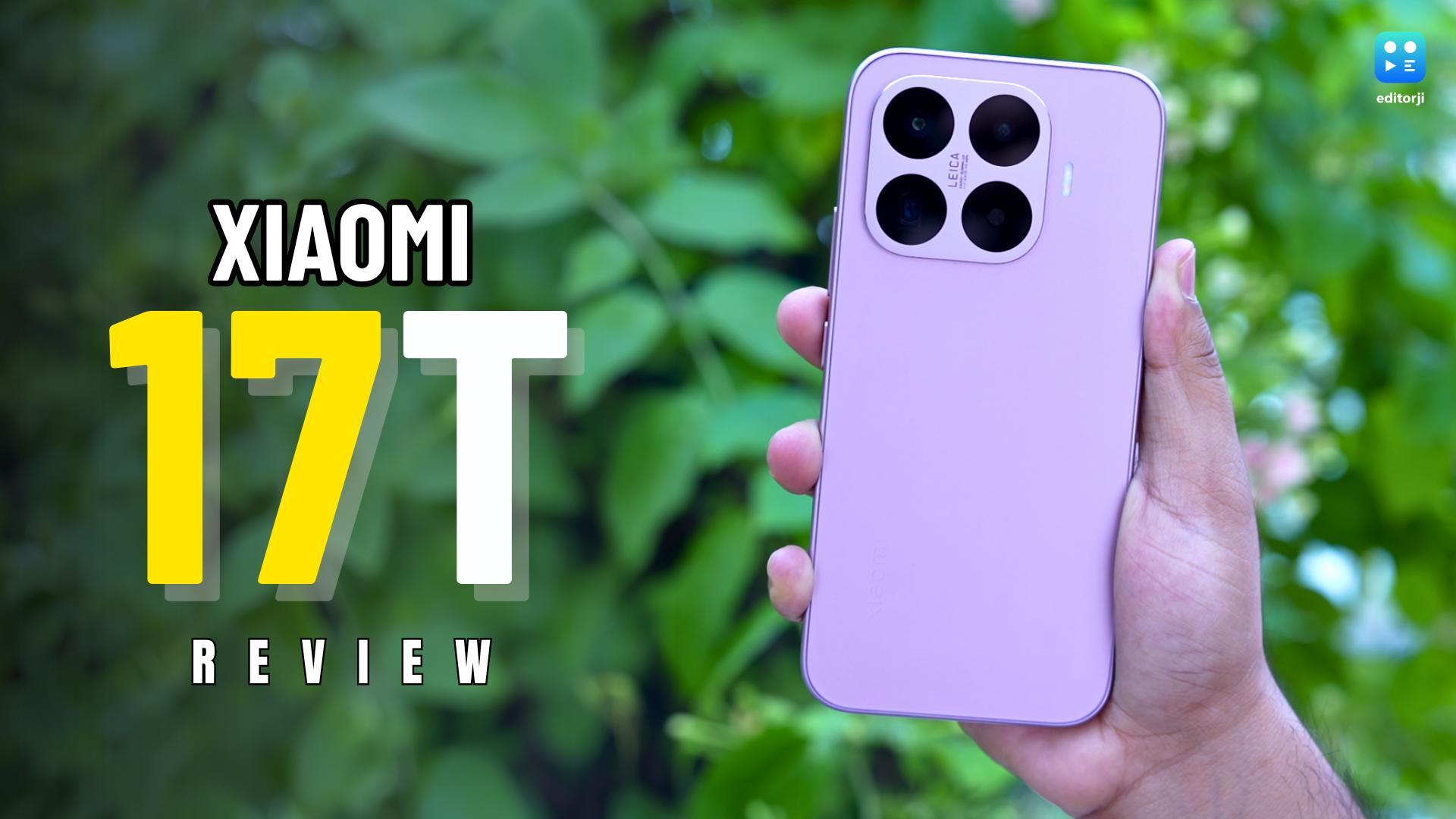
The Xiaomi 17T prioritizes photography with its Leica-tuned cameras and 50MP 5X periscope lens, while also offering a great display, strong battery life, and dependable performance at ₹59,999.


| Category | Key Specification |
| Display | 6.59-inch 1.5K LTPS AMOLED, 120Hz, 3500 nits |
| Processor | MediaTek Dimensity 8500-Ultra |
| Camera | 50MP Main + 50MP 5X Periscope + 12MP Ultrawide |
| Battery | 6,500mAh Silicon Carbon Battery |
| Charging | 67W HyperCharge + 22.5W Reverse Charging |
- Excellent 50MP 5X periscope telephoto camera
- Natural Leica-tuned image processing
- Outstanding battery life
- Premium design with IP68 rating
- Aggressive pricing
- No wireless charging
- Ultrawide camera is average
- LTPS panel instead of LTPO
The Xiaomi 17T arrives at a moment when smartphones that sit just below the ultra-premium tier are quietly creeping up in price with each new generation. Capabilities that once comfortably fit within a ₹60,000 budget are now being pushed further up the pricing ladder, often surfacing only on devices that cross the ₹80,000, ₹90,000, or even ₹1 lakh threshold. This makes the hunt for a genuinely premium experience, without going all the way to the top, much harder than it used to be.
The Xiaomi 17T, starting at ₹59,999, makes a strong case for itself in this context. It brings a Leica-tuned camera setup led by a 50MP 5X periscope telephoto lens, a refined design, a capable display, a sizeable 6,500mAh battery, and performance that should handle most everyday demands with ease.
After using it as a daily driver for a couple of weeks, the 17T comes across as a device built around a camera-first philosophy, rather than one purely chasing spec-sheet wins. Whether that singular focus is enough to justify its price is the real question.
Xiaomi 17T Review: Pricing
Xiaomi appears to have landed on exactly the right number with the 17T. At a time when mid-to-premium smartphones are becoming progressively harder to justify on price alone, the 17T stands out as a refreshingly well-calibrated option for what it puts on the table.
The variant I reviewed, 12GB LPDDR5X RAM paired with 256GB of UFS 4.1 storage carries a price tag of ₹59,999. Factor in the launch offers currently available, and that figure effectively drops to ₹54,999. Those who need the added breathing room of 512GB storage will be looking at ₹64,999, though introductory pricing brings that down to ₹59,999 as well.
When you consider the full picture, like the Leica-tuned optics, a proper 5X periscope telephoto, flagship-level processing power, and a substantial battery, the value proposition here is difficult to argue with. At its effective starting price, the 17T becomes one of the easier recommendations in its segment.
Xiaomi 17T Review: Design
Few phones at this price have made as immediate an impression on me as the 17T. The design conversation in this segment has largely been dominated by chunky, circular rear camera arrays, but Xiaomi has charted its own course; a compact, geometric camera block that sits flush and purposeful on the back. The result is something that looks expensive without being loud about it.
The violet unit I had on hand was a head-turner, though never in a garish way.
Xiaomi has used a matte polycarbonate rear that handled daily grime far better than glossy or glass alternatives tend to. Rivals may offer glass backs around this price, but you genuinely would not notice the difference here. The build quality stays solid throughout. A flat frame with metal-like finishing and gently rounded corners rounds out a form factor that remains pleasant to grip across long periods.
At 8.2mm of thickness and a 200g weight sits in a sweet spot; heavy enough to feel like a serious piece of hardware, light enough that marathon gaming sessions, photography-heavy outings, or full days of use never leave your hand feeling strained.
Xiaomi has been thorough on the protection front too, IP68 dust and water resistance is a welcome inclusion, and Gorilla Glass 7i keeps the display from picking up unnecessary damage. A metallic housing around the cameras adds a dash of character without disrupting the overall restraint of the design.
The connectivity is also as complete as it could get: NFC, IR blaster, eSIM, Bluetooth 6.0, Wi-Fi 6E, and USB 2.0 are all on board. The optical under-display fingerprint reader delivered consistent, snappy unlocks across my entire review period.
Xiaomi has played this one well. The 17T gets a premium identity, holds together with confidence, and handles the basics without a single misstep.
Xiaomi 17T Review: Display
The 6.59-inch 1.5K LTPS AMOLED screen on the 17T turned out to be one of the device's most impressive attributes during my extended use. Pixel density sits at roughly 460ppi, and the sharpness on offer is immediately apparent. Text are crystal clear, images hold fine detail, and even routine tasks like scrolling through a feed feel extremely polished.
Plus, the 120Hz refresh rate keeps interactions feeling light and immediate, whether that's navigating through a fast-paced game, scrubbing through photo edits, streaming video, or just moving between apps. Nothing ever felt sluggish or stuttery.
Where the display really distinguished itself was in how it handles colour. The 12-bit panel supports upwards of 68 billion colours, and that range is genuinely perceptible when you put quality photographs or HDR content in front of it. Colour transitions are smoother, tones feel more convincing without veering into oversaturation, and the overall image quality has a naturalism that I found particularly useful when evaluating camera output and editing photos for social media.
Dolby Vision and HDR10+ support means the panel is well-equipped for streaming too. Watching the latest season of From on Prime Video was a genuinely enjoyable experience. Contrast held up well, colours stayed vivid, and bright highlights had real punch to them.
Peak HDR brightness reaches 3,500 nits, and outdoor legibility holds up accordingly. Even in harsh afternoon sun, the screen remained easy to read without any squinting required.
We also get a bunch of TUV Rheinland certifications which should ensure long-term comfort, covering low blue light output, flicker-free operation, circadian-friendly display modes, and broader eye-care provisions. These rarely make headlines, but their value shows up during prolonged daily use.
The stereo speakers do a pretty solid job, though they are clearly not the main event here. For the asking price, this ranks among the strongest displays I have encountered this year. My one gripe is that Xiaomi has gone with an LTPS panel rather than LTPO. At this price, an LTPO panel would have been a welcome inclusion.
Xiaomi 17T Review: Cameras
Xiaomi has absolutely nailed the camera experience on the 17T, especially considering the prie. The centrepiece is a 50MP periscope telephoto with 5X optical zoom, the kind of hardware that typically shows up on phones costing significantly more. Having it here, at this price point, is what gives the 17T a genuine leg up on most of its competition.
The three-lens array pairs that periscope telephoto with a 50MP primary sensor and a 12MP ultrawide, with Leica's tuning applied across the board. The main camera holds its own, but the telephoto is where the 17T finds its identity.
Optically stabilised and covering a 115mm equivalent focal length, the periscope lens is the kind of hardware that changes how you actually use a phone camera. In-Sensor Zoom technology allows for what Xiaomi calls 10X optical-grade lossless zoom, and AI Ultra Zoom stretches that ceiling to 120X. Realistically, keeping things between 5X and 10X is where the results are strongest, and in that window, the output is hard to fault.
In good light, the system is a pleasure to shoot with. Detail is plentiful, dynamic range is well-managed, and colour rendering leans toward accuracy rather than impact. This is where Leica's influence is most apparent. The 17T is not trying to produce images that look immediately striking on a small screen. It is after something more considered. Controlled highlights, honest skin tones, and a tonal quality that holds up when you look more carefully. It is closer in spirit to what a dedicated camera produces than what most phones at this price deliver.
The telephoto was the lens I gravitated toward most throughout the review period. At 5X, the level of sharpness and surface detail in images is excellent. At 10X, the camera retains far more information than you might reasonably expect. Buildings, street scenes, subjects pulled from busy backgrounds, the telephoto handled all of it with a consistency that made it genuinely enjoyable to use.
Portrait shooting benefits from six selectable focal lengths running from 23mm through to 115mm, a range that provides real creative latitude. Leica's processing keeps portraits grounded, and realistic. The separation between subject and background is clean, skin tones stay accurate, and the sense of depth reads as natural rather than computed.
There is a cinematic quality to the results without any of the artificial sheen that often comes with heavily processed portrait modes.
The 12MP ultrawide does not have the same resolving power as the primary sensor, but it integrates well into the system. Colour rendering stays consistent across lenses, and overall quality sits comfortably above what the specification might lead you to expect.
One unexpected highlight was telemacro shooting. The periscope lens can focus at distances as close as 30cm, and the close-up results it produces, complete with natural background falloff, make a compelling argument against the low-resolution dedicated macro sensors that still populate many smartphones at this price.
On the processing side, Xiaomi's AISP engine draws on FusionLM, ToneLM, PortraitLM, and ColorLM to handle image refinement. What matters is that the processing stays measured. Images are improved where needed, but the camera stops short of manufacturing a result that looks nothing like the scene in front of it.
Stage Mode turned out to be more than a marketing feature. Designed around concert and live event shooting, it activates automatically when the camera recognises the right conditions and is optimised specifically for 5X and 10X zoom. In the kind of challenging mixed lighting that trips up most phone cameras, it made a visible difference to image cleanliness.
Video capability extends to 4K at 60fps with HDR10+ support, and Leica Live Moment processing gives footage a more filmic character. Up front, a 32MP selfie camera delivers reliable stills and handles video calls well, though front-facing video tops out at 4K 30fps rather than 60fps.
In low light too, we get the same restrained processing philosophy. Rather than aggressively pushing exposure to make night shots look dramatic, the 17T focuses on keeping noise controlled, preserving the atmosphere of a scene, and holding colour accuracy. The results will not grab attention the way some competitors' night modes do, but they look better, natural and feel more honest. Combined with the periscope telephoto, it adds up to one of the most rewarding camera experiences available at this price.
Xiaomi 17T Review: Performance
Under the hood, the 17T runs on MediaTek's Dimensity 8500-Ultra, a 4nm chip backed by 12GB of LPDDR5X RAM and UFS 4.1 storage. The specifications fit comfortably within what this segment calls for, and day-to-day use reflects that. The phone feels as capable as those numbers imply.
Over the course of testing, the experience held up without complaint. Applications opened without hesitation, switching between tasks felt weightless, and there was no point at which the phone gave any indication of struggling. Photo editing, video recording, heavy multitasking, extended social media sessions, none of it gave the 17T any trouble worth noting.
Benchmark figures back up that real-world impression, with the device posting just over 2.02 million points on AnTuTu. There are phones in this bracket that score higher, but those gaps on paper rarely amount to anything you would actually notice in use.
That is also the right lens through which to understand what Xiaomi is doing with the 17T. This is not a phone built to top performance charts. It is a camera-focused device that happens to keep pace with more performance-oriented competition in everyday situations, and for the vast majority of users, that is entirely sufficient.
Thermal management plays a meaningful role in sustaining that experience. The 3D IceLoop cooling system does a solid job of keeping heat in check during demanding use. Extended gaming, prolonged camera sessions, and lengthy 4K recording runs all failed to push the phone into uncomfortable territory.
Gaming holds up well in practice. BGMI currently runs at up to 90fps, and given what the chipset is capable of, 120fps support through a future update would not be a surprise.
Ultimately, benchmark numbers capture only a fraction of what makes a phone feel good to use over time. Assessed on that basis, the 17T earns its marks. It stays quick, smooth, and reliable across weeks of daily use, and for most people, the performance headroom here should remain relevant for years.
Xiaomi 17T Review: Software
Out of the box, the 17T ships with HyperOS 3, and time spent with it makes one thing clear: Xiaomi's software has come a long way. The interface carries a tidiness and sense of organisation that earlier versions lacked, and while customisation options remain plentiful, nothing about the experience feels excessive or thrown together.
Two features stood out during regular use. HyperIsland brings a more considered approach to managing notifications and background processes, making the whole thing feel less like a chore. HyperConnect, meanwhile, is particularly valuable for anyone already invested in the Xiaomi ecosystem, knitting together phones, tablets, wearables, and other devices into something that actually functions cohesively.
Artificial intelligence gets considerable attention here. The HyperAI suite comes bundled alongside Google's Gemini, covering a broad range of productivity and smart assistance functions. The camera system draws on this further, with AI Scene Recognition, AI Ultra Zoom, and the AISP imaging engine all operating in the background to lift image quality without requiring manual input.
Through extended daily use, HyperOS 3 stayed smooth, stable, and responsive. There is a lot packed in, but the software presents itself with enough restraint that it never feels like it is competing for your attention.
On the updates front, Xiaomi is committing to four years of Android OS upgrades and six years of security patches. Some competitors have stretched those timelines further, but this remains a reasonable promise that should keep the 17T in good standing for a while yet.
Xiaomi 17T Review: Battery
Among everything the 17T gets right, battery life ranks near the top. The phone houses a 6,500mAh Silicon Carbon cell, which is not the largest capacity on the market given that several competitors have now crossed the 7,000mAh threshold, but the real-world performance tells a more nuanced story than raw numbers suggest.
On a typical day, battery anxiety simply was not part of the experience. Even during heavier use involving photography, navigation, gaming, and social media, the phone made it through from morning to night without issue. Lighter days occasionally stretched into a second day before a charge became necessary. Screen-on times of six to seven hours were a consistent outcome throughout testing.
When you do need to charge the phone, the bundled 67W HyperCharge adapter brings the battery back to full in under an hour, which is a reasonable turnaround for a cell of this size. The 17T also supports 22.5W reverse wired charging, a useful addition for topping up accessories or a second device when needed.
Xiaomi 17T Review: Verdict
The Xiaomi 17T is a phone that knows what it wants to be. Rather than spreading itself thin across every possible use case, it puts its energy into delivering a premium photography experience, and on that front, it largely delivers.
The 50MP 5X periscope telephoto is the feature that defines the device. It genuinely shifts the way you approach mobile photography, offering real optical reach that holds up under scrutiny rather than papering over the gaps with heavy digital processing. Leica's tuning keeps the output honest, detailed, and full of character. The display makes going through and editing shots a genuine pleasure, and the 6,500mAh battery is large enough to support a full day of intensive use without complaint.
There are areas where concessions have been made. BGMI is currently capped at 90fps, wireless charging is absent, the 12MP ultrawide trails the best in class, and Xiaomi's software support window is not the most generous in the segment.
That said, for anyone who puts mobile photography at the centre of what they want from a phone, the Xiaomi 17T makes a compelling case for itself at this price.
Frequently Asked Questions
ADVERTISEMENT
Up Next
Xiaomi 17T Review: A Camera-First Flagship That Gets Almost Everything Right
ASUS Vivobooks Add Intel-Powered Flip Laptops, Snapdragon Battery Champs And AMD Power
POCO X8 Power Review: The 10,000mAh Battery Phone Done Right
Samsung Galaxy S26 FE Launched in India at Rs 79,999 With Exynos 2500 and One UI 9
vivo Buds Review: The Budget Earbuds I’d Actually Trust for a Full Workweek
Infinix HOT 70 Pro 5G Review: Big Battery, Distinct Design, But Is It Worth It?
ADVERTISEMENT

More videos

Apple iPhone Duo Price In India: What Do You Get For ₹2,99,900?

iPhone Duo Costs ₹2,99,900 In India. Here’s What It Costs In Other Countries

iPhone 18 Pro vs iPhone 17 Pro: What Does Apple Actually Give You For ₹1.65 Lakh?

Google Pixel 11 Pro XL Review: Google Knows Exactly What It’s Good At

Logitech Launches MX Keypad in India, Brings Physical Controls to AI Coding Workflows

Smartphone Habits Are Reshaping What Indian Consumers Expect From Laptops and AI PCs

India Is Buying Fewer Smartphones, But Spending More. POCO Says ‘Value’ Has Fundamentally Changed

POCO X8, X8 Power Launched in India With Up to 10,000mAh Battery, 100W Charging

Asus Zenbook Duo (2026) Review: Two Gorgeous OLED Screens Make Multitasking Addictive

Tecno Spark Go 3 Pro Review: Rugged Build Meets Entry-Level Essentials


