Smartphone prices have been creeping up steadily, and it's hard to ignore. Things that were once standard in the ₹25,000–₹30,000 range have gradually shifted to ₹40,000, ₹50,000, or beyond. So when Xiaomi priced the Redmi Turbo 5 at ₹35,999, it naturally caught my attention.
Because the spec sheet alone makes it look like it should cost considerably more. You're getting a glass-and-metal build, a crisp 1.5K AMOLED display, LPDDR5X Ultra RAM, UFS 4.1 storage, a 7540mAh battery, 100W charging, and the Dimensity 8500 Ultra handling the processing. That's a strong lineup at any price point.
Which raises the obvious question: where has Xiaomi cut corners?
After spending time with the device, the answer is surprisingly reassuring. There are a few compromises here and there, but the Turbo 5 feels far more complete than its price would suggest. Redmi positions it as their fastest phone yet, and while the performance holds up, that's not the whole story. This is a well-rounded device that delivers across most of the areas that actually matter.
Redmi Turbo 5 Review: Pricing
Xiaomi has launched the Redmi Turbo 5 at ₹35,999 for the 8GB RAM and 256GB storage variant, while the 12GB RAM model is priced at ₹38,999 under the company's introductory launch offers.
Buyers can sweeten the deal further with an instant ₹2,000 discount on select SBI, ICICI, and Axis Bank credit cards. Once the promotional pricing ends, the two variants will retail at ₹37,999 and ₹40,999, respectively.
The smartphone is available in Turbo White, Nitro Blue, and Asphalt Black colourways, with sales beginning on June 19 through Amazon, mi.com, and authorised retail outlets.
In my opinion, pricing is one of the Turbo 5's biggest strengths. Given the premium build, large battery, fast charging, and overall hardware package on offer, this feels like a smartphone that could easily have been priced significantly higher.
Redmi Turbo 5 Review: Design
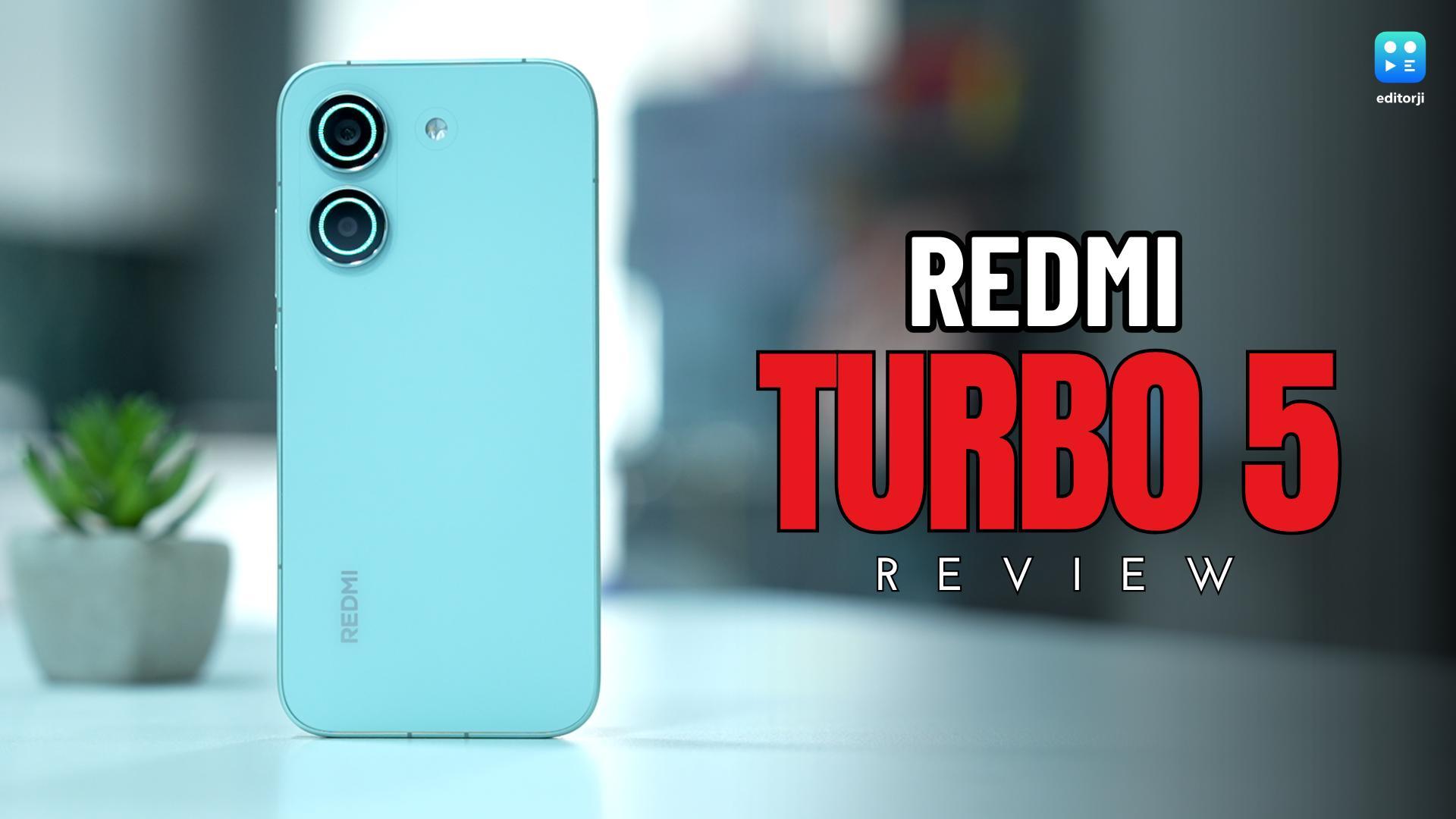
Before I even switched the Redmi Turbo 5 on, the design and build had already won me over. Xiaomi has done an excellent job with the fit and finish, and this is one of those phones that immediately feels more expensive than its asking price.
The Turbo 5 uses a glass-and-metal construction, with Gorilla Glass 7i protecting the display, reinforced glass at the rear, and an aluminium frame tying everything together. It's a combination that's usually reserved for pricier devices, and it gives the phone a reassuringly solid feel.
What I liked most, however, was the rear finish. The matte glass not only feels great in the hand, but also does a fantastic job of resisting smudges. Even after a few days of constant use, it never turned into the fingerprint magnet that so many glossy phones become.
Xiaomi has also shown some restraint with the camera design. Rather than a giant camera module dominating the rear panel, the Turbo 5 gets two neatly integrated camera rings that help the phone stand out without looking flashy.
Speaking of flashy, the Pixel Matrix lighting around the cameras adds a touch of fun. It can react to incoming notifications, music playback, charging, and gaming events. It's not a feature you'll buy the phone for, but it does give the Turbo 5 a bit of personality.
Perhaps most impressive is how Xiaomi has packaged everything. Despite carrying a huge 7,540mAh battery, the phone remains relatively slim at 8.18mm and weighs 204g. Add IP66, IP68, IP69, and IP69K protection into the mix, and you end up with a device that feels every bit as premium as it looks.
Redmi Turbo 5 Review: Display & Audio
The Redmi Turbo 5 carries a 6.59-inch 1.5K AMOLED display with a 120Hz refresh rate, and after a few weeks with it, this is easily one of the device's strongest suits.
Sharpness is immediately apparent. Text renders cleanly, images hold plenty of detail, and the 120Hz refresh rate keeps everyday navigation feeling smooth and responsive throughout.
Where it really earns its keep, though, is during media consumption.
The display packs 12-bit colour depth, which translates to support for over 68 billion colours. It's not something you actively notice, but it does make gradients look smoother and images appear more lifelike overall.
I watched a fair amount of Netflix and YouTube on this, and Dolby Vision content looks genuinely impressive. Colours are rich and well-saturated, contrast holds up well, and HDR scenes carry a sense of depth that actually adds to the experience rather than just checking a box.
Outdoor visibility has been equally strong. Xiaomi quotes a peak brightness of 3500 nits, and while that's not something I can verify independently, I had zero issues using the phone under Delhi's punishing afternoon sun. The display stayed perfectly readable throughout.
On the audio side, the stereo speakers put in some solid work. Volume levels are generous, and they handled everything from YouTube to gaming without complaint during my testing. The sound profile isn't the most refined I've come across, but for day-to-day media use, they're more than adequate.
Redmi Turbo 5 Review: Cameras
Heading into this review, the cameras weren't something I expected to spend much time praising. Xiaomi has clearly built the Turbo 5 around performance, so I assumed photography would take a back seat. It didn't, quite.
The setup consists of a 50MP Sony primary sensor and an 8MP ultrawide. Nothing that looks exceptional on a spec sheet, but the main camera produces images that are genuinely easy to like.
A lot of that comes down to Xiaomi's processing approach. Rather than cranking up saturation and HDR to make shots look dramatic, the Turbo 5 leans toward balanced, natural-looking output. Detail retention is good, dynamic range holds up well across most situations, and colours feel accurate without looking flat.
Daylight shooting is where it's most convincing. Landscapes, street photography, portraits, the main camera handles them all with consistency, and the results rarely need much post-processing before they're worth sharing.
The ultrawide is a step down, as expected with an 8MP sensor. It gets the job done when you need a broader frame, but detail falls off noticeably compared to the primary camera.
Low-light performance also held up better than I anticipated. The camera manages noise reasonably well, retains a decent level of detail, and tends to render warmer tones that make night shots look more natural than clinical.
Turbo Snap, Xiaomi's burst mode, was something I ended up using more than expected. It's fast enough to be genuinely useful when shooting moving subjects, and it works without much fuss.
Video tops out at 4K 60fps with HDR10+ support. Footage carries the same natural quality as stills, with colours that look good without being overdone.
The 20MP front camera rounds things off well. Sharpness isn't class-leading, but skin tones look natural and the overall quality is solid enough for social media and calls.
Redmi Turbo 5 Review: Performance
Performance is likely the primary reason most people will look at the Turbo 5, and it holds up well. The Dimensity 8500 Ultra chipset sits at the core, backed by LPDDR5X Ultra RAM and UFS 4.1 storage, a combination that looks strong on paper and follows through in practice.
Benchmark numbers back that up, with the phone comfortably clearing the two-million mark on AnTuTu, placing it among the more capable devices in this price range.
Numbers aside, though, the real-world experience is what counts.
Day-to-day use feels snappy and responsive throughout. Apps open without hesitation, multitasking stays smooth, and I didn't run into any meaningful slowdowns across my testing period. Whether I was switching between social apps, streaming content, editing photos, or keeping a heavy browser session going, the phone kept pace without complaint.
Gaming performance holds up just as well. BGMI runs at up to 120fps, and during a sustained half-hour session, frame rates averaged around 116fps with no significant drops or stutters to speak of.
Thermal management is worth calling out too. Even after longer gaming sessions, the phone stayed cool and comfortable, something that isn't always a given at this price point.
Is it the outright fastest option available here? Not quite. But after extended use, it's clear the Turbo 5 delivers well beyond what most users will actually demand of it day to day.
Redmi Turbo 5 Review: Software
The Turbo 5 runs HyperOS 3 on top of Android 16, and the experience is largely positive. If you've spent time with a recent Xiaomi phone, the interface will feel familiar from the start.
There's plenty on offer feature-wise. HyperIsland, extensive customisation options, and AI tools woven throughout the system give you a lot to work with. The AI editing features inside the Photos app are genuinely useful, and Gemini integration is a welcome addition for anyone who leans on AI tools regularly.
The interface stays smooth and responsive day-to-day, and I didn't run into any notable bugs or glitches throughout my testing.
The one area that still needs work is bloatware. There's a fair number of pre-installed apps that most users will want to clear out fairly quickly.It's something Xiaomi has been called out on before, and it remains an issue here.
On the software support front, things look more reassuring. Four Android version updates and six years of security patches is a commitment that gives the Turbo 5 some genuine long-term value.
Redmi Turbo 5 Battery & Charging: Two-Day Battery Beast
If there's one area where the Turbo 5 truly stands apart, it's battery life.
The 7540mAh cell is large by any measure, and the real-world endurance matches the spec. Throughout my testing, I consistently hit seven to eight hours of screen-on time even with fairly demanding usage. For most people, this is a comfortable two-day phone. Lighter users could realistically push it further.
What makes it better is that Xiaomi hasn't traded charging speed for capacity. The Turbo 5 supports 100W HyperCharge, and the charger is still included in the box — something worth noting as that becomes increasingly rare. A full charge from near empty takes around an hour, and even a quick 10 to 15-minute top-up is enough to see you through the rest of the day without worry.
The addition of 27W reverse wired charging is a thoughtful touch, letting you top up accessories or another phone when needed.
Redmi Turbo 5 Verdict: Easy Recommendation
Two weeks with the Redmi Turbo 5 make it pretty clear what Xiaomi is on about this one.
The performance is excellent, gaming is smooth, charging is fast, and the battery life is among the best I've seen at this price. But what stayed with me most was how well-rounded the whole package is.
You're getting a premium glass-and-metal design, a great Dolby Vision display, dependable cameras, flagship-grade memory and storage, solid durability, and a software support commitment that keeps the phone relevant well into the future.
The ultrawide camera isn't particularly impressive, and the bloatware situation in HyperOS still needs addressing. But these feel like minor footnotes against everything else the Turbo 5 gets right.
At ₹35,999, this is one of the more compelling smartphones available right now. In a market where prices keep climbing and value keeps shrinking, Xiaomi has put together something that feels genuinely aggressive, and more importantly, it feels like a return to what made Redmi worth paying attention to in the first place.
If you're shopping in the ₹35,000 to ₹40,000 bracket, the Redmi Turbo 5 is an easy recommendation.