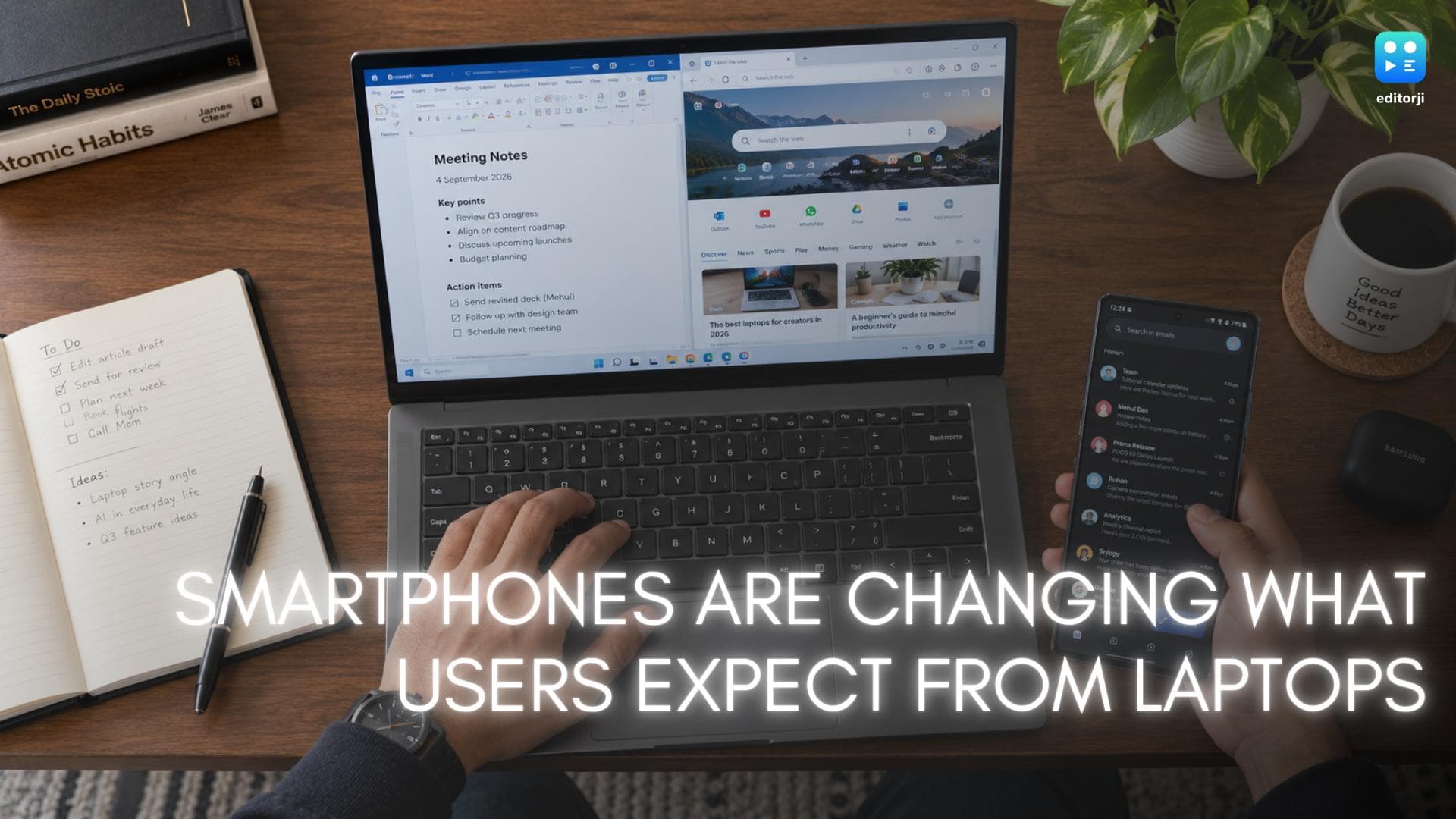
For years, buying a laptop meant comparing processors, RAM, storage and perhaps display specifications before deciding how much performance you could get for your money. But a generation raised on smartphones is beginning to judge PCs rather differently.
A Techarc analysis of 5,412 verified laptop reviews from Amazon India and Flipkart suggests that smartphone experiences are increasingly setting the benchmark for laptops. According to the report, 88% of laptop users agree that their expectations from laptops have been defined by their smartphone experiences.
That means all-day battery life, instant responsiveness, premium construction and increasingly, built-in AI capabilities are moving from nice-to-have features to fundamental parts of the computing experience.
And as the PC industry races towards its next generation of AI-powered machines, that shift could prove just as important as the processors powering them.
Smartphones Have Changed What a ‘Good Laptop’ Means
Sumit Sonal, Head of Marketing at Qualcomm India, believes years of smartphone use have fundamentally changed the baseline consumers bring to PCs.
“Today's users have grown up with devices that are intuitive, responsive, and always ready, and they now expect the same from their PCs,” Sonal said.
Techarc's findings support that shift. Consumers accustomed to phones lasting through the day increasingly expect similar endurance from laptops, while the near-instant responsiveness of modern smartphones makes slow boot-ups and sluggish wake times more noticeable.
Traditional priorities haven't disappeared either. Value for money remains the strongest satisfaction driver, with 84% positive sentiment, followed by performance at 82% and build and design quality at 78%.
The differences between PC platforms are also visible. Snapdragon-powered laptops score 4.4 out of five for battery satisfaction, compared with 3.9 for Intel and 3.8 for AMD. Snapdragon also scores 4.3 for thermal management and build/design.
Connectivity, however, remains an industry weak spot, recording just 53% positive sentiment and the lowest satisfaction in the study.
AI PCs Have an Expectation Problem to Solve
AI represents perhaps the clearest example of smartphone expectations spilling over into PCs.
Consumers have already grown accustomed to voice assistants and increasingly sophisticated on-device AI features on their phones. Techarc identifies AI features as the fastest-growing trigger category for laptops. Yet satisfaction currently averages only 3.7 out of five, with 64% positive sentiment.
That gap presents both a challenge and an opportunity for AI PCs. Simply advertising an NPU or attaching an “AI” label to a laptop may not be enough. The technology increasingly needs to translate into useful everyday experiences that consumers can actually recognise.
In other words, the AI PC race isn't only about how many TOPS a processor can deliver. The more important question may be whether AI can become as accessible and useful on a laptop as the features consumers already take for granted on their phones.
The Next PC Battle Could Be About Experience, Not Specs
That changing benchmark could ultimately reshape how PC makers compete.
Techarc's analysis identifies battery life and AI features as two attributes with particularly high cross-platform variance, giving processor makers and laptop manufacturers room to differentiate themselves beyond conventional performance metrics.
“As AI becomes more integrated into everyday computing, consumers are looking beyond specifications and evaluating how a laptop fits into the way they work, learn, create, and collaborate,” Sonal said.
That is perhaps the bigger transition taking place. Performance and value still matter enormously, but the definition of a good laptop is expanding.
The smartphone did not replace the PC. Instead, it may be doing something far more consequential: teaching an entire generation what their next PC should feel like.