There was a time when recommending a budget or mid-range smartphone in India was almost ridiculously easy. If someone wanted good hardware without spending a fortune, chances are a Redmi Note was somewhere near the top of the list. That formula worked incredibly well for Xiaomi, turning the Note series into one of its biggest success stories in India.
But the playground is a lot more crowded now. Realme, Motorola, CMF and iQOO are fighting aggressively for the same buyers, while POCO gives Xiaomi some competition from within its own house. Prices have gone up too, so the Redmi Note badge alone doesn't carry quite the same weight anymore.
Enter the Redmi Note 17.
Redmi is playing to its strengths here, with a large display, capable everyday performance, a promising primary camera and an absolutely enormous battery.
Prices start at ₹27,999 for the 6GB + 128GB model, dropping to ₹24,999 with bank offers, while the 8GB + 128GB variant costs ₹30,999.
So, can the Note 17 still stand out?
Redmi Note 17 Review: Plastic, But Far From Boring
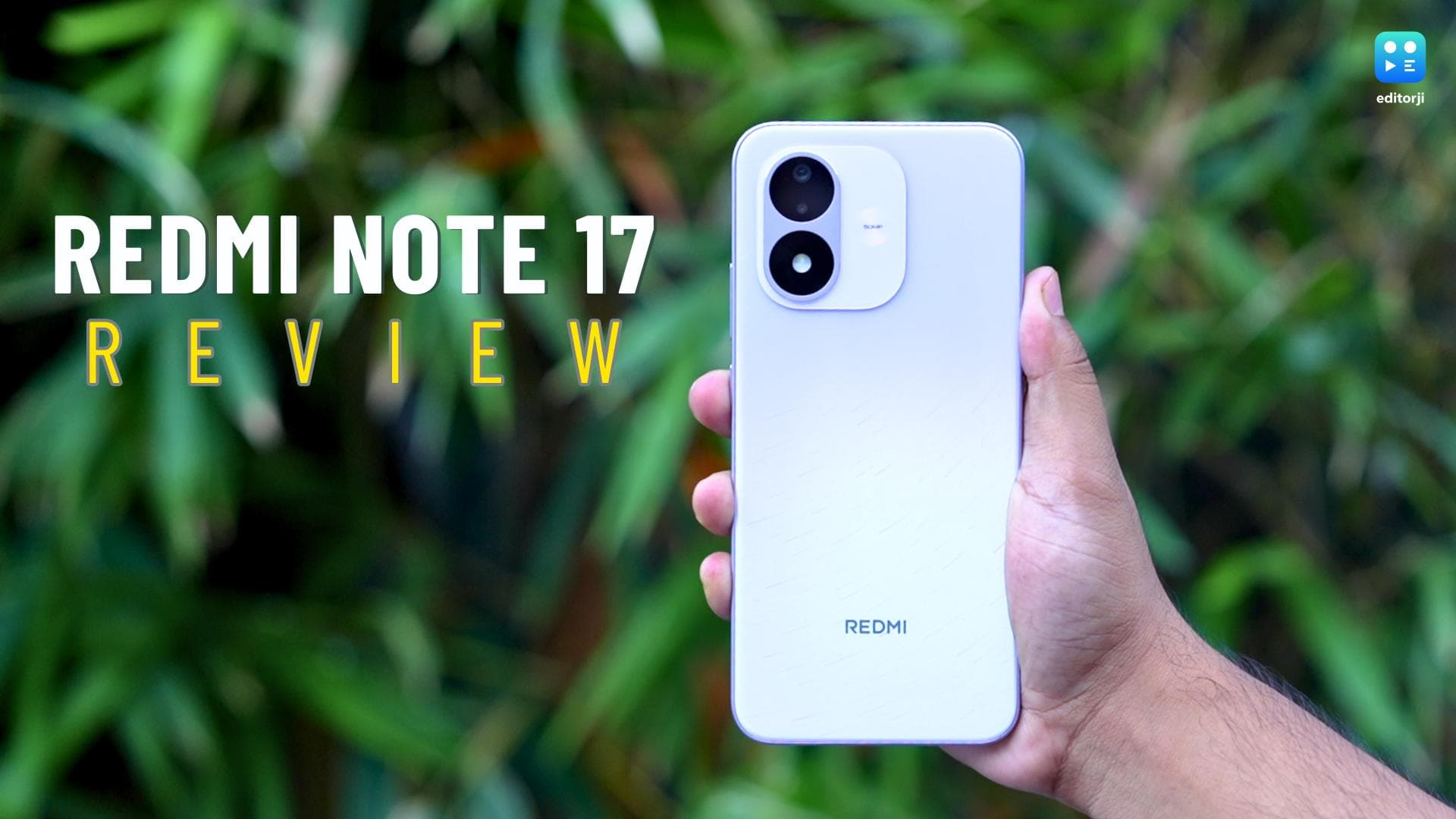
For a phone built almost entirely out of plastic, the Redmi Note 17 does a surprisingly good job of not looking boring. A lot of that comes down to the Starlight Purple variant I’ve been using. The back has this lovely starry finish, with a shooting-star effect that reveals itself as you move the phone under light. It’s playful without going completely overboard. If that isn’t your thing, Arctic Blue and Dark Night are the more restrained alternatives.
I also quite like what Redmi has done with the cameras. The squarish camera island houses a pill-shaped section for the lenses and flash, giving the back some visual identity without an enormous camera bump.
What’s more impressive is how Redmi has squeezed an 8,000mAh silicon-carbon battery into an 8.4mm body. There is a trade-off, though. At 225 grams, the Note 17 is undeniably heavy, and I could feel that weight during longer one-handed sessions. The plastic frame and back don't exactly scream premium either, but the phone itself feels sturdy.
You get Gorilla Glass 7i on the front, an IP65 rating for dust and water resistance, and a reinforced chassis. HydroTouch 2.0 is useful too, keeping the touchscreen responsive when your fingers are wet.
The connectivity package is fairly straightforward, with USB Type-C 2.0, Bluetooth 5.0 and Wi-Fi 5. Redmi has also retained the IR blaster, which is always handy. More importantly, there’s microSD expansion for up to 2TB, something that’s becoming increasingly difficult to find even at this end of the market.
Redmi Note 17 Review: Bright, Vibrant and Seriously Smooth
The 6.9-inch Full HD+ TrueColour AMOLED display is easily one of my favourite things about the Redmi Note 17. It’s big, bright and generally a lovely screen to use, whether I was catching up on YouTube, scrolling through Instagram or squeezing in a quick gaming session. The 120Hz refresh rate keeps everything looking smooth, while the 240Hz touch sampling rate makes the phone feel responsive enough during games and everyday use.
I particularly liked the way Redmi has tuned the colours. With 100% DCI-P3 coverage, there’s plenty of punch without everything looking unnecessarily saturated. You also get the deep blacks and excellent viewing angles you’d expect from AMOLED, while the Full HD+ resolution keeps things suitably sharp.
Unfortunately, HDR and Dolby Vision are both missing. That takes some shine off the experience if you watch a lot of OTT content, although videos still look quite good thanks to the panel itself.
Outdoor visibility is excellent too. Redmi claims 1,800 nits of peak brightness, and I had no difficulty reading messages or using the phone under harsh sunlight. HydroTouch 2.0 also keeps the touchscreen working reliably with wet or oily fingers.
For eye comfort, there’s 960Hz PWM, DC dimming and TÜV Rheinland Low Blue Light and Circadian Friendly certifications.
I just wish the speakers were equally impressive. The stereo setup gets seriously loud, especially with the 200% volume mode, but sound lacks bass, depth and character. It’s perfectly fine for Reels, Shorts and casual videos, but for movies or OTT shows, I found myself reaching for earphones instead.
Redmi Note 17 Review: Cameras That Punch Above Their Weight
The Redmi Note 17 keeps things fairly simple when it comes to cameras, with the 50MP primary sensor doing most of the work. Thankfully, it’s a pretty capable shooter for the price. Give it plenty of daylight and you can get some genuinely good-looking photos, with plenty of detail and respectable dynamic range. Colours are pleasing too, although Redmi’s processing tends to favour slightly cooler tones.
There’s also a 2x in-sensor zoom, which I found surprisingly usable. Images at 2x retain a decent amount of detail and are perfectly good for sharing on social media. Go any further, however, and the limitations of digital zoom become obvious, with finer details quickly turning soft.
Things are understandably less impressive once the sun goes down. Low-light photos are usable, with decent highlight control, while the dedicated Night Mode does a reasonable job of brightening darker scenes. Portraits fare well too, with mostly accurate edge detection and fairly natural background separation.
You also get AI HDR, AI Scene Detection, Dynamic Shots, AI Bokeh and an AI Editor for tweaking photos afterwards.
Video is more restrictive, topping out at 1080p 30FPS. Colours are fine, but stabilisation could certainly be better, particularly when recording while walking.
Finally, the 8MP front camera gets the basics done. It’s absolutely fine for video calls and the occasional selfie, but anyone serious about selfies will want more.
Redmi Note 17 Review: Built for Consistency, Not Speed
The Snapdragon 4 Gen 4 powering the Redmi Note 17 isn’t going to win any benchmark battles, but that’s not really what this phone is trying to do. This 4nm chip is geared more towards efficiency and consistent everyday performance, and for the most part, it delivers.
My review unit came with 8GB of LPDDR4X RAM and UFS 2.2 storage, along with another 8GB of virtual RAM if needed. There’s also microSD expansion for up to 2TB.
Day-to-day performance was pleasantly smooth. Apps opened quickly, jumping between them wasn’t a problem, and I rarely encountered stutters or slowdowns during regular use. An AnTuTu score of around 6.35 lakh reinforces that this is firmly mid-range territory.
Gaming follows much the same story. BGMI and Call of Duty Mobile run at around 60FPS, and while that won’t excite competitive gamers, frame rates remained remarkably consistent during longer sessions. The massive 10,416mm² graphite cooling layer also keeps temperatures nicely under control.
Redmi’s Long-Term Fluency Engine supposedly manages resources to maintain performance over time, with the company promising 48 months of lag-free use. I obviously can’t test that claim yet, but it’s reassuring for anyone planning to keep the Note 17 for several years.
Redmi Note 17 Review: HyperOS Comes With Baggage
HyperOS 3, based on Android 16, feels pretty much exactly how you’d expect on the Redmi Note 17. It’s smooth, animations look polished, and there are enough customisation options to make the phone feel like your own. If you’ve used a recent Xiaomi or Redmi device, you’ll feel at home almost immediately.
Unfortunately, some familiar annoyances have made the journey across too. There are plenty of pre-installed apps, along with system ads that make the software feel unnecessarily cluttered straight out of the box. Most can be removed or disabled with a little effort, but I’d much rather not have to clean up a new phone in the first place.
The AI toolbox is fairly extensive. You get AI summaries, AI photo editing and Google Gemini, alongside Circle to Search. Xiaomi also includes HyperIsland for live notifications, while its Intelligent AI Engine can learn your usage patterns and prioritise frequently used apps.
The strongest part of the software package, though, is long-term support. Redmi promises four Android OS upgrades and six years of security updates, which is excellent for this segment and makes the Note 17 a much easier phone to consider keeping long-term.
Redmi Note 17 Review: Built to Outlast Your Weekend
Charging the Redmi Note 17 every night quickly became unnecessary. With an 8,000mAh silicon-carbon battery inside, I could comfortably use the phone for two days before reaching for the charger. More conservative users could potentially squeeze even more out of it.
And with that much battery available, Redmi lets you share some of it. The Note 17 supports 22.5W reverse wired charging, so it can double up as an emergency power bank for another phone or your accessories.
Eventually, though, you will have to plug it in. The bundled charger delivers 45W wired charging, which feels relatively slow when there’s an enormous 8,000mAh cell to fill.
Longevity looks promising on paper as well. Redmi says the battery is designed to retain at least 80% of its original capacity even after 1,600 charging cycles, which should be reassuring if you intend to keep the phone for several years.
Verdict: Still a Note Worth Considering
After using the Redmi Note 17, I don’t think it needs to be the fastest or most feature-packed phone around ₹25,000 to make sense. Its strength lies elsewhere: it gets the fundamentals right and then throws genuinely exceptional battery life into the equation.
That 8,000mAh silicon-carbon battery is easily my favourite thing about the phone. Two days between charges became completely normal during my time with it, and the fact that Redmi has managed this without creating an unwieldy brick makes it even better. The large AMOLED display is another highlight, especially for watching videos and scrolling through social media.
Elsewhere, things are more straightforward. The Snapdragon 4 Gen 4 is perfectly comfortable with everyday tasks and casual gaming, while the 50MP camera can take some impressive daylight photos. Redmi’s promise of four Android upgrades and six years of security patches is another meaningful advantage if you don’t replace your phone every couple of years.
There are rough edges. The speakers sound rather lifeless, video capabilities are basic, demanding games quickly expose the chipset’s limitations, and HyperOS 3 still comes with unnecessary clutter.
Would I buy it? At the ₹24,999 offer price, yes, especially if battery life and display quality sit high on your priority list. At ₹30,999 for the 8GB model, no. There are simply too many stronger options once you cross ₹30,000, especially when you look at last year’s phones.
The Note 17 isn’t a return to Redmi’s giant-killing days, but at the right price, it doesn’t need to be.