The Indian smartphone market in 2026 has been fascinating to watch. We are witnessing a fresh wave of homegrown ambition, with audio and lifestyle names like Fire-Boltt and Mivi trying their hand at budget handsets. Navigating an industry plagued by rising component costs is no easy task, so seeing young labels pack ambitious hardware into reasonably priced devices definitely raises eyebrows.
Amid ongoing chatter surrounding data privacy and local manufacturing claims, Ai+ is back with its latest contender: the Nova 2 Power 5G, priced at ₹16,999 for the 6GB RAM and 128GB storage model. Instead of getting tangled up in online debates, I wanted to judge the smartphone purely on its merits as an everyday driver.
After spending considerable time testing it, the phone revealed several unexpected quirks, quite a few of which turned out to be genuinely impressive.
Unboxing & Design
Ai+ deserves credit for keeping the retail package complete in an era where many brands cut back on inbox essentials. Opening the box reveals the handset accompanied by a 33W fast-charging power adapter, a USB Type-C data cable, a clear TPU protective case, and a SIM ejector pin.
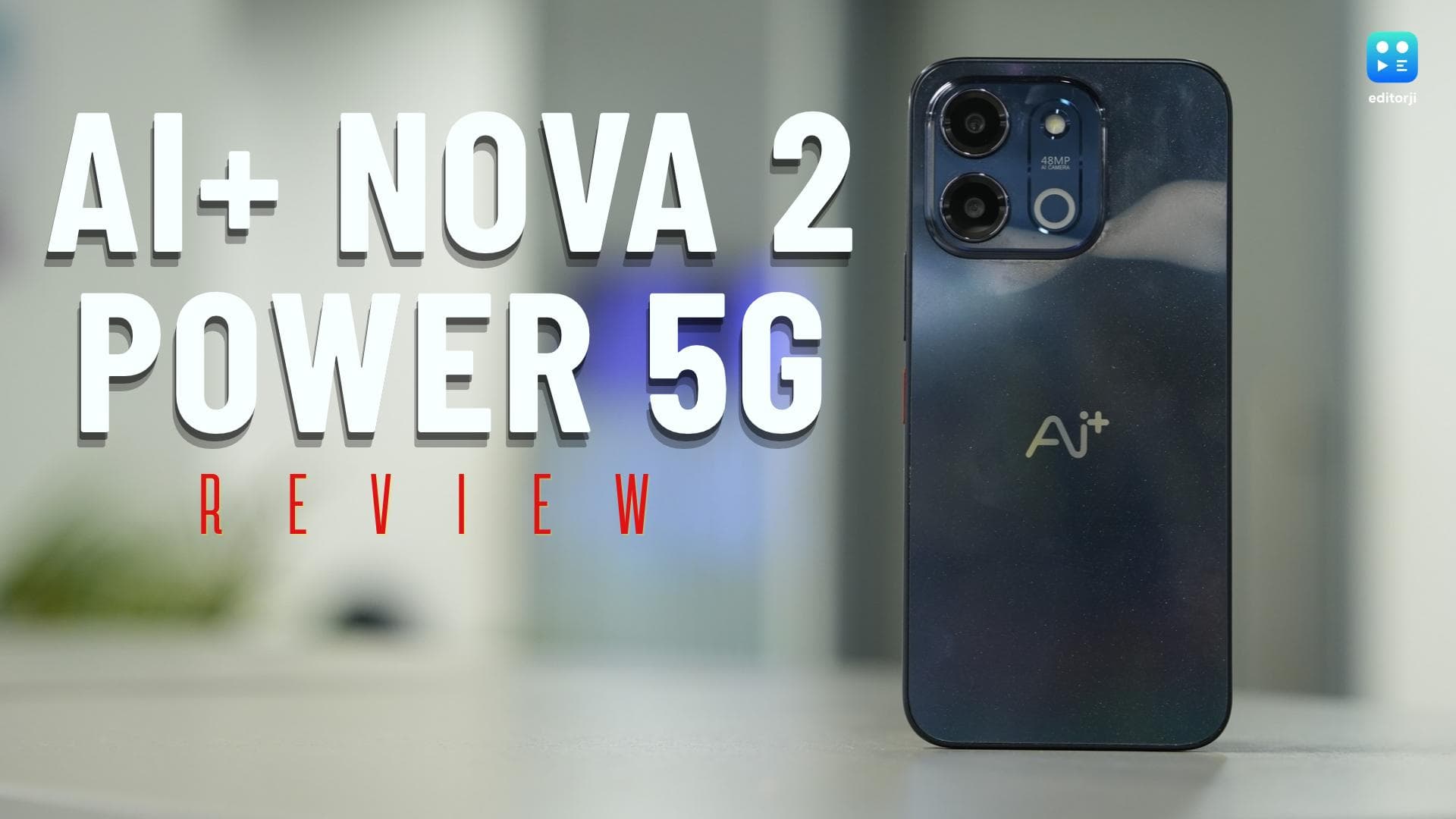
I tested the Midnight Black edition. From an arm's length, the deep back panel gives off a stealthy look with subtle micro-reflections when light catches the surface at an angle. The build here is plastic, so it does not mimic the cool touch of frosted glass, yet the body feels dense, rigid, and free from creaks along the frame. But because of the glossy finish, it attracts fingerprints and oily smudges within minutes of bare-hand handling.
Now, the phone is obviously on the chunkier side, weighing nearly 222 grams. But Ai+ has balanced the weight distribution well across its large frame which also houses a 6.75-inch display, preventing it from feeling awkward or top-heavy during routine thumb typing.
Moving around the edges, everything is kept simple. The right side has the volume rockers and the power button, which also doubles as the fingerprint sensor. The power button has got a red accent which also adds a character to the phone’s design. It is snappy in nature, although in my experience it did struggle to register the fingerprint at times. The bottom has the speaker, mic, and a C-type charging port. The left houses a triple-slot tray that lets you run two Nano-SIMs alongside a microSD card up to 1TB simultaneously.
But the real surprise for me was on the durability front. It is IP65 rated, which brings decent dust ingress protection and water submersion resistance rarely seen in this price category.
Display
Flip to the front, and you run into a huge 6.75-inch LCD with subtle curved edges. I have to admit right off the bat, I’m not a big fan of giant phones. This thing is a total handful to use while walking, and my thumb constantly struggled to reach the upper corners.
The fluid 120Hz refresh does help soften the blow. Tapping through apps, flicking down Reddit feeds, and scrolling pages feels snappy without annoying jitters. But sit down to binge YouTube or stream a show, and the budget reality hits fast. The borders framing the screen are chunky, and that bottom chin is undeniably thick. You just never get that clean, edge-to-edge look phones have spoilt us with lately. Strangely, though, YouTube gave me working HDR playback, which I definitely didn't see coming at this price.
The bigger drawback is outright clarity. Ai+ stuck with a basic 720p HD+ resolution here, landing around 256 pixels per inch. For an LCD, colours and viewing angles hold their ground, but text edges and tiny app labels look noticeably fuzzy compared to any standard 1080p panel. If you stare at dense documents or read tiny website text all afternoon, your eyes will notice the softness right away.
Outdoor visibility, however, was a pleasant surprise. Ai+ claims a peak boost up to 1,800 nits, and in practice, it really delivers. I took calls and checked messages right under blistering afternoon sunlight without ever having to squint or shade the glass with my other hand.
Camera
You get a 48MP main camera and an 8MP ultra-wide lens on the back, plus a 13MP sensor upfront for your selfies. People online are arguing whether this brand is actually Indian or just repackaging imported kits. I really do not care about that debate; I just wanted to see if the hardware works in daily life. And honestly, given how expensive the phone market is right now, getting a functional ultra-wide at this price is a pleasant surprise. Big brands charge over thirty grand these days and still dump a single lens or a useless 2MP macro sensor on you, so props to Ai+ for packing this.
Honestly, my expectations were quite low, but the 48MP primary sensor surprised me. It will not win photography contests, yet it turned out to be a solid point-and-shoot camera. Daylight photos look clean with natural colours, completely avoiding that neon-green grass look budget phones love. Pointing it into strong backlighting struggles with dynamic range, but typical daylight shots come out sharp. Then comes the 8MP ultra-wide lens. Don't expect miraculous detail, though; corners get visibly soft, so treat it as a tool for casual holiday landscapes rather than detailed framing.
At night, things get tricky. Streetlights create messy flares across the glass, though you still get decent shots if the street is bright enough. Pitch-black scenes, however, turn into mushy wax paintings. Upfront, the 13MP selfie camera is basic. It works fine for video calls, but nothing crazy. Both front and rear shoot 2K at 30fps, though 1080p at 60fps looks much cleaner. The real pain point is stabilisation. Even with ultra-stabilisation turned on, handheld clips wobble heavily, meaning you will need stone-still hands while walking.
Performance
Under the hood, the Nova 2 Power 5G packs the MediaTek Dimensity 7100, and given how crazy chip prices are right now, I am genuinely surprised to see it here. Like, hell knows how they are managing to do this. To test the raw muscle, I ran my usual benchmark suite. On AnTuTu, it scored a solid 916,473, while Geekbench 7 returned 853 in single-core and 2,894 in multi-core tests. In the 3DMark Wild Life Extreme stress test, it achieved a 99.1% stability score with a 692 best loop, barely breaking a sweat thermally.
Day-to-day multitasking felt effortless, with fast app boots and zero stutter jumping between heavy browser sessions and random apps. For gaming, both BGMI and Call of Duty: Mobile were capped at 60 fps during my testing. It handles casual matches without dropped frames, and the chassis only gets mildly warm near the cameras after forty minutes.
My real reservation is long-term sustainability. The phone handles daily duties and casual matches well right out of the box, but we have all seen plenty of budget devices launch with smooth software only to turn into laggy, choppy nightmares after six months of updates. Whether this hardware can maintain its current speed over the next year remains the bigger question.
Software, UI/UX & AI Features
The smartphone boots out of the box running Android 16 with Ai+'s NxtQuantum OS interface on top.
The software makes a clean first impression. It stays free of the obnoxious banner notifications, clickbait lock-screen widgets, and heavy bloatware packages that clutter many competing devices in this segment. The interface adheres closely to standard Android conventions, making navigation effortless right from the initial setup. Honestly, the UI experience is genuinely clean and unique, and it offers some good-looking app icon customisations.
However, an interesting paradox emerges here: despite having "AI" right in the brand name, the phone barely packs any practical or meaningful AI-driven features. It also greets you during boot-up with the tagline "Your Data Stays Safe in India." While I cannot independently verify that claim, I have to give credit where it is due: the overall daily user experience feels crisp. Flipping through app drawers and triggering gesture animations happens instantaneously, with the system steering clear of any noticeable micro-stutters.
Battery & Charging
Endurance is the standout trait of the Ai+ Nova 2 Power 5G, and the numbers translate directly into real-world peace of mind.
Housing a massive 7,000mAh battery pack, this phone easily delivers nearly one and a half days of demanding usage on a single charge. During testing with heavy 5G data use, video playback, social media browsing, and continuous music streaming over Bluetooth, the phone consistently wrapped up day one with over 50 per cent juice remaining. Light users can comfortably stretch usage into a full two days before needing a recharge, making it a reliable road-trip companion where wall sockets are sparse.
Refuelling that enormous battery is handled by the supplied 33W fast charger. Getting from zero to a full charge takes around 2 hours and 15 minutes. While that turnaround time is longer than smaller 5,000mAh batteries paired with aggressive 65W bricks, it is a very fair trade-off considering the sheer battery capacity. A 30-minute top-up puts enough energy into the pack to easily cover an entire standard workday.
Final Verdict: Should You Buy It?
At the end of the day, the Nova 2 Power 5G isn't pretending to be a sleek showpiece, and that honesty works in its favour. It is aimed squarely at anyone sick and tired of watching their battery percentage tick down by mid-afternoon. If you spend your days on the road, travel often, or just want an uncompromising workhorse with a tough IP65 shell, smooth 120Hz scrolling, and two full days of juice, this phone fits the bill. You will have to live with a couple of rough edges, specifically that low-res 720p panel and the chunky, smudge-prone plastic back.
Timing really matters here because of the price tag. Ai+ has the 6GB base variant listed at ₹16,999 on its official store, but platforms like Flipkart are letting it go for a launch deal of ₹15,999. That offer expires on 14th November 2026. Come 15th November, the price gets bumped straight up to ₹17,999. If you manage to pick one up at the discounted sixteen-thousand mark, it is a steal for battery-first users. But once it climbs near eighteen grand, that soft HD+ resolution makes it a lot harder to justify over the competition.