Tech pricing has shifted massively in recent years. Flagship smartphones now rival laptops in cost, and high-end accessories keep pushing boundaries with each fresh release.
The Oppo Pad Mini highlights that exact trend. Costing ₹94,999, it occupies a unique niche for an 8.8-inch Android slate. It outprices the standard iPad mini while championing a distinct vision of portable computing.
Spending the past week testing it out for daily tasks meant seeing how it handles work, streaming, reading, and commuting. The goal here is clear: this device ignores the budget category entirely, aiming straight for the luxury compact market.
Oppo Pad Mini Review: The Design
The moment you unbox the Oppo Pad Mini, the design immediately strikes you as remarkably restrained. Eschewing loud patterns or aggressive visual statements, the brand leans into a clean, understated aesthetic that feels genuinely high-end.
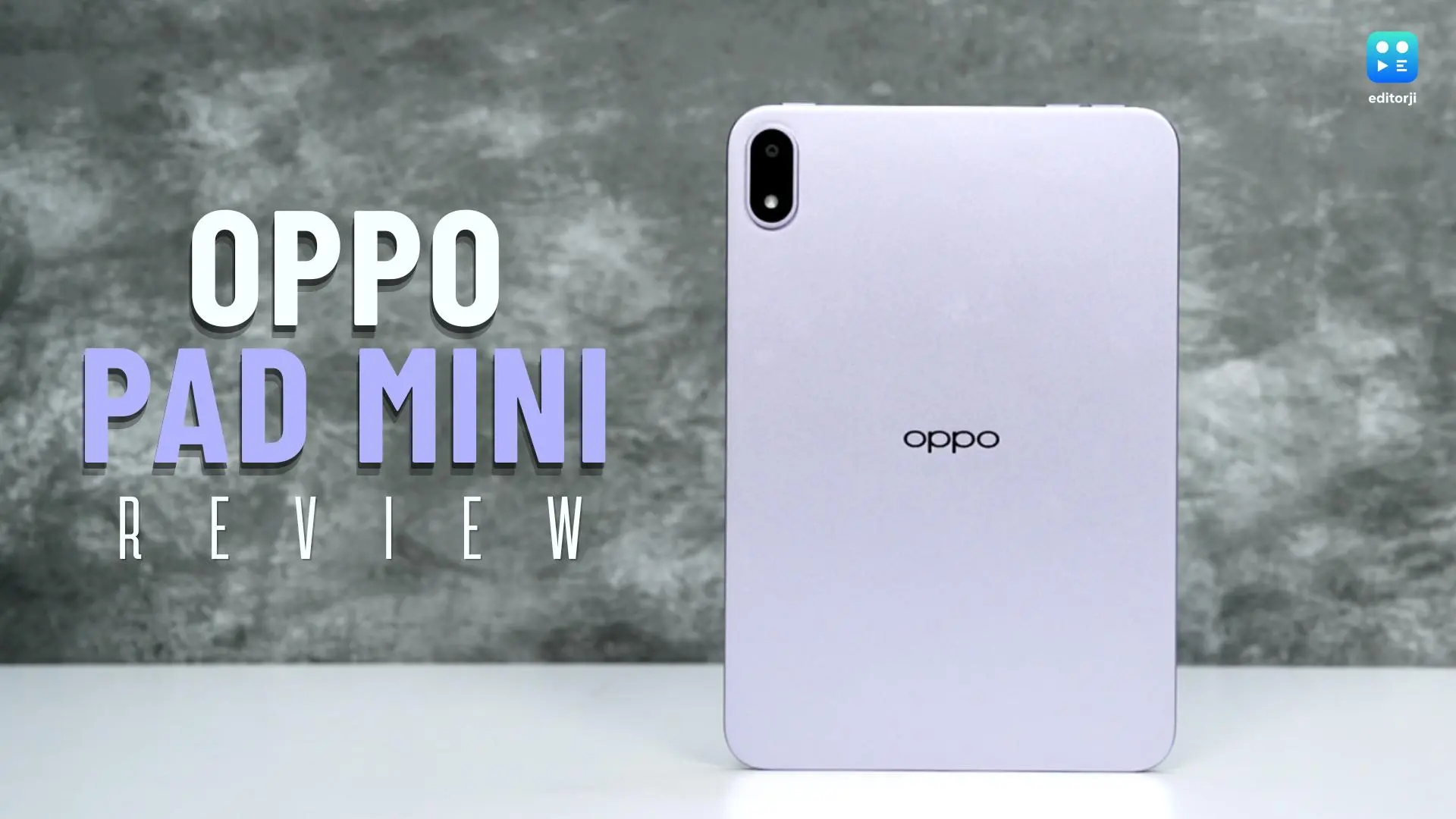
Turn it around, and you are greeted by a soft matte back panel that provides a fantastic tactile feel. A modest pill-shaped camera cutout sits tucked away in the upper left, while Oppo’s logo is neatly centered. The Lavender Purple review unit adds a nice pop of color without feeling overly flashy or loud.
Practicality matches the aesthetics here. Greasy smudges and fingerprint marks—usually an annoyance on portable tech—barely show up, meaning you will not constantly find yourself reaching for a microfiber cloth. It does collect a bit of fine dust when used outdoors, but nothing major.
Portability remains its biggest selling point. Coming in at just 282g and an ultra-slim 5.46mm profile, it easily slips into a standard pocket when you are stepping out light. Handling it one-handed for reading, social scrolling, or video playback during a commute feels effortless, and hand strain stays out of the picture.
Just keep in mind that there is no official water or dust resistance certification, so you will want to keep it clear of accidental coffee spills and harsh environments.
Oppo Pad Mini Review: The Display Experience
Lighting up the Oppo Pad Mini and cueing up my usual watchlist, the screen immediately grabs your attention. It features an 8.8-inch 2.5K OLED panel backed by a 144Hz refresh rate, plus Dolby Vision and HDR10+ support. Movies, TV shows, and YouTube clips look fantastic. Blacks are properly inky, colors have plenty of life, and the panel makes the device feel way more high-end than its size suggests.
Because it is so small, I found myself holding it closer while watching videos or playing games. That actually makes the viewing experience feel much more engaging than expected from an 8.8-inch display.
The matte finish is easily my favorite part. Sitting near a bright window or taking it outside did not turn the screen into a mirror. The coating diffuses light really well, and combined with the claimed 3,200 nits of peak brightness, I never had to squint or look for a shady spot.
There is no fingerprint reader on board, so face recognition is your only biometric choice. It got the job done during my time with it, though having a physical scanner would have rounded things out nicely.
Sound comes through stereo speakers tuned with Dolby Atmos. Dialogue stays sharp, and the speakers get surprisingly loud for something this thin. Bass is a bit restrained, but the overall media setup is genuinely great. The display stands out as one of the best things about this tablet.
Oppo Pad Mini Review: Performance and Internal Muscle
Performance is honestly one of the best things about this tablet. Oppo stuffed a Snapdragon 8 Gen 5 chip inside this little frame, along with fast LPDDR5x RAM and UFS 4.1 storage. We are talking proper flagship stuff here. Day to day, that kind of power meant I could easily jump between floating windows, knock out some edits, and juggle heavy apps without running into any lag.
When I fired up games like Call of Duty: Mobile and BGMI, the tablet just cruised right through them, pushing a steady 120 fps that kept all the fast action looking completely fluid. Even during long gaming sessions, the back got a bit warm in my palms like you would expect, but it never developed any annoying hot spots that bothered my grip.
If you are into raw numbers, I ran a couple of standard tests while checking out the device. On AnTuTu, it pulled a huge score of 2,881,279. Geekbench gave me a single-core score of 1,527 and a multi-core score of 7,069, and the 3DMark stress test wrapped up with a best loop score of 4,889 at 71.5 percent stability.
Oppo Pad Mini Review: Software, UI, and AI Ecosystem
Out of the box, the Oppo Pad Mini runs ColorOS 16 built on top of Android 17. The interface feels quick and responsive across daily tasks, offering smooth animations and gesture navigation that always registered properly. Handling multiple apps on this form factor felt very natural, and I frequently ended up splitting the screen or tossing open floating windows while juggling notes and media playback.
For creators, the wireless interconnectivity tools genuinely help workflow efficiency. Linking the tablet to other gadgets using O+ Connect made transferring files between my phone and PC dead simple, and the multi screen display extender worked without a hitch.
AI capabilities are well represented too, bringing a useful set of productivity tools right out of the box, including the crowd favorite Mind Space feature.
That said, one detail felt genuinely weird during testing. Since this is a late 2026 launch, I honestly expected it to ship with ColorOS 17 right away. Instead, my review unit arrived on an interim build, trailing behind other devices in the family that had already moved up. While an update will sort it out eventually, finding an older software version on a brand new high-end gadget felt like a strange misstep from Oppo.
Oppo Pad Mini Review: Camera Capabilities
Nobody buys a tablet expecting phone quality photos, and testing the Oppo Pad Mini proved that true. Its 13MP rear shooter handles scanning bills or grabbing quick whiteboard snaps, functioning strictly as a practical utility tool.
On the front, the 8MP selfie camera provides clean, bright video, making virtual work meetings and family video calls look crisp rather than grainy or washed out.
Oppo Pad Mini Review: Accessories That Sweeten the Deal
Value gets a nice bump thanks to the extras Oppo throws into the box, turning the Pad Mini into a much more complete kit. You get a dedicated Smart Case that typically retails for around ₹3,999, plus the Oppo Pencil 3 Pro valued at roughly ₹6,999. That totals nearly ₹12,000 in free gear right out of the gate, though you will want to keep in mind that this bundle is exclusive to direct purchases from Oppo.
Spending plenty of time with the Pencil 3 Pro proved it is a stellar tool. It glides across that matte screen smoothly with practically zero lag. Whether jotting down notes, marking up docs, or throwing together quick sketches, it tracked every stroke without skipping a beat. It turns the tablet from a simple media consumption device into a genuine productivity companion.
Oppo Pad Mini Review: Battery Life and Charging
Packing an 8,000mAh battery inside a 5.46mm thin body makes the endurance of the Oppo Pad Mini a genuinely pleasant surprise.
Juggling streaming, web browsing, doc editing, and casual gaming easily netted me a solid day and a half on one charge. On quieter days focused mostly on reading and catching up on shows, it stretched even further, meaning I almost never felt the need to lug a charger around.
Juicing it back up is equally hassle free. Oppo tosses an 80W SuperVOOC brick in the box, while the tablet caps its intake at 67W. Even a brief power top up before rushing out the door provided plenty of juice to sail through the rest of the evening.
For a small tablet running top tier hardware, living with this kind of battery life is an absolute breeze.
Final Verdict: Should You Buy It?
Price is the elephant in the room. At ₹94,999, asking that much for an 8.8-inch Android slate is steep, especially since it undercuts the base iPad mini on cost and faces off against much larger traditional screens.
However, Oppo is not charging flagship rates for a bare-bones portable device. You are getting top-tier power from a Snapdragon 8 Gen 5 processor, a stunning 144Hz matte OLED panel, an 8,000mAh battery, and a featherlight 282g frame. Bundling the Oppo Pencil 3 Pro and Smart Case right in the box adds nearly ₹12,000 in extra value.
What seals the deal is everyday usability. This slate slipped effortlessly into pockets and felt natural for one-handed use, yet it handled heavy multitasking, gaming, reading, and sketching without breaking a sweat.
That convenience defines its core pitch. You pay extra for the truly pocketable footprint, but in return, you get a full-blown flagship powerhouse that frees you from lugging around a bulky tablet.