Highlights

  • Gulab Singh bought J&K from East India Company in 1846
  • Hari Singh signed 'Instrument of Accession' after 'tribesmen' raided his kingdom
  • Article 370 came into existence when Indian constitution was adopted in November, 1949

Latest news

India, Russia are embarking on new journey of innovation, co-production and co-creation: PM Modi

India, Russia are embarking on new journey of innovation, co-production and co-creation: PM Modi

India is conducting independent and sovereign policy under leadership of PM Modi,  achieving very good results: President Putin

India is conducting independent and sovereign policy under leadership of PM Modi, achieving very good results: President Putin

Indian businesses can replace void left by Western companies in Russia, says Roscongress CEO Stuglev

Indian businesses can replace void left by Western companies in Russia, says Roscongress CEO Stuglev

Regulator DGCA eases flight duty norms for pilots amid IndiGo crisis

Regulator DGCA eases flight duty norms for pilots amid IndiGo crisis

Dalai Lama launches 'Forest Resources in India' focused on climate, conservation and community

Dalai Lama launches 'Forest Resources in India' focused on climate, conservation and community

RBI raises FY26 GDP growth projection to 7.3 pc

RBI raises FY26 GDP growth projection to 7.3 pc

AAP to hold farmers’ Mahapanchayat in Gujarat's Amreli on December 7 amid crop loss crisis

AAP to hold farmers’ Mahapanchayat in Gujarat's Amreli on December 7 amid crop loss crisis

OnePlus marks 12 years in India with a new six-star lineup for the 15R reveal

OnePlus marks 12 years in India with a new six-star lineup for the 15R reveal

Supreme Court Article 370 verdict: timeline of Jammu and Kashmir’s special status

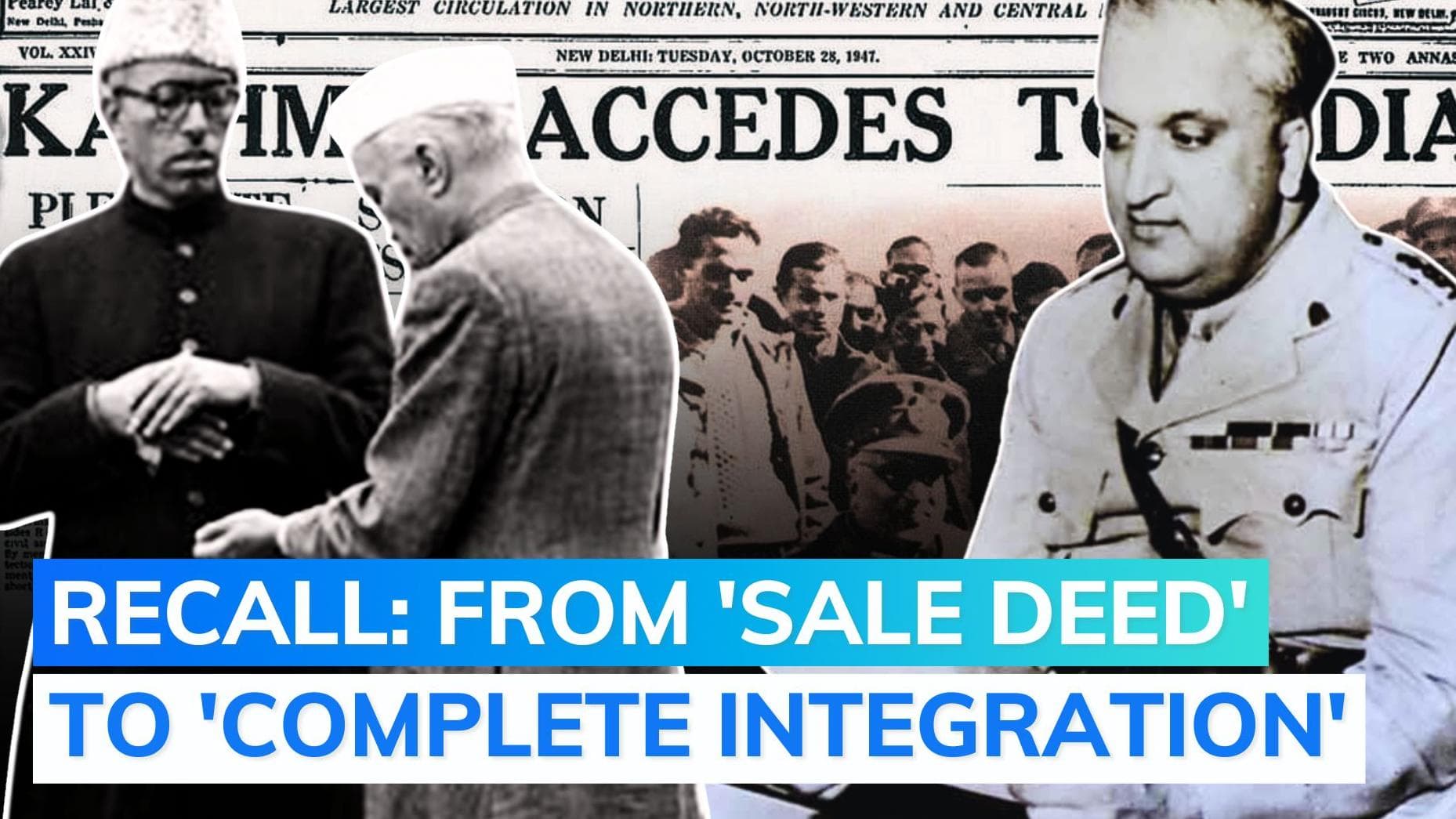
While one Dogra ruler bought the valley for 75 lakh Nanakshahis in 1846, another in 1947 was forced to sign the 'Instrument of Accession'

Supreme Court Article 370 verdict: timeline of Jammu and Kashmir’s special status

Speaking in the Lok Sabha, National Conference President and Member Parliament from Srinagar constituency, reminded the lawmakers: "Maharaja Kashmir (Hari Singh) wanted to remain independent. He wanted to be between these two nations. But Pakistanis did not want that. Pakistanis invaded and he had to come to India for help."

Farooq Abdullah, who has been chief minister of Jammu and Kashmir multiple times, and whose party won a thumping majority when the democratic process restarted in the region in 1996 after the eruption of militancy in 1989, was responding to the Narendra Modi government’s decision to water down the special status guaranteed under Article 370, the arrangement which was rooted in the Amritsar Treat of 1846, signed between the East India Company and Maharaja of Punjab Empire Ranjit Singh.

The British colonisers as a reward for the Dogra ruler Gulab Singh’s stance during the Anglo-Sikh war offered him a sale deed granting him dominion over Jammu and Kashmir for 7.5 million Nanakshahi rupees on March 16, 1846.

When the Treaty of Amritsar was formalised in 1846 between Ranjit Singh and The British East India Company, the British rewarded Gulab Singh, the Dogra ruler for his neutrality in the Anglo-Sikh war by granting him dominion over Jammu and Kashmir through a sale deed. And, thus, came to existence the state of Jammu & Kashmir that had 5 regions - Jammu, the Valley, Ladakh, Gilgit, and Baltistan.

In 1947, India got its independence, was divided into 2 nations and Kashmir was still under the Dogra ruler Hari Singh with a choice to join either side. However, as per several accounts of historians, Hari Singh, the great grandson of Gulab Singh, wanted J&K to be the "Switzerland of the East”- a neutral territory between the Hindu-majority but secular India and the Muslim state of Pakistan.

The winds of freedom struggle in the Indian sub-continent had breached the mighty Pir Panjal and crossed over to Kashmir valley where a young Shiekh Mohammad Abdullah— after returning as a science post-graduate from the Aligarh Muslim University— had waged people’s resistance against the autocratic Maharaja.

He blamed the Hindu Dogra ruler for not providing the Muslim population enough opportunities. Shiekh and his organisation All Jammu and Kashmir Muslim Conference wanted the people of Kashmir to decide their own fate. After the 1931 revolt against Maharaja which saw dozens of Kashmir people being killed, Shiekh rechristened his political group to a more encompassing National Conference.

In August 1947, Hari Singh offered to sign an agreement with both the neighbouring nations which would allow free movement of people across borders. While Pakistan became a signatory, India refused. Two months later, tribesmen who were supported by the Pakistan army attacked Kashmir and the Dogra king hurriedly sought India’s help – which obliged in lieu of the signing of “Instrument of Accession”.

Meanwhile, Sheikh who was a good friend of Jawaharlal Nehru – a Kashmiri Pandit, also urged India’s first Prime Minister to help Kashmiris fight the invaders.

While Hari Singh signed the accession document in exchange for India’s help, he sought special privileges for his people along the lines of a 1927 law that denied outsiders the right to own property in the state. The document stated that India would only take care of defence, external affairs and communication and all other control would be retained by the ruler of Jammu & Kashmir – unlike the other 565 princely states that decided to merge with India entirely, the case of Kashmir became a peculiar one.

India which accepted the conditions, worked out the terms in the period between 1947-49. With the adoption of India’s constitution, Article 370 also came into existence on 26th November 1949.

Amit Shah has repeatedly blamed Nehru for letting go “one-third of Kashmir”, but was there anything else that the former Indian Prime Minister could have done? Yes, he could have chosen to fight Pakistan but would that benefit the just-freed country of India?

While India’s first Prime Minister was seen as a tall leader who advocated secularism, Nehru’s interests in Kashmir were also based on the fact that he was a Kashmiri Pandit and he sympathised with the minor-Hindu population present in a state that was Muslim-dominated.

Nehru indirectly saved the interests of the Kashmiri Hindus by abiding by the Line of Control that was agreed to on 1st of January 1949 as a unification of J&K would have further made Hindus a minority in the state

ADVERTISEMENT

Up Next

Supreme Court Article 370 verdict: timeline of Jammu and Kashmir’s special status

Supreme Court Article 370 verdict: timeline of Jammu and Kashmir’s special status

India not neutral, it is on side of peace: PM Modi to Putin on Ukraine conflict

India not neutral, it is on side of peace: PM Modi to Putin on Ukraine conflict

AAP to hold farmers’ Mahapanchayat in Gujarat's Amreli on December 7 amid crop loss crisis

AAP to hold farmers’ Mahapanchayat in Gujarat's Amreli on December 7 amid crop loss crisis

Russian President Putin accorded ceremonial welcome at Rashtrapati Bhavan

Russian President Putin accorded ceremonial welcome at Rashtrapati Bhavan

IndiGo disruptions worsen; over 400 flights cancelled, passengers stranded for long hours

IndiGo disruptions worsen; over 400 flights cancelled, passengers stranded for long hours

Over 500 BJP and Congress leaders join AAP at Gujarat Jodo JANSABHA in Morva Hadaf

Over 500 BJP and Congress leaders join AAP at Gujarat Jodo JANSABHA in Morva Hadaf

ADVERTISEMENT

editorji-whatsApp

More videos

Gujarat AAP alleges irregularities in farmer relief package distribution

Gujarat AAP alleges irregularities in farmer relief package distribution

IndiGo cancels all departing flights from Delhi airport till Friday midnight

IndiGo cancels all departing flights from Delhi airport till Friday midnight

Major traffic restrictions in Delhi amid Putin's visit

Major traffic restrictions in Delhi amid Putin's visit

SIR in Gujarat: More than 17 lakh deceased voters found on electoral rolls

SIR in Gujarat: More than 17 lakh deceased voters found on electoral rolls

Indian athletes boosting nation's pride globally: UP CM Adityanath

Indian athletes boosting nation's pride globally: UP CM Adityanath

Uttarakhand begins pre-revision exercise to verify voters from 2003 rolls

Uttarakhand begins pre-revision exercise to verify voters from 2003 rolls

PM Modi presents copy of Gita in Russian to Putin

PM Modi presents copy of Gita in Russian to Putin

IndiGo says ops to be fully normal by Feb 10, seeks FDTL relaxations; cancels over 550 flights

IndiGo says ops to be fully normal by Feb 10, seeks FDTL relaxations; cancels over 550 flights

PM Modi warmly welcomes Putin at Delhi airport; hosts private dinner, reflecting time-tested friendship

PM Modi warmly welcomes Putin at Delhi airport; hosts private dinner, reflecting time-tested friendship

Russian President Putin says India, Russia collaboration not directed against anyone

Russian President Putin says India, Russia collaboration not directed against anyone

Editorji Technologies Pvt. Ltd. © 2022 All Rights Reserved.