Vivo’s X-series lineup has usually been easy to understand, which is why the X200T immediately raises eyebrows. It sits right between the regular X200 and the wildly popular X200 FE, and that positioning alone makes it an interesting phone to evaluate. The X200 FE, in particular, has built something close to a cult following. It is compact, feels genuinely flagship, and hits a price point that makes it hard to ignore. Throw in the X300 series, and things become even more complicated.
So this naturally raises a big question. Does the Vivo X200T actually make sense, or does it end up stuck in an awkward middle ground? It is slightly more expensive than the X200 FE, and in 2026, buyers are far less forgiving about paying extra unless the upgrade is obvious. To answer that, it makes sense to put both phones side by side and see where the real differences show up in everyday use.
Vivo X200T vs Vivo X200 FE: Design
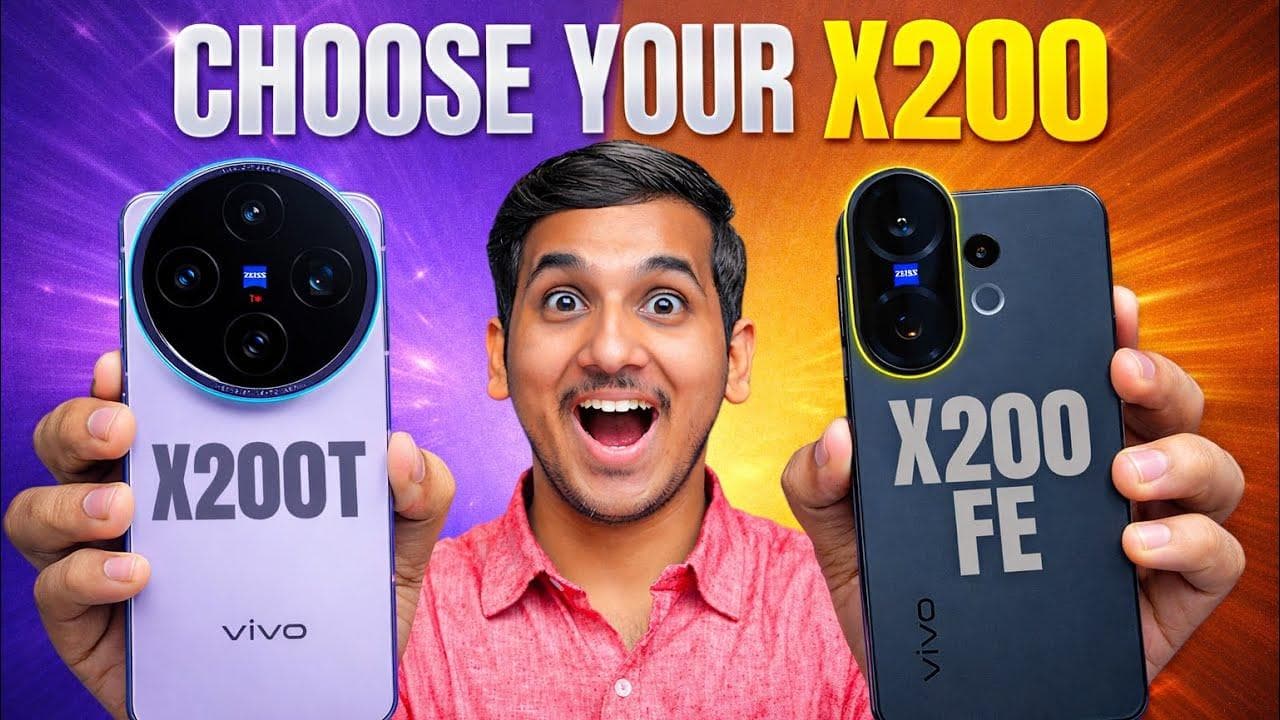
From the back, the X200T looks far more like a traditional X200-series phone than the X200 FE, and the camera module is the main reason why. The X200 FE uses a vertical, pill-shaped camera layout, with one camera and the Aura Light sitting outside the main housing. The result is a phone that tends to wobble when placed flat on a table.
The X200T adopts the large, centrally placed circular camera module seen on other X200 models. This makes it far more stable on flat surfaces, though it does introduce a slight top-heavy feel compared to the X200 FE. Build quality is excellent on both phones, with glass-like backs that have a smooth, velvety texture and aluminium frames.
The X200T is the bigger device overall, but not as heavy as expected. It weighs around 203 grams, while the X200 FE comes in lighter at roughly 183 grams. Both phones also carry IP68 and IP69 ratings, so everyday exposure to water and dust is not a concern. For screen protection, the X200 FE uses Gorilla Shield, while the X200T opts for Schott Glass. Personally, the compact size of the X200 FE makes it feel denser and more comfortable in hand, but that largely comes down to preference.
Vivo X200T vs Vivo X200 FE: Display
On paper, the displays look quite different, but in real-world use, the gap is smaller than expected. The X200 FE features a 6.31-inch LTPO panel, while the X200T steps up to a larger 6.67-inch LTPS panel. Beyond size and panel technology, the core specifications are nearly identical. Both phones offer a 1.5K resolution, a 120Hz refresh rate, and HDR10+ support.
Despite the larger screen, the X200T looks just as sharp as the X200 FE, and clarity is never an issue on either device. Colour reproduction is also extremely close, thanks to Zeiss Master Colour Display tuning on both phones. HDR content on YouTube looks punchy, and Netflix shows and movies appear vibrant and well-balanced.
Outdoors, the X200 FE has a slight advantage. Its 1800 nits high brightness mode makes it a bit easier to see under harsh sunlight compared to the X200T’s 1600 nits. The X200T does pull ahead with an ultrasonic fingerprint scanner, which feels quicker and more reliable than the optical solution on the X200 FE. Both phones also deliver strong stereo speaker performance, though the X200T has slightly better bass.
Vivo X200T vs Vivo X200 FE: Cameras
This is where the comparison gets genuinely interesting. Both phones clearly lean on Vivo and Zeiss’s flagship camera tuning, and it shows in everyday shooting. The X200 FE comes with a 50MP main camera with OIS, a 50MP 3x telephoto with OIS, and an 8MP ultrawide. The X200T, meanwhile, goes all-in with 50MP sensors across the board, including the main camera with OIS, a 50MP telephoto, and a 50MP ultrawide.
On paper, the X200T looks like the clear winner, but in practice, the difference is smaller than expected. Photos from the main cameras on both phones are excellent, with strong detail, natural colours, accurate skin tones, and well-controlled highlights. Both cameras tend to lean slightly underexposed at times, but the results are difficult to tell apart for most users.
The gap becomes more noticeable when switching to the ultrawide camera. The lower-resolution sensor on the X200 FE does fall behind the X200T, especially when you look closely. Low-light performance follows a similar pattern. The main cameras perform very well on both devices, but the X200T’s higher-resolution ultrawide gives it a clear edge.
Portraits are reliable on both phones, with good edge detection and natural-looking background blur. Zoom performance is also solid across the board. Video recording is nearly identical, with both phones supporting 4K at 60fps, good stabilisation, and HDR. For slow motion, the X200 FE tops out at 1080p 120fps, while the X200T can push up to 240fps.
Selfies are one area where the X200T takes a small hit. It uses a 32MP front camera compared to the X200 FE’s 50MP sensor. While sharpness is not dramatically different, the colour output from the X200T is more pleasing overall. Taken as a whole, it is a close contest, but based on personal usage, the X200T feels slightly more versatile.
Vivo X200T vs Vivo X200 FE: Performance
Performance is another area where the X200T pulls ahead, at least on paper. It runs on the Dimensity 9400+, which actually places it above even the X200 and X200 Pro in raw performance terms. The X200 FE uses the Dimensity 9300+, which is still a very capable chip.
Both phones use LPDDR5X RAM, but storage is where the X200T gains a meaningful advantage. The X200 FE sticks with UFS 3.1, while the X200T upgrades to faster UFS 4.1. In everyday use, both phones feel quick and responsive, but the X200T handles heavier files and demanding apps more comfortably.
Benchmarks make the difference clearer. In AnTuTu, the X200T leads by nearly a million points. Geekbench narrows the gap, though the X200T still stays ahead, and 3DMark shows a similar trend. In real-world usage, however, both phones feel smooth enough that the performance gap often fades into the background.
Gaming performance reflects this. Both phones handle titles like BGMI and Call of Duty Mobile without issues. The X200 FE tops out at 90fps, while the X200T can push up to 120fps. Heat management is better on the X200T, while the more compact X200 FE tends to warm up sooner during longer gaming sessions.
Vivo X200T vs Vivo X200 FE: Battery & Charging
Battery capacity is one area where Vivo has made an unexpected move. The X200T packs a 6200mAh battery, which is smaller than the 6500mAh unit in the X200 FE, despite the larger body. In practice, battery life on both phones is solid, with either device comfortably lasting a full day.
On paper, the X200 FE should have an edge thanks to the larger battery and LTPO display, but in early testing, the difference is hard to notice. Charging is where the two phones clearly split. Both support 90W wired charging, but the X200T adds 40W wireless charging, giving it more flexibility.
Vivo X200T vs Vivo X200 FE: Verdict
This turned out to be a much closer comparison than expected. The Vivo X200T is the more future-ready phone, offering stronger raw performance, faster storage, a slightly more capable camera setup, and longer software support. At the same time, the X200 FE never feels left behind. It is lighter, more compact, still very fast in daily use, and its cameras are more than good enough for most people.
Choosing between the two comes down to priorities. If you want maximum power, features, and long-term value, the X200T makes more sense. If you prefer a smaller phone that still delivers a flagship-level experience, the X200 FE remains an excellent choice.