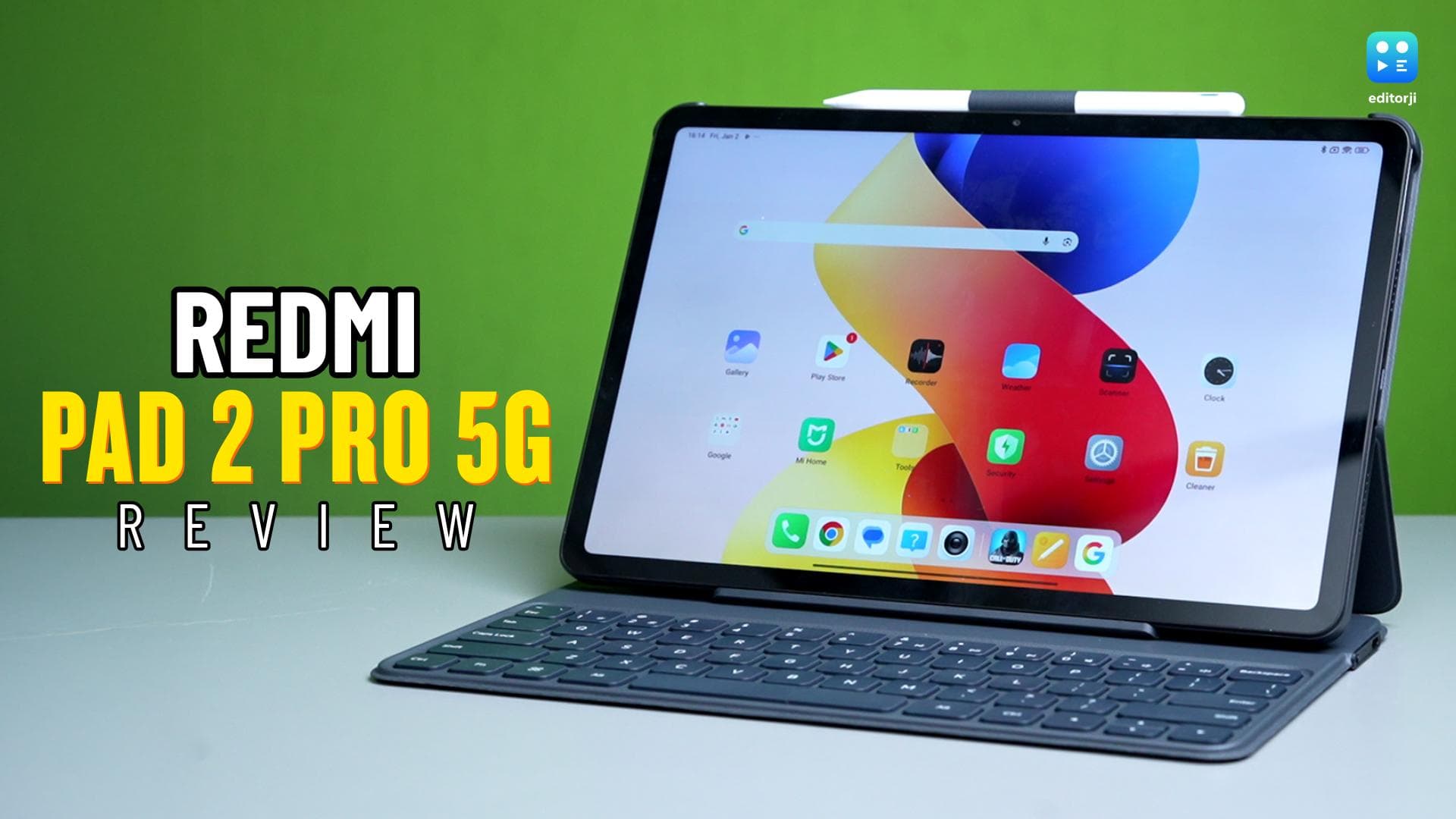
I have spent plenty of time with the original Redmi Pad Pro, and it set a solid reference point for how a big, affordable Android tablet should feel. So when I started using the Redmi Pad 2 Pro 5G, I was genuinely curious whether Xiaomi would push for something new or stick to a formula that already worked. It quickly became clear that this tablet leans firmly towards refinement rather than reinvention.
The moment I picked it up, everything felt familiar. The design philosophy has not really changed, and that is not a negative. Instead of chasing flashy changes, Xiaomi seems to have focused on smoothing out the experience, fixing small annoyances, and polishing the parts that matter most in daily use.
On paper, a lot looks similar: a large display, strong battery life, and accessories that suggest light productivity. But after using it every day for work, streaming, and casual tasks, it is obvious that the Pad 2 Pro prioritises practicality, stability, and long-term comfort over trying to replace a laptop.
Redmi Pad 2 Pro 5G Review: A big, smooth screen that plays it safe
I want to start with the display because, on a tablet, this is the one thing that really shapes how usable it feels every single day.
With the Redmi Pad 2 Pro 5G, the screen did not try to impress me in the first five minutes. Instead, it slowly won me over the longer I used it.
The tablet uses a 12.1-inch IPS LCD panel, and after days of working, binge-watching, and casual browsing, it felt like a sensible choice for this category. The 120Hz refresh rate makes a real difference in daily use. Scrolling feels smooth, app transitions look clean, and nothing ever feels jumpy or strained. I noticed this most during long reading sessions, where the higher refresh rate made the experience feel easier on my eyes rather than just visually flashy.
Dolby Vision support adds another layer to media consumption. Movies and shows look polished, with good contrast and controlled highlights, without pushing colours too hard. This is not a display that screams for attention, and I liked that. It stays comfortable over long sessions, which is exactly what I want from a tablet screen.
One design choice I appreciated more than expected was the bezel thickness. They are clearly visible, but in actual use, that works in the tablet’s favour. I could hold the Pad 2 Pro securely without my palms constantly triggering the screen. Whether I was reading in portrait mode or watching videos in landscape, it felt easier to grip than tablets that chase ultra-thin bezels just for looks.
The 16:10 aspect ratio suits entertainment really well. Streaming content fills the screen nicely, with minimal black bars, and videos feel immersive. For productivity, especially when reviewing documents or reading long articles, I did sometimes wish for a bit more vertical space. That said, it never disrupted my workflow enough to be annoying, just something I noticed occasionally.
Sharpness was never a concern. The 2.5K resolution looks crisp at this size, with clear text and well-defined UI elements. Colours are handled in a balanced way too. With support for around a billion colours, photos and videos look lively but not exaggerated. Compared to the older Redmi Pad Pro’s 12-bit panel, this is technically a downgrade, but in real-world use, I could not tell the difference unless I actively tried to.
Brightness peaks at around 600 nits. Indoors, I had zero complaints. Outdoors, direct sunlight does affect visibility, but the screen remains usable.
The quad-speaker setup with Dolby Atmos complements the display well. Audio is clear and reasonably loud, and the presence of a 3.5mm headphone jack just adds to the tablet’s overall practicality.
Redmi Pad 2 Pro 5G Review: Familiar looks, solid feel, and a focus on practicality
The Redmi Pad 2 Pro 5G plays things very safe when it comes to design, and you notice that straight away. Visually, it feels almost like a continuation of the earlier Pad Pro, and as someone who has used that tablet quite a bit, the familiarity stood out straight away.
The wide, rectangular shape and overall proportions feel unchanged, and if you have seen the previous model, this one will look instantly recognisable.
I found the design a bit too safe. The aluminium back, paired with the plastic strip that houses the camera, gives it a clean but conservative look. On my grey unit especially, the tablet looks understated to the point of being almost dull.
Apart from a subtle triangular texture on the plastic section, there is very little visual drama. It does not try to stand out on a desk, and that felt like a very deliberate choice.
That said, the finish started to grow on me the more I used it. The matte coating on the back turned out to be genuinely practical. It does not attract fingerprints easily, and even after days of use, it continued to look fairly clean.
I also appreciated the symmetry on the rear. There are two circular rings, even though only one holds the camera. The second ring is for the LED flash, and while it is a small detail, it keeps the back from looking lopsided.
In terms of build quality, I had no complaints. The aluminium back and frame feel solid and reassuring, with no flex or creaks when handling the tablet. It feels tougher than many tablets in this price range.
Gorilla Glass 3 protects the front, and the IP54 rating gave me a bit more confidence using it around the house, in the kitchen, or while throwing it into my backpack.
The port and button layout felt sensible in daily use. I liked having USB-C, a proper 3.5mm headphone jack, a SIM tray for 5G, and a microSD card slot for storage expansion. At around 600 grams for the 5G variant, it is easy enough to carry around, but the large 12.1-inch size did make long handheld sessions tiring for me, especially when using it one-handed.
Redmi Pad 2 Pro 5G Review: Accessories that add to the experience
Xiaomi offers a dedicated keyboard case and Smart Pen as optional add-ons for the Redmi Pad 2 Pro 5G, and I spent some time using both to see how much they actually add to the experience.
The second-generation keyboard is made specifically for this tablet and doubles up as a protective case. In day-to-day use, I found it comfortable enough for emails, document edits, and quick notes. The keys have decent travel, and even during longer typing sessions, the layout never felt cramped or awkward.
That said, there are some clear limitations. The keyboard skips backlighting and does not include a trackpad, which immediately puts a ceiling on how far you can push it for serious work. It also connects over Bluetooth instead of using POGO pins, so it needs to be charged separately. In practice, this means one more device to keep an eye on, which slightly takes away from the plug-and-play convenience you expect from tablet accessories.
The Smart Pen follows a similar pattern. It needs its own charging and does not magnetically attach to the tablet, so there is no easy way to snap it on when you are done using it. However, once I actually started writing with it, those concerns faded a bit.
The pen feels responsive, palm rejection works well, and handwriting recognition is reliable. Pressure sensitivity makes it good for note-taking and light sketches, and the pen holder built into the keyboard case helped me keep it from getting lost.
Redmi Pad 2 Pro 5G Review: Reliable performance that stayed consistent
Performance was never a concern for me while using the Redmi Pad 2 Pro 5G. It runs on the Snapdragon 7s Gen 4, an upper mid-range chip that feels well matched to a large Android tablet. In daily use, things stayed smooth and predictable. Apps opened quickly, animations felt fluid, and moving between multiple apps never felt messy. I often had several apps running side by side, and the tablet handled that without slowing down.
My unit came with LPDDR4X RAM and UFS 2.2 storage. While those specs may not look impressive on paper, they did not hold the experience back in real-world use. Multitasking felt reliable, and I did not run into frequent app reloads during normal usage. I also appreciated that Redmi continues to offer expandable storage on both the Wi-Fi and 5G variants, which is useful if you plan to store a lot of media or large files locally.
Benchmark numbers line up with that experience. The tablet crossed around 1.1 million points on AnTuTu and delivered solid Geekbench scores. 3DMark stability results were also respectable, suggesting it can sustain performance over longer sessions without major drops.
Gaming performance was reassuring as well. I played BGMI and Call of Duty Mobile, and both ran smoothly with stable frame rates.
Overall, the Pad 2 Pro feels tuned for steady, long-term use rather than chasing peak benchmark numbers, which suits a tablet focused on media, gaming, and everyday productivity.
Redmi Pad 2 Pro 5G Review: Stable software with strong multitasking support
Using the Redmi Pad 2 Pro 5G, the software experience felt thoughtfully tuned for a large display, which is not something every Android tablet gets right. The tablet runs HyperOS 2 based on Android 15, and while the overall design language will feel familiar if you have used Xiaomi devices before, it adapts reasonably well to the tablet form factor. UI elements scale properly, layouts make good use of the extra space, and nothing felt awkwardly stretched or oversized. That said, some parts of the interface are starting to feel a little dated in terms of visual style.
Day-to-day use, however, was smooth. Animations and transitions are handled well, thanks to Xiaomi’s HyperCore system running behind the scenes. The interface prioritises stability over flashiness, which worked in its favour during longer sessions. There are a few preloaded apps, but most of them feel tablet-relevant rather than unnecessary clutter, and none of them actively got in my way.
Where HyperOS 2 really impressed me was multitasking. Being able to run up to four apps at the same time turned out to be genuinely useful. I could mix split-screen views with floating windows, and the tablet handled it without feeling cramped or unstable. For my usual routine of watching videos, browsing the web, replying to messages, and taking notes simultaneously, this flexibility made the tablet feel far more capable.
On the AI side, Google Gemini is integrated into HyperOS 2, and in my use, it worked smoothly and reliably for everyday tasks.
Redmi Pad 2 Pro 5G Review: A very basic camera setup
The cameras on the Redmi Pad 2 Pro 5G are very much an afterthought, and that was obvious in my use. On the back, you get an 8MP camera with a flash, but image quality is strictly basic. I found it useful for scanning documents or QR codes, and not much beyond that. Photos lack detail and consistency, so it is not something I would rely on for actual photography.
The 8MP front camera is more practical. It handled Zoom meetings and WhatsApp calls just fine in good lighting, delivering clear and usable results. Video recording is capped at 1080p at 30fps on both cameras. Realistically, I only see myself using video mode in an emergency, not by choice.
Redmi Pad 2 Pro 5G Review: Long-lasting battery that made charging a non-issue
Battery life has easily been one of my favourite parts of using the Redmi Pad 2 Pro 5G. It comes with a huge 12,000mAh battery, and in real-world use, that size genuinely shows.
With my usual mix of streaming, browsing, light work, and occasional gaming, I was comfortably getting close to four days on a single charge. That kind of endurance really changes how relaxed you feel about using a tablet, especially if it is your main device for media or travel.
Charging is capped at 33W, and Xiaomi includes the charger in the box, which I appreciated. It is not the fastest out there, but it gets the job done without fuss.
The tablet also supports 27W reverse wired charging, which I found surprisingly useful for topping up my earbuds or giving my phone a quick boost when needed.
Verdict: Is the Redmi Pad 2 Pro 5G worth buying?
Starting at ₹24,999 for the Wi-Fi version and ₹27,999 for the Wi-Fi + 5G model, the Redmi Pad 2 Pro 5G makes its priorities clear. Xiaomi has focused on nailing the fundamentals instead of chasing premium touches.
Battery life is a clear strength, multitasking feels genuinely usable, and expandable storage across all variants adds to its day-to-day practicality. If you want a tablet that can comfortably last days without living near a charger, this one delivers.
The optional keyboard and Smart Pen also help push it beyond basic media use. They are not perfect, but they make typing, note-taking, and light work far more manageable. A magnetically charging pen and a backlit keyboard with a trackpad would have elevated the experience further.
There are trade-offs. The design is functional rather than inspiring, the display is good but not class-leading, and the AI features feel fairly basic. HyperOS 2 runs smoothly, but it already looks a bit dated.
Still, for the asking price, the Redmi Pad 2 Pro 5G is a dependable, no-frills Android tablet that prioritises battery life, stability, and everyday usability.