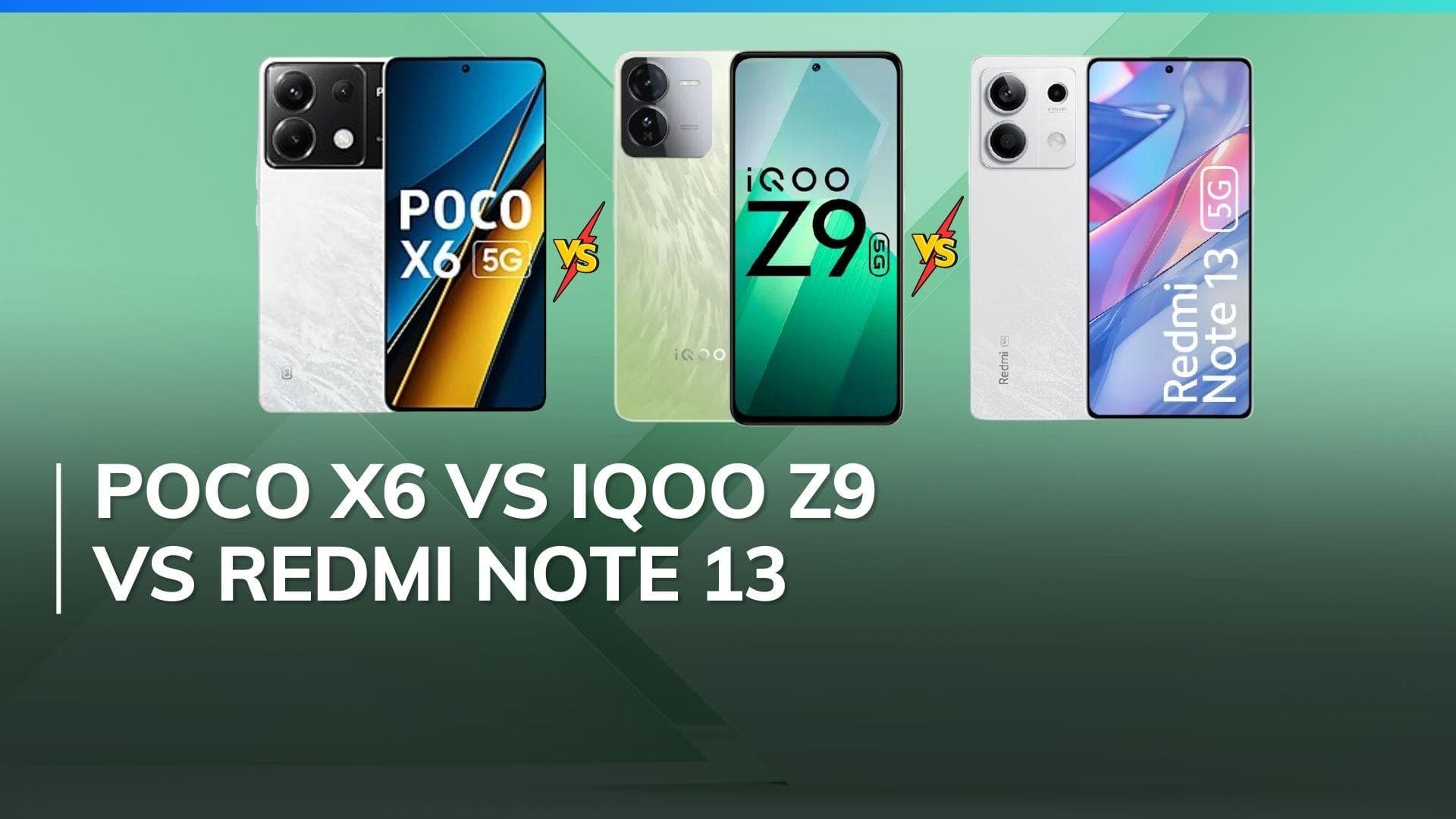
The quest for an affordable smartphone that packs a punch is never-ending. Three contenders have stepped into the ring – the Poco X6, iQOO Z9, and Redmi Note 13. Let's dissect their specs and see which one emerges as the mid-range champion.
Poco X6 vs iQOO Z9 vs Redmi Note 13: Design and Build
Poco X6: This device offers a balanced design approach. Its dimensions provide a comfortable in-hand feel, while the reinforced Gorilla Glass Victus front offers superior protection. The IP54 dust and splash resistance rating adds a layer of reassurance for everyday use.
iQOO Z9: Slightly larger than the Poco X6, the Z9 maintains a focus on durability. The glass front and IP54 rating ensure it can handle the rigors of daily life with ease.
Redmi Note 13: With a similar footprint to the Poco X6, the Note 13 boasts impressive lightness. It also features a Gorilla Glass 5 front and the same IP54 rating, making it a durable choice.
All three smartphones prioritize robust construction. Users seeking a compact feel may gravitate towards the Poco X6 or Redmi Note 13, while those less concerned about a slightly larger size will find the iQOO Z9 equally well-built.
Poco X6 vs iQOO Z9 vs Redmi Note 13: Display
Poco X6: This device offers an AMOLED screen bursting with 68 billion colours, a super-smooth 120Hz refresh rate, and an eye-popping 1800 nits of brightness, the Poco X6 is a winner for movies and games. Dolby Vision support takes the experience over the top and its extra-sharp resolution delivers crystal-clear details.
iQOO Z9: This phone also packs an AMOLED display with a 120Hz refresh rate and 1800 nits of brightness, ideal for vibrant colours and outdoor viewing. It offers HDR support for a great dynamic range, even if the resolution isn't quite as sharp as the Poco X6.
Redmi Note 13: The Note 13 keeps up with its rivals thanks to its 6.67-inch AMOLED display, 120Hz refresh rate, and a respectable 1000 nits of brightness. While it supports fewer colours in some regions and offers a slightly lower resolution, it still delivers a great viewing experience.
If you want the absolute best display, the Poco X6 is the clear winner. The iQOO Z9 provides a very similar experience with slightly lower resolution. And, the Redmi Note 13 does a commendable job for anyone seeking a slightly more budget-friendly option.
Poco X6 vs iQOO Z9 vs Redmi Note 13: Performance and Software
Poco X6: The Snapdragon 7s Gen 2 chip inside the Poco X6 is a reliable choice – snappy for everyday stuff and capable of handling most games without breaking a sweat. Android 13 with MIUI 14 brings a familiar, tweakable interface, and the promised upgrade to Android 14 is a good sign. "HyperOS" enhancements sound interesting, hinting at possible performance boosts.
iQOO Z9: The iQOO Z9's Mediatek Dimensity 7200 chip should outperform the competition. Even demanding games shouldn't be an issue. Plus, starting with Android 14 and Funtouch 14 means you're getting the latest software with all those cutting-edge features.
Redmi Note 13: The Mediatek Dimensity 6080 in the Note 13 is a bit less beefy than the Z9's but good enough for most people. Think smooth for everyday use and some lighter gaming. Just like the Poco X6, you get Android 13 with MIUI 14 for a customizable, feature-packed experience.
If you want the best balance of performance and future software updates, the Poco X6 is solid. Those prioritizing extra power and the absolute latest Android experience should look to the iQOO Z9. The Redmi Note 13 is a great budget-conscious pick that doesn't skimp too much.
Poco X6 vs iQOO Z9 vs Redmi Note 13: Camera
Poco X6: The triple-camera system on the Poco X6 provides flexibility for various shooting scenarios. The 64MP main sensor should deliver crisp images, while the ultra-wide lens opens up possibilities for landscapes and group photos. The inclusion of OIS (Optical Image Stabilization) on the primary camera enhances low-light performance and minimizes blur.
iQOO Z9: This device offers a dual-camera setup, with a focus on its 50MP main sensor. The larger sensor size implies excellent detail capture and natural background blur (bokeh). OIS remains a key advantage, ensuring sharp, well-exposed images across a variety of lighting conditions.
Redmi Note 13: The Redmi Note 13 boasts a 108MP main camera, a significant step up in resolution. This allows for exceptional detail retention, making it suitable for cropping, large prints, or anyone seeking maximum clarity. The auxiliary ultra-wide lens maintains flexibility for broader scenes.
For photographers desiring a well-rounded system with various focal lengths, the Poco X6 or Redmi Note 13 present compelling options. If image quality is paramount, with an emphasis on detail and natural-looking depth effects, the iQOO Z9 is worth serious consideration.
Poco X6 vs iQOO Z9 vs Redmi Note 13: Battery and Charging
Poco X6: The Poco X6 has a slightly larger battery than its rivals at 5100 mAh, which should translate to solid all-day use. But, the real star of the show is its 67W fast charging. Getting a full charge in under 45 minutes is a huge plus for those always on the go.
iQOO Z9: This device offers a 5000 mAh battery is standard, it keeps up with a 44W fast charging option. This means you can snag a 50% charge in roughly half an hour - perfect for a quick top-up before heading out.
Redmi Note 13: The Redmi Note 13 also sports a 5000 mAh battery, giving it good potential for all-day use. Unfortunately, its 33W charging is noticeably slower than the competition. This might be a dealbreaker for those who need their phone recharged in a hurry.
If you want the absolute fastest charging speeds, the Poco X6 is your best bet. The iQOO Z9 strikes a good balance between battery capacity and quick charging. The Redmi Note 13, while offering respectable battery life, lags behind when it comes to topping up the power.
Poco X6 vs iQOO Z9 vs Redmi Note 13: Price
The Poco X6 and iQOO Z9 cost Rs 19,999 each and come with 8GB RAM and 256GB storage, offering lots of space and fast performance. The Redmi Note 13 is cheaper at ₹17,499, with 6GB RAM and 128GB storage, making it a good deal for those who want to save money but still get a quality phone.
Also watch: Google I/O 2024 date confirmed: Android 15 launch, Pixel 8a, and AI innovations expected