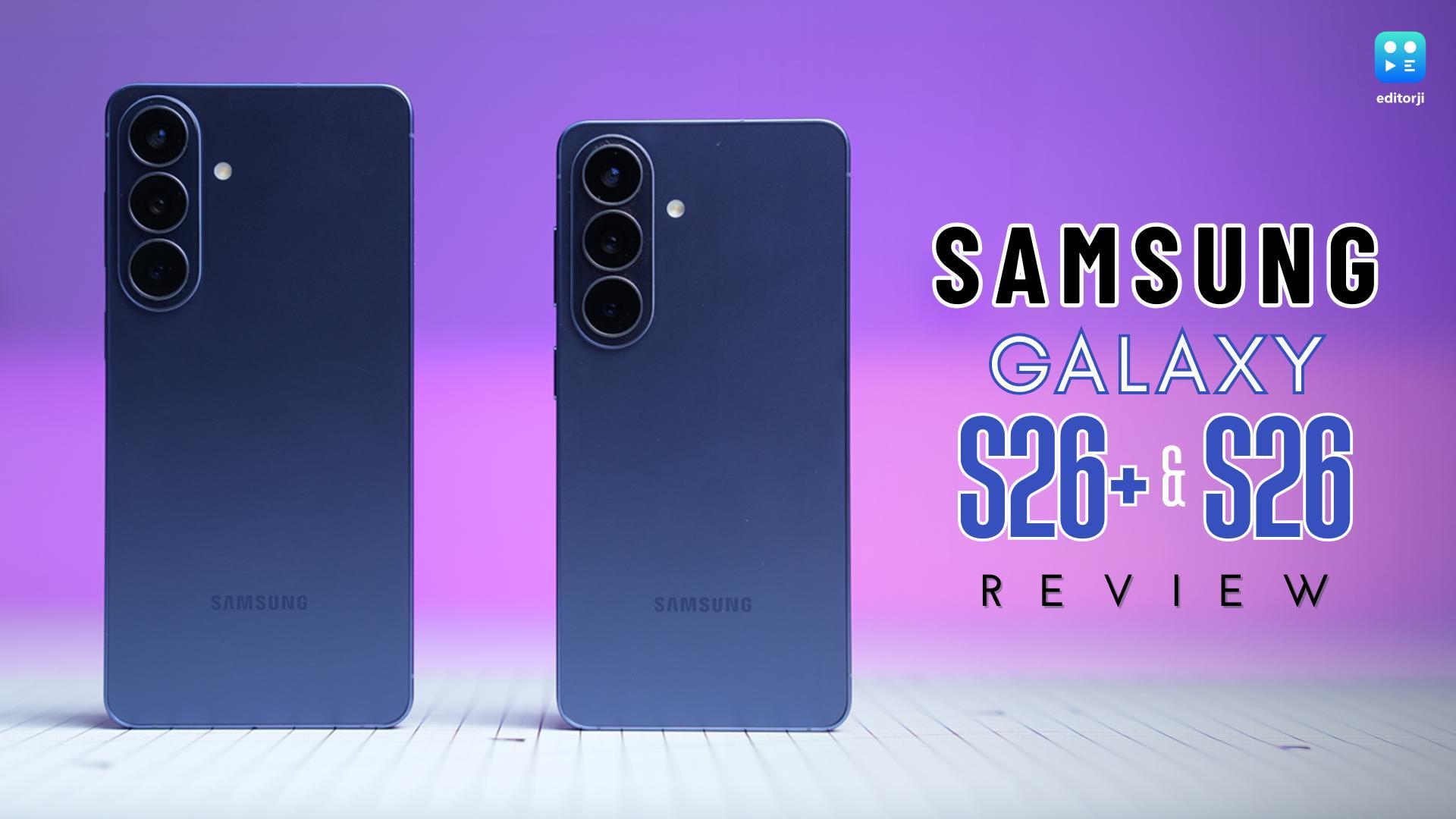
The Samsung Galaxy S26 and Samsung Galaxy S26+ are not phones that impress instantly on a spec sheet. At ₹87,999 for the S26 and ₹1,19,999 for the S26+, they sit firmly in premium territory, yet on paper, they feel very close to last year’s models. That, however, only tells part of the story.
What Samsung has done this year is refine rather than reinvent. The cameras feel more polished, the new Exynos 2600 delivers performance that genuinely surprised me, and the displays remain among the best you will find on any Android phone.
The S26 continues to stand out as a compact flagship done right, while the S26+ builds on that experience without pushing you into Ultra-level pricing. The real question is whether these quieter improvements feel worth it at this price point in 2025.
Samsung Galaxy S26+ and Galaxy S26 Review: Design
When I first picked up the Samsung Galaxy S26 and Samsung Galaxy S26+, they felt instantly familiar. At a glance, both look almost identical to last year’s models, and the changes are subtle rather than dramatic.
The most noticeable update is around the camera module. This time, the lenses sit on a slightly raised platform instead of directly on the back. The camera rings are slimmer and colour-matched to the body, which makes the whole rear panel look cleaner and more refined. It is not a big redesign, but it does feel more polished in hand.
Beyond that, I genuinely had to look twice to tell these apart from their predecessors. The S26 still feels like one of the best compact Android flagships you can buy, while the S26+ continues to sit in that middle space between the standard model and the Ultra.
The dimensions have not changed much either. The S26+ is 7.3mm thick, and the S26 comes in at 7.2mm. Both feel slimmer and easier to handle than the Ultra, especially if you prefer something lighter. Weight is also nearly identical. The S26+ stays at 190 grams, while the S26 goes up slightly from 162 grams to 167 grams.
That familiarity is not a bad thing. The moment I held them, both phones felt just as solid as before. The Armour Aluminium frame and matte glass back give them a premium, grippy feel. The matte finish also helps keep fingerprints in check, and the Cobalt Violet variant, in particular, looks great. The S26, thanks to its smaller size, is especially comfortable for long use.
There is a small trade-off with the new camera design. Both phones wobble slightly when placed on a flat surface. The S26+ does it a bit more, but it is not a major issue and feels similar to last year.
Durability is still a strong point. I get Gorilla Glass Victus 2 on both sides, an Armour Aluminium frame, and IP68 water resistance. Connectivity is well covered too, with WiFi 7, Bluetooth 5.4, NFC, and a USB 3.2 Type-C port with DisplayPort 1.2 support. I still do not understand why Samsung skips an IR blaster, though.
In India, the S26+ comes in Cobalt Violet and Black, with Pink Gold and Silver Shadow available online. The S26 adds Sky Blue and White, giving it a slightly wider range of colours.
Samsung Galaxy S26+ and Galaxy S26 Review: Displays
Samsung has clearly saved the bigger display upgrades for the Ultra. The S26+ sticks with a 6.7-inch panel, while the S26 gets a small bump to 6.3 inches from 6.2 inches last year.
What stood out to me immediately was how slim the bezels feel. They look even thinner this time, though Samsung has not shared exact figures yet. Either way, both phones look sharp and modern from the front.
The core experience remains familiar. Both displays support a 120Hz refresh rate, peak brightness of 2600 nits, and HDR10+. They are LTPO panels as well, so the refresh rate can shift between 1Hz and 120Hz depending on what you are doing. In day-to-day use, that means I could leave the always-on display active or glance at notifications without worrying about battery drain.
Resolution is where things split. The S26+ keeps its 1440p panel, while the S26 stays at 1080p. Personally, I never found the lower resolution on the S26 to be an issue. At this size, it still looks sharp, landing at around 411ppi. The S26+, on the other hand, is noticeably crisper and actually ends up being the sharpest in the lineup, even edging past the Ultra in pixel density.
One thing worth noting is that the Privacy Display feature is still limited to the Ultra.
In daily use, though, I had very little to complain about. Both phones use Dynamic AMOLED 2X panels, and the colour reproduction is excellent. Even with 8-bit panels, banding is handled well. Blacks look deep, colours pop nicely, and HDR content on Netflix looked consistently great thanks to HDR10+, even without Dolby Vision support.
Outdoor visibility held up just as well. Even under harsh sunlight, I had no trouble using maps or reading messages.
Both phones also come with an ultrasonic fingerprint scanner under the display, and it worked flawlessly during my testing. It is quick, accurate, and easy to reach.
For audio, you get stereo speakers on both. The S26+ sounds slightly fuller, likely due to its larger size, but both get loud enough. There is no headphone jack, but wireless audio support is solid, with codecs like aptX, aptX HD, Samsung SSC, AAC, SBC, and LDAC all supported.
Samsung Galaxy S26+ and Galaxy S26 Review: Cameras
With the Samsung Galaxy S26 and Samsung Galaxy S26+, Samsung has clearly leaned into refinement rather than big hardware changes. On paper, the setup looks familiar. Both phones get a 50MP main camera, a 12MP ultrawide, and a 10MP 3x telephoto.
Up front, there is a 12MP selfie camera, now with a slightly wider field of view. I found this genuinely useful, especially when trying to fit more into the frame without awkward positioning.
After spending time with both, it is clear that the focus here is consistency. In daylight, the main camera delivers excellent results. Images are detailed, textures look natural, colours stay balanced, and dynamic range is handled confidently. I also noticed a bit of grain in darker areas, but instead of looking messy, it actually helps photos feel more natural and less over-processed. Portraits come out clean with accurate skin tones, although the background blur can sometimes feel slightly aggressive.
The 2x crop from the main sensor ended up being more useful than I expected. I found myself using it often for portraits, as it holds detail really well without a noticeable drop in quality. The 3x telephoto is reliable too. It may not lead its class in detail, but colours and dynamic range stay consistent. Zoom goes up to 30x, though beyond a point, the results start to lose clarity.
The ultrawide works best in good lighting. It captures vibrant colours and decent detail for landscapes and group shots, though I would avoid using it for close-ups. Selfies, on the other hand, were a strong point. They come out sharp and well-exposed, and the wider framing makes a real difference.
Low-light performance is where things get interesting. Samsung’s automatic Night mode runs quietly in the background and improves detail while reducing noise. I did find that manually enabling it gives more consistent results. If you want more control, the Camera Assistant app adds extra settings that are worth exploring.
Video remains a strong area. I could shoot up to 4K at 60fps across all cameras, and 8K on the main sensor. Footage looks sharp in daylight, holds up reasonably well in low light, and stabilisation is dependable. Features like Horizon Lock, Log recording, and LUT support add extra flexibility if you like tweaking your footage.
These cameras are not chasing dramatic upgrades. Instead, they deliver a steady, reliable experience that holds up in everyday use, and that ends up mattering far more.
Samsung Galaxy S26+ and Galaxy S26 Review: Performance
Performance is where things start to get interesting with the Samsung Galaxy S26 and Samsung Galaxy S26+, and I will be honest, one result here genuinely caught me off guard.
Samsung has moved back to its in-house silicon this year, with the Exynos 2600 powering both devices. After using Snapdragon on last year’s non-Ultra models, this shift feels significant. On paper, the contrast is clear. The Ultra’s Snapdragon chip sticks to an octa-core design, while the Exynos 2600 goes with a deca-core setup. It is a different approach, and one Samsung seems confident about.
In everyday use, that confidence shows. With 12GB of RAM across both storage variants, I found performance to be consistently smooth. Whether I was scrolling through apps, browsing, or just hopping between tasks, everything felt fluid and responsive.
The benchmarks tell a layered story. In AnTuTu, the S26 scored 3.07 million and the S26+ reached 3.14 million, while the Ultra pulled ahead at 3.73 million. That gap was expected. Geekbench results were closer, especially in multicore performance, where both phones held their ground without any surprises.
The real twist came in sustained performance. In the 3DMark Wildlife Extreme Stress Test, the S26 and S26+ delivered better stability than the Ultra. The S26 recorded a stability of 58.6 per cent, and the S26+ came in at 54.2 per cent. Even in terms of the best loop score, the S26+ outscored the S26 Ultra. The Ultra also had the lowest loop score, and dropped to 42.7 per cent stability.
That means these Exynos-powered phones not only held performance better over time, but also avoided the sharper drops seen on the Ultra. It is not something I expected going in, especially given how things have played out in previous years.
Gaming performance reflects this too. Titles like BGMI and Call of Duty: Mobile ran smoothly at up to 120fps in my testing. The phones do warm up during longer sessions, but thermals feel better controlled this time. Samsung’s larger vapour chamber and improved thermal design seem to be doing their job well.
For now, this is a strong showing. The bigger question is how the Exynos 2600 holds up over time compared to the Snapdragon chip in the Ultra. But based on what I have seen so far, it is putting up a far more convincing fight than I expected.
Samsung Galaxy S26+ and Galaxy S26 Review: Software, AI and UI
On the software side, the Samsung Galaxy S26 and Samsung Galaxy S26+ feel very close to the Ultra. Both run One UI 8.5 based on Android 16, and in day-to-day use, I am getting nearly the same experience. The only real omission is anything tied to the S Pen, which remains exclusive to the Ultra.
Everything else carries over. All the Galaxy AI features are here, so if you have seen what the Ultra can do, this feels largely identical.
Using it daily, One UI 8.5 comes across as clean, fluid, and well-optimised. Animations are smooth, transitions feel quick, and the overall experience feels polished in a way that only a handful of brands consistently manage.
That said, one long-standing annoyance is still here. Samsung continues to duplicate core apps. I still get two browsers, two app stores, two note apps, and even two voice assistants. It is not a dealbreaker, but over time, it does make the app drawer feel unnecessarily cluttered.
The AI features are where things get more interesting. Photo Assist now lets me edit images using simple prompts. I could describe what I wanted changed, and the phone would handle it. It works well for tasks like removing objects or tweaking colours, and Samsung adds an AI watermark to generated edits, which feels like the right move.
Bixby has also improved, with better natural language understanding and access to web results. Even then, I still found myself leaning towards alternatives like Gemini Live for most things.
The more intriguing addition is Perplexity AI, which I can trigger with a simple voice command. It integrates with system and third-party apps and can handle more complex, multi-step tasks, which makes it genuinely useful.
Features like Document Scan have also improved, doing a better job of cleaning up scans and correcting distortions. Meanwhile, Now Brief and Now Nudge feel smarter this time. Brief does a better job of organising my day, while Nudge offers timely suggestions based on what I am doing. They are subtle additions, but they grow on you.
Samsung is also promising seven years of OS updates and security patches for the S26 lineup, matching what Google offers with its Pixel devices. That kind of long-term support adds real value over time.
Samsung Galaxy S26+ and Galaxy S26 Review: Battery
Battery and charging are where the Samsung Galaxy S26 and Samsung Galaxy S26+ feel a bit unchanged. The S26+ sticks with a 4900mAh battery, 45W wired charging, and PD 3.0, while wireless charging sees a bump to 20W. The S26 gets a small upgrade to 4300mAh, but charging remains at 25W wired and 15W wireless.
In daily use, both phones take just over an hour to fully charge. The S26 is slightly slower despite the smaller battery, mainly due to its lower charging speeds. There is no built-in MagSafe-style support either, so you will need compatible cases for magnetic charging. Both phones do support 4.5W reverse wireless charging, which is handy for accessories.
Battery life itself has been reliable. I was consistently getting around six to seven hours of screen-on time, even with heavy usage outdoors.
That said, this is one area where Samsung feels behind. Rivals are pushing larger batteries and faster charging, and the 25W limit on the base S26, in particular, now feels overdue for an upgrade.
Samsung Galaxy S26+ and Galaxy S26 Review: Verdict
After spending time with the Samsung Galaxy S26 and Samsung Galaxy S26+, I walked away more impressed than I expected, especially with how the Exynos 2600 performs in real use.
The S26 is an easy pick for me. If you want a compact flagship that feels premium, performs well, and does not push you into Ultra pricing, this makes a lot of sense at ₹87,999. It is one of the most well-rounded small Android flagships you can buy right now.
The S26+, at ₹1,19,999, is a harder recommendation. This has always been a tricky spot in Samsung’s lineup, and it feels even more so this time. It is a great phone on its own, but the gap between it and the Ultra feels smaller than before, which makes the decision less straightforward.
Taken together, both phones feel polished and reliable. Samsung has not changed the formula, but it has clearly refined it.