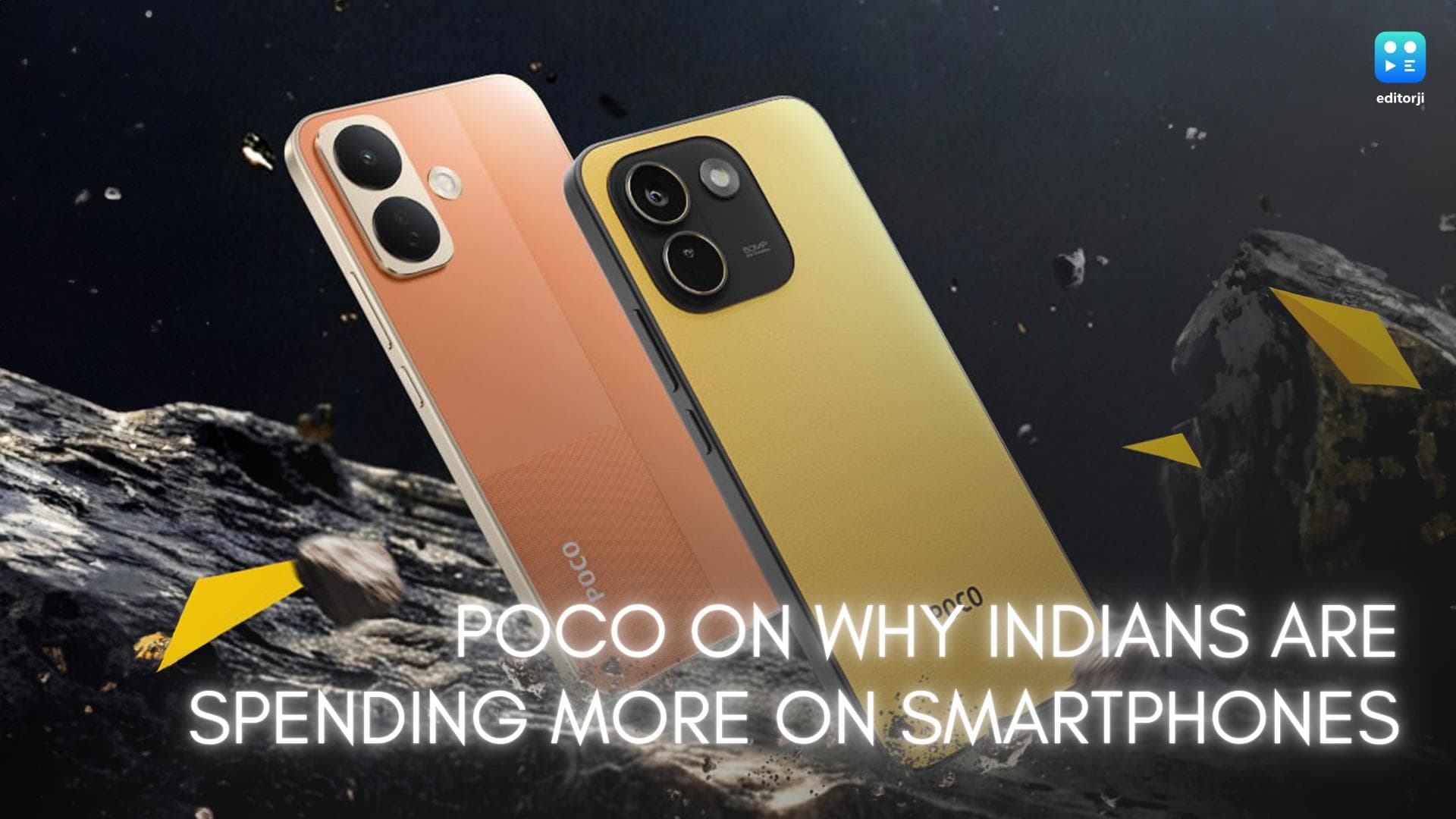
India's smartphone market is going through an unusual transition. Consumers are buying fewer phones, holding onto them longer and increasingly moving towards more expensive devices. For smartphone brands, that means the old playbook of packing the biggest specifications into the lowest possible price is beginning to lose some of its power.
According to IDC, India shipped 33.2 million smartphones in Q2 2026, down 11.1% year-on-year. Yet the average selling price climbed 14.4% to a record $315, helping the overall value of the market grow 1.7%.
For Ken Sekhar, Marketing Head at POCO India, these seemingly contradictory numbers point towards a fundamental change in how Indians think about smartphones.
"The biggest change isn't that consumers have become more price-sensitive. It's that they've become significantly more value-conscious," Sekhar told Editorji.
"A few years ago, value for money largely meant getting the highest specifications at the lowest possible price. Today, consumers evaluate value across the entire ownership journey rather than just the purchase price."
Indians Are Spending More, But Keeping Their Phones Longer
The shift is particularly significant for a company like POCO, which built much of its identity around aggressive specifications and performance-per-rupee.
Sekhar believes consumers are now willing to pay more upfront because smartphones themselves have increasingly become longer-term purchases.
"We're seeing people consciously invest more in smartphones because they plan to use them much longer. The replacement cycle has steadily extended from around two years to nearly four years for many users," he said.
"Once someone decides to keep a device for that long, they're naturally willing to spend more upfront, provided the experience remains consistently fast and reliable over the years."
Market data supports the broader premiumisation trend. While affordable smartphones below ₹15,000 saw shipments decline sharply in Q2, the $400–600 segment grew 60.3% year-on-year. CMR's data also points towards premium smartphones growing 54%, while the ₹50,000–₹1 lakh super-premium category surged 72%.
Financing has helped make that transition possible. More than half of mainline smartphone sales in Q2 involved financing, according to the research, with zero-cost EMIs and trade-ins increasingly replacing straightforward discounts as the mechanism allowing consumers to stretch their budgets.
Performance Is No Longer Just About the Processor
This changing definition of value is also reshaping what "performance" means.
"Performance today is the result of an entire ecosystem rather than a single specification," Sekhar said.
"A powerful processor remains important, but consumers increasingly understand that great real-world performance depends on how well the chipset, RAM, storage, thermal management and software work together."
He argues that buyers are consequently looking beyond processor names and benchmark scores towards storage speeds, sustained gaming performance, heat management and software optimisation.
"Ultimately, nobody buys a phone simply to post benchmark scores," Sekhar said. "They buy it expecting the device to remain smooth after hundreds of charging cycles, multiple software updates and years of everyday use. That's increasingly becoming the true definition of performance."
POCO is also seeing its consumers gravitate towards higher RAM and storage configurations, which Sekhar describes as buyers "future-proofing their purchase" for heavier apps, AI features, gaming and high-resolution content.
Battery, Software and Durability Are Becoming Part of ‘Value’
The same logic increasingly applies to other parts of the smartphone.
"Battery capacity itself has become a hygiene factor," Sekhar said. "Consumers now expect every smartphone to comfortably last an entire day. What increasingly differentiates devices is battery longevity and consistency."
As ownership periods stretch, buyers are increasingly concerned with how batteries age, charging speeds, thermal behaviour and battery management rather than capacity alone.
Software support and durability are following a similar trajectory.
"Software longevity and build quality have moved from being value additions to becoming core purchase considerations," Sekhar said.
"Consumers today don't simply want feature-rich smartphones. They want devices that can keep pace with their lives for years. Long-term ownership experience has become one of the strongest indicators of value."
Rising Component Costs Are Rewriting the Smartphone Equation
All of this is happening while manufacturers face enormous cost pressure.
The memory shortage has hit affordable devices particularly hard. The report estimates that DRAM and NAND inflation has pushed memory's contribution to the bill of materials in some mass-market phones from below 20% to more than 45%.
"The smartphone industry is undoubtedly operating under increased cost pressures today," Sekhar acknowledged, pointing to component prices, memory costs, currency fluctuations and investment in newer technologies.
POCO's response, he says, is to prioritise where that money is spent.
"Rather than chasing every specification, we prioritise the features that matter most to our users, whether that's sustained performance, efficient cooling, battery life, software optimisation or durability."
That may ultimately describe the broader transition taking place in India's smartphone market.
"The conversation has therefore moved from 'How much performance can I buy today?' to 'How well will this phone perform throughout its life?'" Sekhar said.
And with consumers spending more while upgrading less frequently, India's next smartphone battle may not simply be about who offers the most hardware for the money.
As Sekhar puts it, consumers are now "spending more, upgrading less frequently and expecting significantly more from every device they buy."