There’s a very specific moment when you upgrade to a bigger TV. You sit down thinking you’ll just check something quickly, and suddenly two hours have passed. The frame feels wider, details start showing up in places you never noticed before, and content you’ve already watched somehow feels new again.
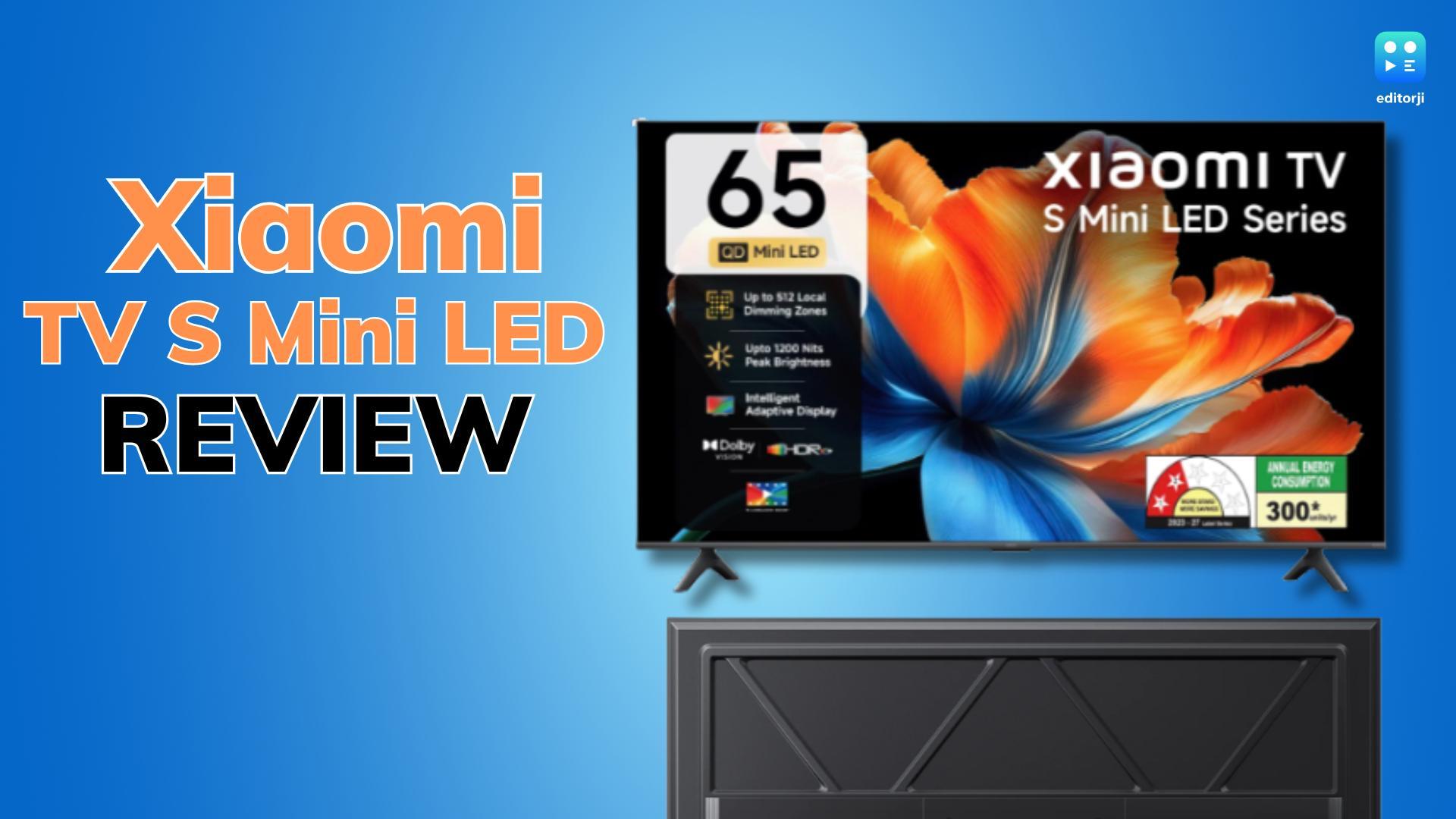
That’s pretty much what happened when I set up the Xiaomi TV S Mini LED 65-inch in my living room.
Part of what makes this TV interesting is where it sits in the market. Pricing starts at ₹51,999 for the 55-inch model, ₹71,999 for the 65-inch, and ₹99,999 for the 75-inch. At that price, you’re usually looking at QLED options, not Mini LED with this kind of hardware.
So the real question is simple... Is it actually any good or just another spec-heavy TV that looks better on paper than in your room? That’s what I wanted to find out.
Xiaomi TV S Mini LED 65-inch Review: Design & Connectivity
The design isn’t trying to win awards, and I think that’s intentional. The bezels are slim enough that they disappear once you start watching something, while the metal frame gives it just enough structure to feel solid without drawing attention to itself.
Yes, the back and stands are plastic, and you do notice that when you’re setting it up. But once it’s in place, it fades into the background completely, which is exactly what you want from something that’s meant to be watched, not admired.
I also appreciated the flexibility with the stand. You can keep it centered if your TV unit is narrow or move the legs outward if you have more space. It’s not something you think about every day, but when you’re setting it up, it makes life easier.
You get three HDMI ports (including one with eARC), USB ports, Ethernet, optical audio out, Bluetooth 5.0, and dual-band Wi-Fi.
In practical terms, that means you can hook up a console, soundbar, and set-top box without juggling cables constantly.
Xiaomi TV S Mini LED 65-inch Review: Display & Picture Quality
On paper, you’re getting a QD-Mini LED panel with a 4K resolution (3840 x 2160), and roughly 384–392 local dimming zones depending on the variant.
That’s one of those specs that doesn’t mean much until you actually see it working.
The difference shows up in contrast, especially in scenes where bright and dark elements exist together. I went back to watching The Batman, mostly because it’s a nightmare for most TVs. Dark scenes, subtle lighting, a lot of shadow detail. On a typical LED panel, blacks tend to look washed out, like the TV can’t fully commit to being dark.
Here, things felt more controlled. Shadows had depth, highlights stayed contained, and the overall image looked more intentional. It’s not OLED-level black, but it gets close enough that you stop thinking about it after a while.
The next day, I switched to an IPL match, and the TV felt like it had completely changed its personality. Bright stadium lights, fast camera pans, and vivid greens all looked lively without feeling exaggerated. That balance is what stood out to me.
HDR content is where this panel really stretches.It supports Dolby Vision, HDR10+, and HLG, and with peak brightness going up to around 1200 nits, highlights feel punchy without becoming overwhelming.
At the same time, the 94% DCI-P3 color gamut helps keep colors rich without tipping into oversaturation, which is something you notice more over time than in the first five minutes.
The panel runs at a native 60Hz but uses DLG and MEMC to push things up to a perceived 120Hz when needed.
In real-world use, that translates to smoother motion during sports and gaming without things looking artificially processed.
I’m not a heavy gamer, but I did plug in a console. The TV supports ALLM, so it automatically switches to low latency mode, and there’s a Game Boost mode that helps with smoother visuals.
It’s not a full high-end gaming display, but for casual use, it feels responsive enough.
There’s also a light sensor built in, and paired with adaptive brightness and color temperature adjustments, the TV subtly changes how it looks based on your room lighting.
During the day, it boosts brightness to stay visible, and at night, it tones things down. It’s not something you actively think about, but after a few days, you realise you haven’t touched the settings at all.
Xiaomi TV S Mini LED 65-inch Review: Audio Performance
You’re getting a 34W quad-speaker setup with Dolby Audio, DTS:X, and DTS Virtual:X support.
For everyday use, it works well. Dialogue is clear, volume is more than enough, and the tuning is decent for casual watching.
But when you switch to movies or live sports, you start wanting more depth. It doesn’t quite deliver that room-filling immersion, which makes a soundbar feel like a natural upgrade.
Xiaomi TV S Mini LED 65-inch Review: Software & Smart Features
The TV runs on Google TV with Xiaomi’s PatchWall layered on top, backed by a quad-core processor, 2GB RAM, and 32GB storage.
In day-to-day use, it feels smooth enough. Apps open quickly, navigation is straightforward, and everything from Netflix to YouTube works as expected.
PatchWall ended up being more useful than I expected, especially for cross-platform content discovery.
Casting is seamless too, with support for Chromecast, AirPlay, and Miracast, so switching between devices feels effortless.
The only limitation is the RAM. For normal use, it’s fine, but if you’re jumping between multiple apps frequently, you might notice the occasional slowdown.
Xiaomi TV S Mini LED 65-inch Review: What I Didn’t Like
There aren’t any major flaws here, but there are a few compromises worth mentioning.
The plastic stand and back panel feel a bit basic during setup. The 2GB RAM can occasionally feel limiting if you’re pushing the system harder than usual. And while the audio is good, it doesn’t quite match the quality of the display.
None of these take away from the core experience, but they do define where the trade-offs are.
Xiaomi TV S Mini LED 65-inch Review: Verdict
The Xiaomi TV S Mini LED 65-inch isn’t trying to reinvent the TV experience. It’s simply trying to deliver a really good one at a price where you’d usually expect more compromises.
And for the most part, it succeeds. You’re getting Mini LED with precise dimming, strong brightness, Dolby Vision support, solid connectivity, and a software experience that mostly stays out of your way.
Yes, there are trade-offs. But when you sit down and start watching, those details fade quickly. And that, more than anything, tells you this TV is doing something right.