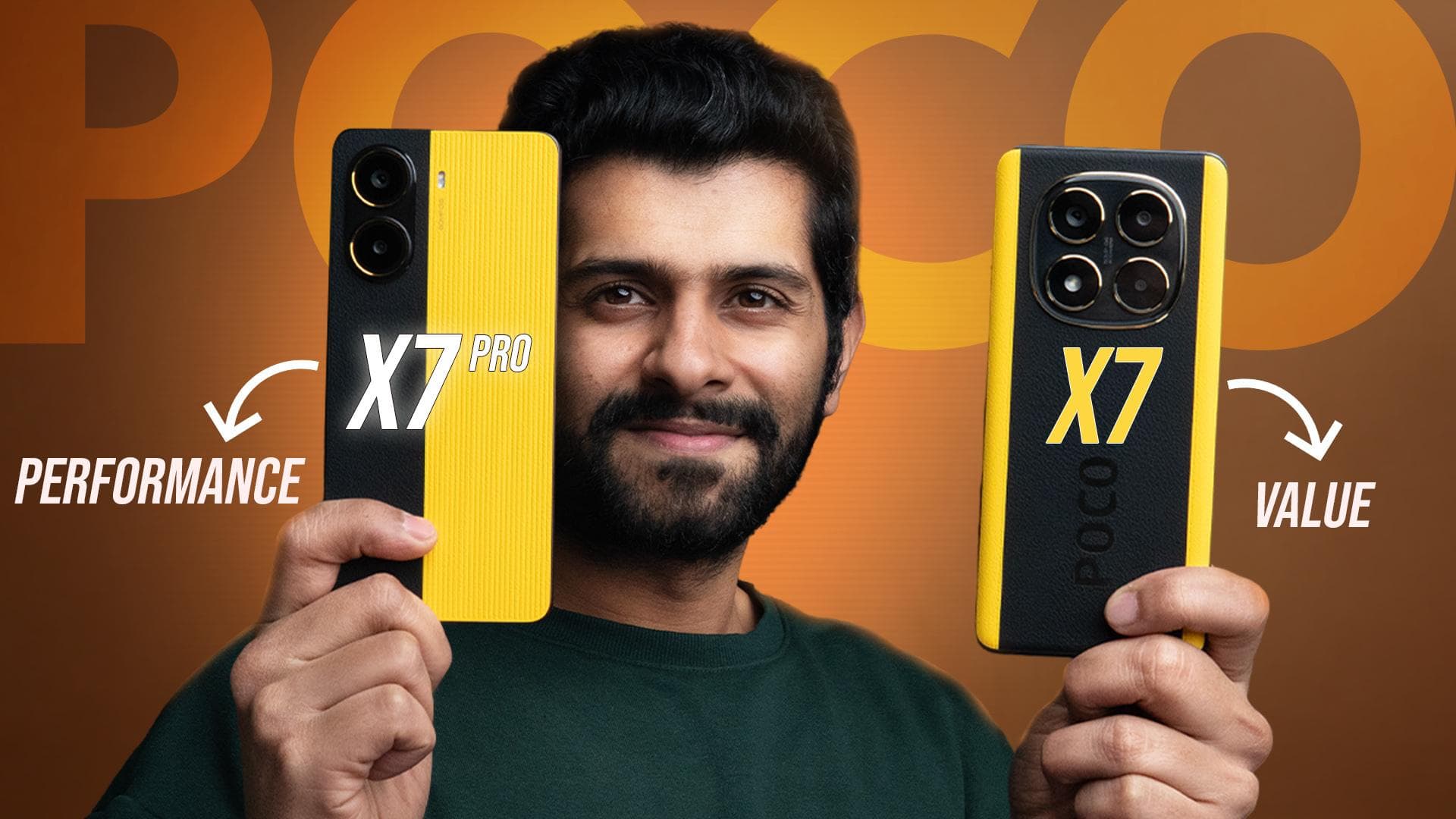
We've got the new Poco X7 series in the house and there's a lot to talk about here.
The X7 Pro succeeds last year’s Poco X6 Pro, which was quite a powerhouse in the ₹20,00-30,000 range. So, can the X7 Pro, with its new Dimensity 8400 Ultra chip, recreate the magic?
And what about the standard X7, does it also hold its ground?
Design
Let’s start with the design because, honestly, it’s interesting to say the least. Usually, phones in the same series have at least some family resemblance, right? But not here! These two phones couldn’t be more different, whether you’re looking at them from the front or the back.
Take the standard X7, for instance. It closely resembles the recently launched Redmi Note 14 Pro. That’s because it’s essentially the same phone, just dressed in Poco’s branding and a different colour scheme.
The X7 Pro, on the other hand, sports a different design language. It is much flatter compared to the X7. Both models feature a vegan leather back with loud yellow-black colour combinations, which is either a love or hate situation for users. You can opt for subtler colours if you like.
If you overlook this big Poco logo, the cheaper X7 actually looks and feels the more premium of the two phones. Its curved front and rear feel great in hand, while the centrally placed camera island looks far better than the Pro’s pill-shaped module.
Additionally, the standard X7 has Gorilla Glass Victus 2 protection for its display, whereas the Pro gets the inferior Gorilla Glass 7i - go figure!
There’s more: the standard X7 includes an extra 2MP macro sensor, which is missing on the Pro model. So, aesthetically, the X7 Pro surprisingly feels less impressive compared to its more affordable sibling.
Thankfully, both phones come with an IP69 rating, which is great to have. The standard model also features an IR blaster and a reliable optical fingerprint reader on both models.
Display
Moving on, the X7 boasts a curved 6.67-inch AMOLED display with a 1.5K resolution and a 120Hz refresh rate. In contrast, the Pro version has a slightly larger 6.73-inch flat panel, which is better suited for gaming. Both panels are Widevine L1 certified and support HDR 10+, ensuring a great viewing experience.
However, the X7 has a warmer tint to its display. Both panels are bright enough for outdoor use, with the Pro model reaching an HBM brightness of 1400 nits and the standard X7 at 1200 nits.
Performance & Software
So, since the standard X7 is essentially a rebranded Redmi Note 14 Pro, it is powered by the Dimensity 7300 Ultra chip. It’s an efficient mid-range chip, scoring over 600,000 on AnTuTu. But despite the "Ultra" in its name, this chip isn’t designed for heavy tasks.
The real star, however, is the brand new Dimensity 8400 Ultra in the Poco X7 Pro. Like its predecessor, it aims to offer flagship-grade performance in the sub-₹30,000 segment. The Antutu and Geekbench scores place it between the Snapdragon 8 Gen 2 and 8 Gen 3 in terms of raw performance, which is fantastic for the price. Please watch the video for benchmark scores.
It glides through BGMI at 60fps in testing without much issue. There was support for 90fps on BGMI at launch, Poco claims it will be added soon.? Heating was non-existent during gaming, although it's worth noting that it was extremely cold in Delhi at the time of my testing.
Anyway, the X7 Pro is generally a snappy phone to use thanks to its UFS 4.0 storage, which means apps load quickly. The standard X7, however, has UFS 2.2 storage and a lower mid-range chip, which results in micro stutters across the UI from time to time.
The software experience on both models is a mixed bag. The X7 Pro runs the latest HyperOS 2 based on Android 15, while the X7 uses the older Android 14-based HyperOS 1.
Both phones come loaded with a ton of preinstalled apps, which makes the app drawer feel quite crowded. On top of that, system app notifications and the Glance lock screen add to the clutter, making the software experience feel less streamlined.
Poco has also added AI features in the Notes and Gallery apps on the X7 Pro. They have potential but could use a little more fine-tuning to deliver their best experience.
Cameras
Now let’s shed some light on the camera capabilities. Both phones feature the same Sony LYT-600 primary sensor and an 8MP ultrawide camera. Interestingly, the standard X7 includes an additional 2MP macro sensor, but it’s irrelevant in everyday use.
Please watch the video for camera samples.
Despite having the same primary sensor, both phones produce very different photos, likely due to different ISPs in the chipsets. The X7’s photos have a softer look and slightly muted colors, while the Pro’s images are sharper but can occasionally feel a bit over-processed.
Videos from the main sensor are suitable for casual social uploads, though they don’t pack a lot of fine detail.
The 8MP ultrawide performs well on both devices, though the color profiles vary between the two.
As for selfies, the 20MP front camera also shows some differences. The X7 takes the lead here, as the X7 Pro sometimes struggles to properly expose the subject’s face.
Battery & Charging
Finally, when it comes to battery and charging, the Poco X7 Pro impresses with its massive 6550mAh battery thanks to cutting-edge Silicon Carbon technology. This allows it to stay impressively slim and light.
A screen time of around 9 hours with mixed to heavy use is easily achievable on this phone. Plus, with 90W fast charging support, recharging doesn’t take much time either.
The standard Poco X7 has a comparatively smaller but still impressive 5500mAh battery. It supports 45W fast charging, which is quite adequate for its segment.
Verdict
Ultimately, neither of these two phones are great camera phones, nor do they offer amazing software. However, the Poco X7 Pro is quite a deal and it is totally worth it to stretch your budget a bit over the standard X7.
The Pro offers a much more powerful chip, UFS 4.0 storage, and a significantly bigger battery compared to the standard X7.
The standard X7 offers great value at a lower price point. It also looks and feels more premium than the Pro model, but that’s about it.
So, if you’re after flagship-grade performance for mid-range money, the X7 Pro is the way to go.