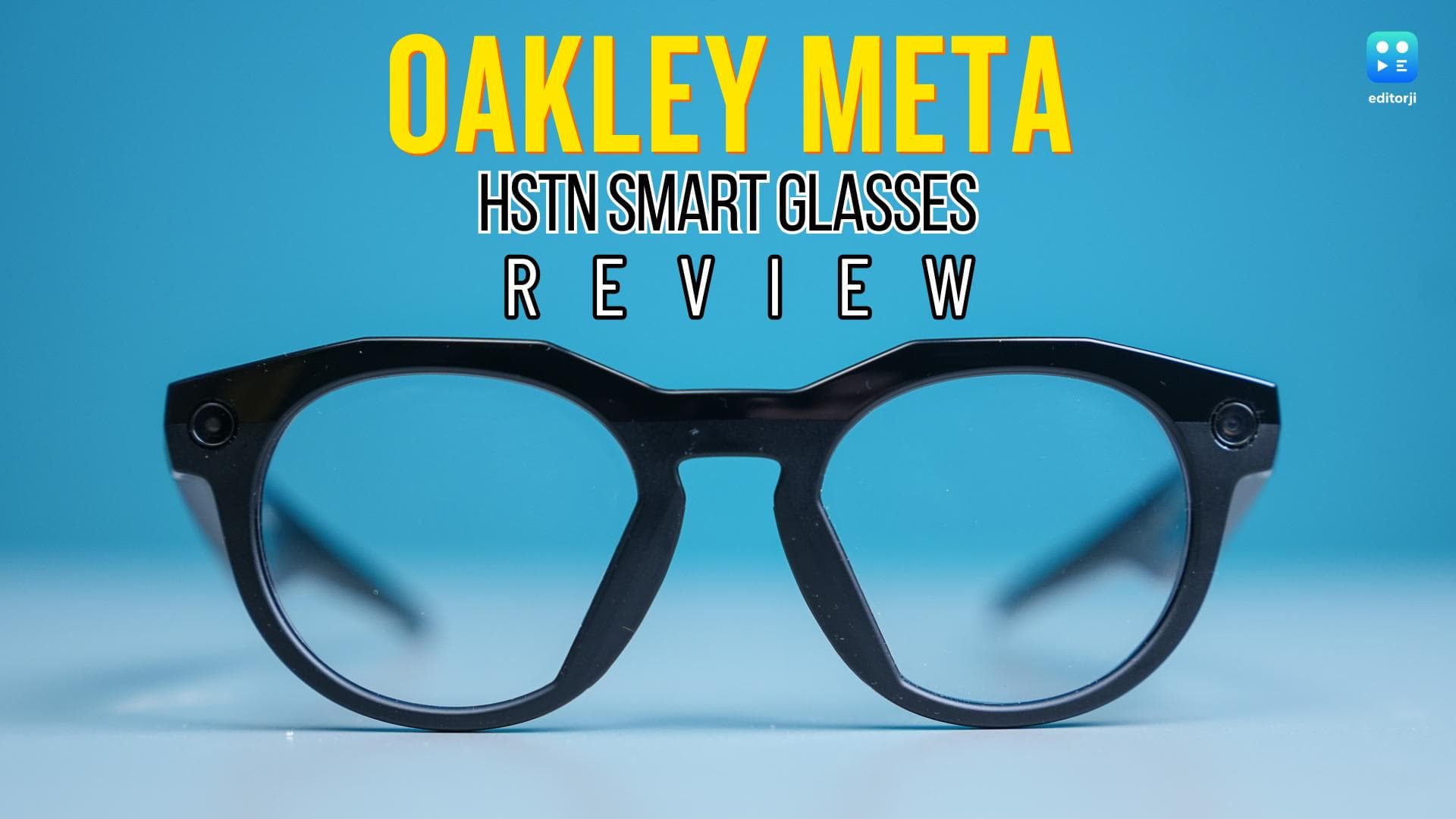
Smart glasses have promised the future for a long time, but they have rarely earned a permanent spot in daily life. Meta’s latest push into eyewear, supported by its long-term partnership with EssilorLuxottica, makes it clear this is no longer a side project.
With the Oakley Meta HSTN arriving in India at ₹41,800, the discussion changes. This is less about whether smart glasses actually work and more about whether they fit into everyday tech habits, especially in a market that cares deeply about both price and how things look.
By blending Meta’s AI features with Oakley’s performance-driven design, the HSTN suggests a future where smart glasses are worn all day, not just pulled out to show off.
Oakley Meta HSTN Smart Glasses: Are they comfy?
The Oakley Meta HSTN comes in multiple frame and lens options, which makes sense because these aren’t glasses you wear once in a while. They’re designed to stay on your face for most of the day.
You get PRIZM Polar lenses for outdoor use, transition lenses for mixed lighting, and clear lenses if you want the most low-key look possible. I used the version with transition lenses, and they’re easily the most practical. Indoors, they behave like regular glasses. Step outside and they darken just enough to stay comfortable. Not full sunglasses-dark, but enough that you’re not squinting your way through the day.
For the most part, people assumed these were normal glasses. That illusion only broke when they noticed the camera lens or saw the LED blink while recording.
Fit is where Oakley’s sports DNA really shows. The glasses sit snug and don’t wobble. I used them on the treadmill and during workouts with plenty of movement, including burpees, which I regret doing but respect for testing purposes. The glasses stayed firmly in place the entire time, which is exactly what you want from something aimed at active users.
Long-term comfort is a bit more mixed. The straight, narrow temple arms help with stability, but after a few hours they’re not as forgiving as the curved arms on the Ray-Ban Meta glasses. Some rubber padding at the tips would have made a noticeable difference.
The glasses themselves are IPX4 rated, so sweat, light rain, and the occasional splash aren’t an issue. You can work out, run outdoors, or get caught in a drizzle without stressing. The charging case, however, doesn’t offer any water protection. For a product clearly aimed at sports and fitness users, that feels like a missed opportunity.
Oakley Meta HSTN: Sound, Calls, and the Camera You Actually Use
Audio turned out to be one of the quiet highlights of the Oakley Meta HSTN. It’s not flashy, but it’s genuinely useful. The open-ear speakers let you listen to music or podcasts without cutting you off from the world around you.
This makes a big difference during everyday use. Walking on busy roads, commuting, or working out, you can still hear traffic, conversations, or someone trying to get your attention. Your music stays in the background instead of taking over. Once you get used to it, regular earbuds start to feel a bit antisocial.
Calls are handled well too. The five-mic setup, spread across the arms and near the nose pad, does a solid job of isolating your voice. Even while moving or dealing with wind, calls stayed clear. No awkward “can you hear me now?” moments, which is more than I can say for some wearables.
The camera is where these glasses start to feel genuinely different from most gadgets. It shines in situations where using your phone feels like extra effort. Crowded streets, quick errands, or moments where your hands are already full. You see something, tap the glasses, and you’re done.
The jump to 3K video sounds bigger than it looks. The footage itself doesn’t suddenly become dramatic or cinematic. What you do notice is better stabilisation. Videos stay steady even when you’re walking or moving around, which makes them far more watchable later.
This is not an action camera replacement, and it doesn’t try to be. The quality works well for quick clips, short videos, and casual sharing. Taking photos or recording video is simple. Press the button or use voice commands. A white LED lights up to show recording is active. It won’t silence every privacy concern, but it’s a visible reminder that the camera is on.
Over time, I found myself using the camera for very ordinary things. A quick clip in the kitchen. Snapping a photo while shopping with both hands full. Capturing something mid-walk that I’d usually forget about five minutes later. The glasses remove just enough friction to make those moments feel worth recording.
That’s where the Oakley Meta HSTN makes the most sense. It’s not chasing cinematic shots or trying to replace your phone. It’s about making it easier to capture everyday moments without breaking your flow. And once that habit sets in, it’s surprisingly hard to unlearn.
Oakley Meta HSTN: Talking to Your Glasses (And When It Actually Helps)
Meta AI works best when you don’t treat it like a serious tool. The moment you stop trying to “test” it and start using it casually, it clicks. You say “Hey Meta” and ask simple things. Weather before stepping out. A nearby café. Something random because you’re killing time on a walk. Most of the time, it does what you expect.
Things get more interesting once you involve the camera. Standing outside a metro station, I asked what I was looking at. The first answer was broad and slightly lazy. I followed up with another question, and it got sharper. That’s how Meta AI tends to behave. It often needs a second push, but once it understands what you want, it becomes genuinely useful.
I tried this again while walking through a park, asking about trees and plants around me. As far as I could tell, it got most of them right. It even went on to explain basic plant care, which I didn’t ask for but didn’t hate either. It’s not something I would ever bother typing into Google, but saying it out loud felt oddly natural.
That said, the AI still has its limits. Ask too many questions back-to-back and it can lose track of the conversation. One minute it’s doing a decent job as a tour guide, the next it forgets what you were talking about entirely. Rephrasing usually helps. The best way to think about it is not as an expert, but as a smart friend who occasionally zones out.
At home, I asked Meta what I was looking at while the TV was on. It correctly identified that I was watching a video game trailer on YouTube, but guessed the wrong game. Close enough to be impressive, wrong enough to remind me not to trust it blindly. That balance comes up often.
All of this is handled through the Meta AI app, which works on both Android and iPhone. If you’ve used Ray-Ban Meta glasses before, the layout will feel familiar. You can manage photos and videos, adjust settings, and connect services like Spotify, Apple Music, Strava, Garmin, and Audible. You can also add multiple glasses to the same app, which is handy if you’re already in deep.
There’s support for Be My Eyes as well, which allows people with low vision to connect with volunteers for help with everyday tasks. It’s not something you’ll use daily, but it’s one of the more thoughtful features here.
The app itself is mostly easy to use, though not without flaws. Some settings are buried deeper than they should be, and the gallery could have been easier to reach. I also ran into a crash or two while poking around the AI settings. Nothing serious, just reminders that this whole experience is still being refined.
Oakley Meta HSTN: How Long They Actually Last
Battery life on the Oakley Meta HSTN is decent, but you do need to plan around it. If you use the glasses the way they’re meant to be used—taking photos, recording videos, listening to music, and chatting with Meta AI—you’re not getting through a full day on a single charge. By the time evening rolls around, the charging case becomes part of the routine.
The good news is that this is still an improvement over the first-generation Ray-Ban Meta glasses. Meta claims up to 8 hours of use on the glasses themselves and up to 48 hours with the charging case. In real-world use, I saw closer to 6 hours on a single charge and roughly 40 hours when using the case. It’s not the big leap Meta advertises, but it’s a clear step forward compared to the Ray-Bans, which topped out at around 36 hours with their case.
Fast charging helps smooth things out. Pop the glasses into the case for about 20 minutes and you get roughly half the battery back. It’s the kind of feature you don’t think about until the day you forget to charge them, and suddenly it feels essential.
The one setting worth being careful with is 3K video. While it sounds like a major upgrade, it doesn’t noticeably improve how your videos look. What it does do is drain the battery faster. Unless you really need it, sticking to 1080p makes more sense. You’ll get similar-looking footage and noticeably better battery life.
Oakley Meta HSTN: The India Verdict
The Oakley Meta HSTN doesn’t suddenly turn smart glasses into an essential purchase, but it gets closer than Meta ever has before. With a starting price of ₹41,800, this is clearly not aimed at everyone, especially in a market like India where price matters just as much as features. You do need to be aware of battery limits, and Meta AI still has its off days. This is very much a product that’s growing into itself.
That said, when everything clicks, the experience is genuinely satisfying. The audio feels natural and useful, the camera turns out to be far more practical than expected, and the hands-free nature of it all slowly changes how often you bother pulling out your phone. Add Oakley’s snug fit and performance-first design, and these glasses start feeling like something you can actually live with, not just test and put away.
The Oakley Meta HSTN isn’t trying to replace your phone, smartwatch, or action camera. It’s meant to sit quietly alongside them and take care of small, everyday moments with less effort. If you’re curious about where smart glasses are headed and don’t mind paying early-adopter prices, this is the strongest case Meta has made so far. If not, it still offers a clear and convincing preview of what this category could become in the next few years.