Highlights

  • NASA's Webb Telescope detects signs of water
  • Cloud and haze also detected on WASP-96 b
  • WASP-96 b 1000 light years away from Earth

Latest news

Delhi court orders framing of charges against Cong MP Karti Chidambaram in Chinese visa scam case

Delhi court orders framing of charges against Cong MP Karti Chidambaram in Chinese visa scam case

London-Hyderabad British Airways flight gets bomb threat, lands safely

London-Hyderabad British Airways flight gets bomb threat, lands safely

US lawmakers condemn killing of Hindu man in Bangladesh

US lawmakers condemn killing of Hindu man in Bangladesh

Messi event fiasco: Calcutta HC refuses to interfere in SIT probe

Messi event fiasco: Calcutta HC refuses to interfere in SIT probe

USISPF welcomes SHANTI Act, calls it turning point for India's energy sector

USISPF welcomes SHANTI Act, calls it turning point for India's energy sector

UP CM Adityanath urges citizens to help needy as UP steps up measures against cold wave

UP CM Adityanath urges citizens to help needy as UP steps up measures against cold wave

BJP committed to fulfil Charan Singh's ideals: UP CM Adityanath on Kisan Diwas

BJP committed to fulfil Charan Singh's ideals: UP CM Adityanath on Kisan Diwas

BJP proposing elimination of Indian Constitution: Rahul Gandhi in Berlin

BJP proposing elimination of Indian Constitution: Rahul Gandhi in Berlin

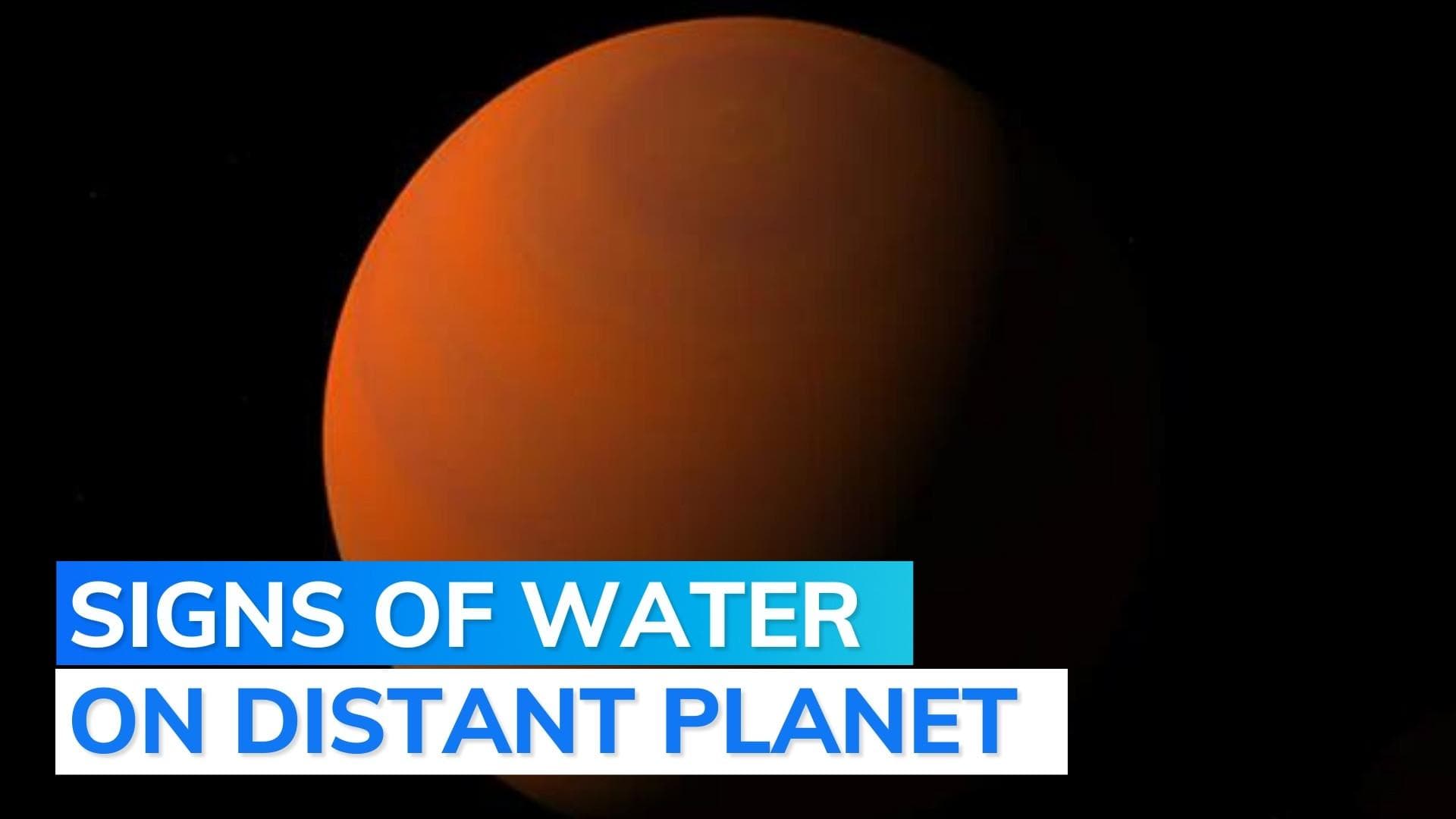
NASA's Webb Telescope detects water on a planet over 1,000 light years away

WASP-96 b orbits extremely close to its Sun-like star, just one-ninth of the distance between Mercury and the Sun, completing one circuit every three-and-a-half Earth-days, according to NASA.

NASA's Webb Telescope detects water on a planet over 1,000 light years away

NASA's James Webb Space Telescope has detected signs of water, along with evidence for clouds and haze, in the atmosphere of a hot, puffy gas giant planet orbiting a Sun-like star over a thousand light years away, the US space agency said on Wednesday.

The observation is the most detailed of its kind to date, demonstrating Webb's unprecedented ability to analyse distant atmospheres, according to NASA. WASP-96 b is one of more than 5,000 confirmed exoplanets in the Milky Way.

Located roughly 1,150 light-years away in the southern-sky constellation Phoenix, it represents a type of gas giant that has no direct analogue in our solar system, it said in a statement.

With a mass less than half that of Jupiter and a diameter 1.2 times greater, WASP-96 b is much puffier than any planet orbiting our Sun. With a temperature greater than 538 degrees Celsius, it is significantly hotter.

WASP-96 b orbits extremely close to its Sun-like star, just one-ninth of the distance between Mercury and the Sun, completing one circuit every three-and-a-half Earth-days, according to NASA.

The combination of large size, short orbital period, puffy atmosphere, and lack of contaminating light from objects nearby in the sky makes WASP-96 b an ideal target for atmospheric observations.

While the Hubble Space Telescope has analysed numerous exoplanet atmospheres over the past two decades, capturing the first clear detection of water in 2013, Webb's immediate and more detailed observation marks a giant leap forward in the quest to characterise potentially habitable planets beyond Earth.

On June 21, Webb's Near-Infrared Imager and Slitless Spectrograph (NIRISS) measured light from the WASP-96 system for 6.4 hours as the planet moved across the star.

This resulted in a light curve showing the overall dimming of starlight during the transit, and a transmission spectrum revealing the brightness change of individual wavelengths of infrared light between 0.6 and 2.8 microns.

The light curve confirmed properties of the planet that had already been determined from other observations - the existence, size, and orbit of the planet.

The transmission spectrum revealed the previously hidden details of the atmosphere: the unambiguous signature of water, indications of haze, and evidence of clouds that were thought not to exist based on prior observations.

A transmission spectrum is made by comparing starlight filtered through a planet's atmosphere as it moves across the star to the unfiltered starlight detected when the planet is beside the star.

Researchers are able to detect and measure the abundances of key gases in a planet's atmosphere based on the absorption pattern - the locations and heights of peaks on the graph.

In the same way that people have distinctive fingerprints and DNA sequences, atoms and molecules have characteristic patterns of wavelengths that they absorb.

The spectrum of WASP-96 b is not only the most detailed near-infrared transmission spectrum of an exoplanet atmosphere captured to date, but it also covers a remarkably wide range of wavelengths, including visible red light and a portion of the spectrum that has not previously been accessible from other telescopes, NASA said.

This part of the spectrum is particularly sensitive to water as well as other key molecules like oxygen, methane, and carbon dioxide.

Also watch: Dying stars to galatic interactions: NASA releases more images from James Webb Telescope

Researchers will be able to use the spectrum to measure the amount of water vapour in the atmosphere, constrain the abundance of various elements like carbon and oxygen, and estimate the temperature of the atmosphere with depth.

They can then use this information to make inferences about the overall make-up of the planet, as well as how, when, and where it formed.

ADVERTISEMENT

Up Next

NASA's Webb Telescope detects water on a planet over 1,000 light years away

NASA's Webb Telescope detects water on a planet over 1,000 light years away

Trump repeats claim he stopped potential nuclear war between India and Pakistan

Trump repeats claim he stopped potential nuclear war between India and Pakistan

Bangladeshi journalists say right to life at stake as mobs target media

Bangladeshi journalists say right to life at stake as mobs target media

UN voices concern over violence in Bangladesh, including lynching of Hindu man

UN voices concern over violence in Bangladesh, including lynching of Hindu man

Vetting being conducted globally for all applicants of all nationalities for H1-B, H-4 visas: US Embassy

Vetting being conducted globally for all applicants of all nationalities for H1-B, H-4 visas: US Embassy

New Zealand Foreign Minister criticizes India–New Zealand FTA as an unfair deal

New Zealand Foreign Minister criticizes India–New Zealand FTA as an unfair deal

ADVERTISEMENT

editorji-whatsApp

More videos

 After Hadi, another Bangladesh student leader shot in head

After Hadi, another Bangladesh student leader shot in head

Alleged Bondi shooters conducted 'tactical' training in countryside, Australian police say

Alleged Bondi shooters conducted 'tactical' training in countryside, Australian police say

Putin hails Ukraine gains, threatens more, in annual press conference

Putin hails Ukraine gains, threatens more, in annual press conference

Pakistan accuses India of attempting to undermine Indus treaty

Pakistan accuses India of attempting to undermine Indus treaty

Bangladesh interim government condemns violence amid nationwide unrest

Bangladesh interim government condemns violence amid nationwide unrest

Arsonists target Bangladesh newspapers after student leader's death

Arsonists target Bangladesh newspapers after student leader's death

US Democrats release Epstein photos showing Bill Gates, Noam Chomsky

US Democrats release Epstein photos showing Bill Gates, Noam Chomsky

PM Modi departs for Oman on last leg of three-nation visit

PM Modi departs for Oman on last leg of three-nation visit

India closes visa application centre in Bangladesh capital due to security situation

India closes visa application centre in Bangladesh capital due to security situation

Pakistan to sell 100 pc stake in PIA after bidders demand complete control post-privatisation

Pakistan to sell 100 pc stake in PIA after bidders demand complete control post-privatisation

Editorji Technologies Pvt. Ltd. © 2022 All Rights Reserved.