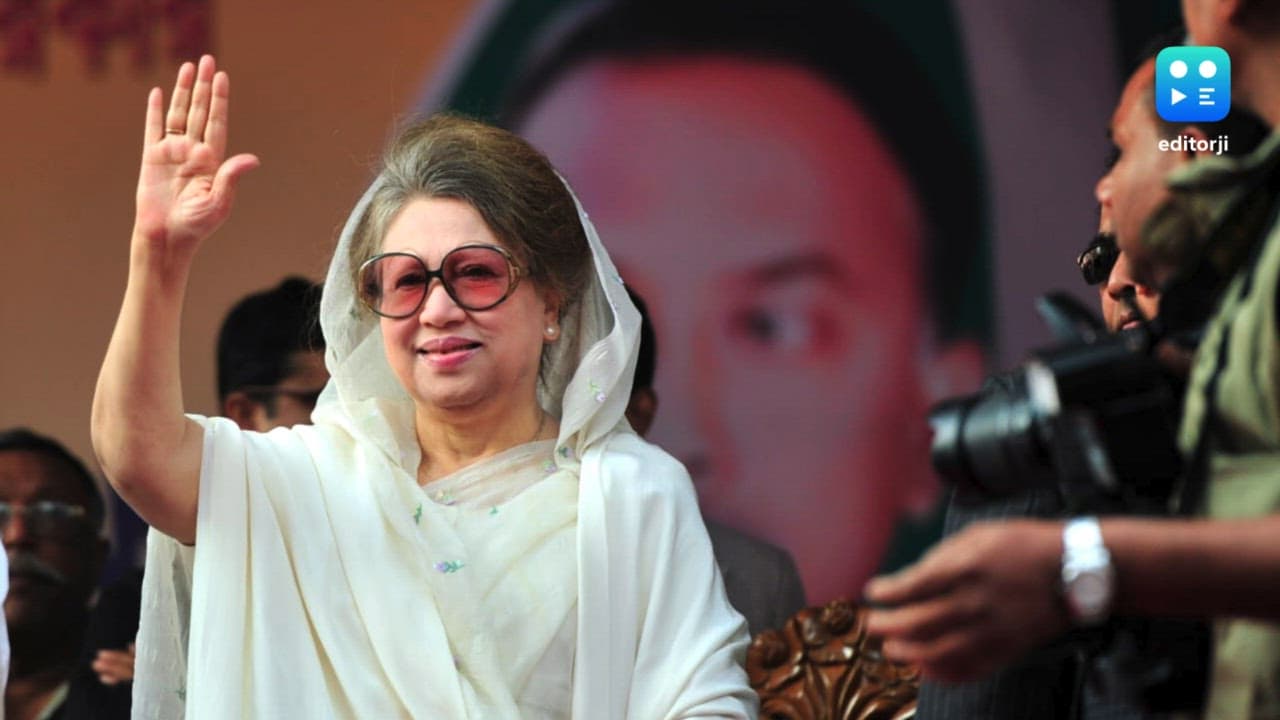
Khaleda Zia, the first woman prime minister of Bangladesh and the second in the Muslim world, dominated the country's politics for decades alongside her arch-rival Sheikh Hasina.
Zia, the longtime chief of the Bangladesh Nationalist Party (BNP) and a three-time prime minister, died early Tuesday in Dhaka after a prolonged illness. She was 80.
She is admired by her supporters for her role in restoring democracy in the country following military or quasi-military rule since 1975.
Zia largely dominated Bangladesh's politics in the 1990s as well as in the early 2000s.
Her political journey, spanning over four decades, was one of tremendous highs and lows: from leading a major party and governing the country to being convicted on corruption charges and later receiving a presidential pardon.
Zia's rise as a public figure is widely viewed as accidental. A decade after becoming a widow at the age of 35, she assumed the role of prime minister, but her entry into politics was not planned.
She was largely unfamiliar with the political world until she was seemingly dragged into it following the assassination of her husband, President Ziaur Rahman, a military strongman turned politician, in an abortive army coup on May 30, 1981.
Before this, she was merely regarded as the wife of a general and later the First Lady.
However, she quickly made her mark as the top leader of the BNP, the party her husband had founded in 1978.
She was enrolled as a primary member on January 3, 1982. By March of the following year, she became the party's vice president, and in May 1984, BNP's Chairperson — a position she held until her death.
Her main rival throughout this period was Sheikh Hasina, the chief of the Awami League.
After the 1982 military coup by the then Army chief Gen HM Ershad, Zia initiated a movement for restoring democracy.
In 1986, Ershad announced a presidential election amid simultaneous campaigns by Zia's BNP-led alliance and Hasina's Awami League-led 15-party coalition.
Both alliances initially decided to boycott the polls, but the Awami League, along with the Communist Party and other parties, eventually participated.
Zia's alliance stuck to the boycott, and Ershad placed Hasina under house arrest before the widely believed rigged March election, securing his position as president as a nominee of the Jatiya Party.
"Her (Zia’s) popularity soared after she boycotted the polls in 1986,” wrote Professor Howher Rizvi, who later became international affairs adviser of Hasina's government.
After the fall of the Ershad regime in December 1990, a caretaker government headed by Chief Justice Shahabuddin Ahmed conducted the elections in February 1991.
BNP emerged as the party with majority to the surprise of many who believed the Awami League would win the polls.
The new parliament amended the constitution, switching to a parliamentary system from a presidential form of government, and Zia became the first woman prime minister in Bangladesh and second in the Muslim world after Pakistan's Benazir Bhutto.
BNP was re-elected to power in 1996, but the government lasted only 12 days as the Awami League staged vigorous street campaigns.
Zia’s government quit after introducing the caretaker government system.
Though BNP lost the fresh election in June 1996, the party won 116 seats, becoming the largest opposition in the country's history.
In 1999, Zia formed a four-party coalition and launched agitations protesting the then-ruling Awami League government.
She was re-elected in 2001.
In 2006, she stepped down from office, passing power to a caretaker administration.
In September 2007, she was arrested on what her party claimed were “baseless charges of corruption”.
Zia's electoral popularity can be gauged by the fact that she never lost in any constituency.
"She was elected in five separate parliamentary constituencies in the elections of 1991, 1996 and 2001, while in 2008, she won in all three constituencies from where she contested,” a BNP leader said.
Zia was born on August 15, 1946, to Taiyaba and Iskandar Majumdar in Dinajpur district in undivided India.
Her father migrated from Jalpaiguri, where the family ran a tea business, to what was East Pakistan after the partition.
In 1960, she married Army Captain Ziaur Rahman, who became the president of Bangladesh.
When Zia became BNP's chief in 1983, many of its leaders and supporters were uncertain about the new chairperson.
Additionally, the party's ousting during the 1982 coup had left the BNP in a state of political wilderness.
She, however, consolidated the party and led it in waging a protracted campaign against the Ershad regime alongside the Awami League.
Ahead of the 2008 polls, Zia claimed to be self-educated in the affidavit attached to her nomination paper.
The BNP website, however, mentions that she studied at Dinajpur Government Girls' School and Surendra Nath College.
Zia spent her last 15 years as a major opposition leader fighting what her party described as the 'autocratic' Hasina regime and also the corruption charges against her.
On February 8, 2018, she was sentenced to five years in jail in the Zia Orphanage Trust case and later received a seven-year sentence in the Zia Charitable Trust case.
In 2024, a day after Hasina was ousted from power, Zia was granted a presidential pardon and released.
The following day, she returned to politics with a massive rally, breathing new life into the BNP despite her ailing health.
During Zia’s first term as prime minister from 1991 to 1996, relations with India were a mix of normal diplomacy and tensions, particularly over water sharing of the Ganges and cross-border insurgencies.
Her government adopted a "Look East" policy, signalling a strategic alignment with China and Islamic countries rather than India.
But her second tenure saw a very low ebb in bilateral ties that largely stalled connectivity and trade expansion, while New Delhi expressed strong concern over militant groups operating from Bangladesh and cross-border infiltration.
Zia, however, visited India twice as the Prime Minister in 1992 and 2006 and once as the opposition leader in 2012 at the invitation of the Indian government.
Her 2006 state visit yielded agreements on trade and security, and her 2012 visit as the opposition leader was aimed at rebuilding BNP ties with New Delhi.
Her son and heir-apparent, Tarique Rahman, who is currently BNP's acting chairman, recently returned home after living in London in self exile since 2008.
Her other son, Arafat Rahman, died of a cardiac arrest in 2015.
BNP Secretary General Mirza Fakhrul Islam Alamgir recently dubbed Zia as the 'Mother of Democracy'.