Over the past few years, Vivo has been on a serious roll with its X-series phones. Devices like the Vivo X300 and X300 Pro came across as polished, dependable flagships when I tested them, combining strong cameras, solid day-to-day performance, and battery life that comfortably survived heavy usage. That formula has clearly carried over to the Vivo X300 FE as well. On paper, it promises the same premium X-series experience, but in a package that is supposed to feel slightly more accessible.
The problem is, the pricing places the X300 FE in a slightly confusing position. Starting at ₹70,000 for the base 12GB+256GB unit, the X300 FE lands dangerously close to the standard X300, while also competing against the newer X200T, which is still very fresh in the market.
After using the X300 FE for around 10 days, I think I finally understand exactly where this phone fits into Vivo’s lineup.
Vivo X300 FE: Pricing and availability
The Vivo X300 FE is priced at ₹79,999 for the 12GB RAM and 256GB storage variant. If you need more storage, the 12GB RAM and 512GB version sits higher in the lineup at ₹89,999.
Vivo is also selling the telephoto extender kit separately for ₹15,999, while the additional accessory bundle costs another ₹3,999. If you pick up the complete photography setup along with the 12GB + 256GB variant, the total comes to ₹95,997 after a ₹4,000 discount on the bundle.
The Vivo X300 FE will officially go on sale starting 14th May 2026.
Vivo X300 FE Review: Design and build quality
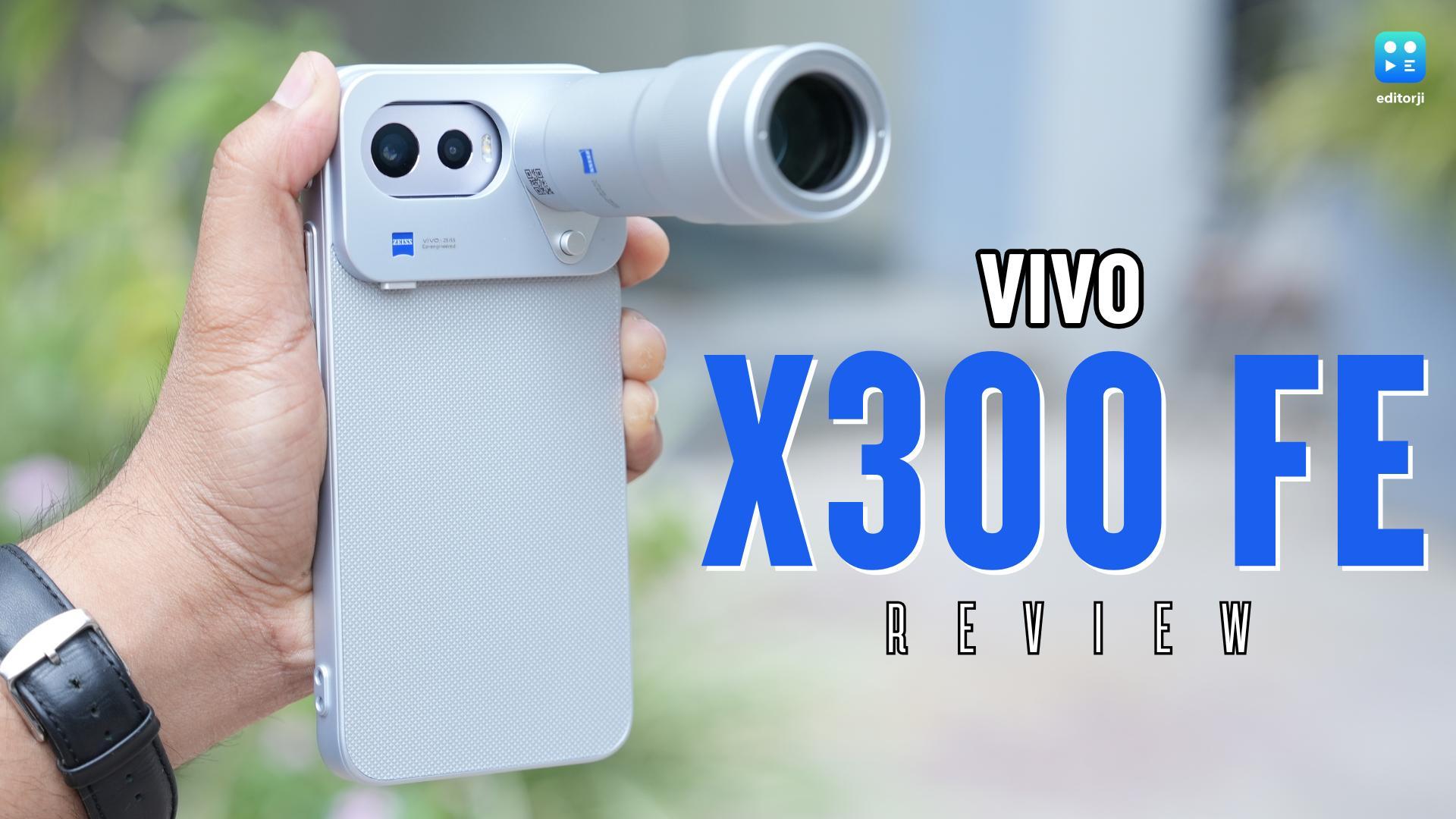
Vivo has played it fairly safe with the design language of its recent X-series phones, especially around the cameras. That changes with the X300 FE. The moment I picked it up, the biggest difference was impossible to miss. Instead of the oversized circular camera setup seen on the X300 Pro and Ultra, Vivo has switched to a much slimmer pill-shaped module that stretches horizontally across the back. It looks cleaner, more modern, and honestly, far less aggressive. The ZEISS branding, flash, and triple-camera setup are tucked neatly into the module without making the rear panel feel cluttered.
More importantly, the slimmer camera housing changes how the phone feels during actual use. The X300 FE does not have that heavy-top sensation some flagship camera phones suffer from. Compared to the regular X300, the balance feels better distributed, which made the phone noticeably more comfortable during long usage sessions.
Despite the redesign, Vivo has not cut corners elsewhere. The X300 FE still feels every bit like a premium flagship. The aluminium frame keeps the chassis rigid, while the matte glass finish on the rear adds grip and resists smudges surprisingly well. At 191 grams and just under 8mm thick, the phone manages to feel sleek without becoming fragile or overly thin.
I also liked the size. The 6.31-inch display sits in a sweet spot where the phone feels manageable without looking small. Reaching across the screen never felt awkward, and one-handed use was far easier than on most modern flagships.
The Lilac Purple finish on my unit gives the phone a younger, more playful vibe, though Vivo also offers subtler Urban Olive and Noir Black variants. Around the front, the slim bezels and flat panel help keep the design sharp and symmetrical. Vivo has also packed in almost every modern connectivity feature you would expect, including Wi-Fi 7, Bluetooth 6.0, NFC, eSIM support, an IR blaster, and USB Type-C.
Vivo X300 FE Review: Display and audio
The display on the Vivo X300 FE ended up surprising me more than I expected. On paper, the specs already look solid, but once I started using the phone daily, it became clear that Vivo has tuned this panel really well. The device comes with a 6.31-inch AMOLED display featuring a 120Hz refresh rate and a resolution of 2640x1216 or about 1.5K. At 460PPI, it's noticeably sharp. Text looks cleaner, fine details stand out more, and high-resolution videos simply feel more refined.
What I appreciated most, though, was the colour reproduction. Vivo’s ZEISS Master Color Display tuning avoids the usual trap of making everything look unnaturally vibrant. Instead, colours appear more controlled and realistic. Skin tones look accurate, HDR videos feel balanced, and photos do not get that exaggerated contrast-heavy treatment many AMOLED panels tend to push.
The panel also supports the P3 wide colour gamut along with HDR10+ playback on streaming platforms like Netflix, so movies and shows look punchy without feeling overprocessed. Vivo has also included 2160Hz high-frequency PWM dimming, which genuinely helps during late-night usage. I noticed far less eye fatigue during long scrolling sessions in dim environments.
Brightness has been excellent too. In regular outdoor conditions, the panel comfortably pushes close to 1800 nits in high brightness mode, which kept visibility perfectly manageable even under aggressive sunlight. HDR highlights can climb all the way up to 5000 nits, allowing bright scenes and reflections in supported content to pop without affecting the darker areas of the image.
The LTPO technology dynamically adjusts the refresh rate depending on what you are doing, which helps balance smoothness and battery efficiency nicely. Vivo has also equipped the phone with an ultrasonic in-display fingerprint scanner, and throughout my usage, it remained consistently fast and accurate.
As for audio, the stereo speakers are clean and sufficiently loud for videos, gaming, and casual content consumption. They do not have the deep, room-filling sound signature of the X300 Pro, but for a phone this size, the speaker setup still performs well.
Vivo X300 FE Review: Cameras
Cameras have consistently been one of Vivo’s biggest strengths, especially across the X-series lineup, and the X300 FE definitely feels like it belongs in that family. After using the phone extensively, I came away feeling that Vivo has focused less on flashy tricks and more on building a camera system that feels dependable across different situations.
The hardware itself is interesting. The phone packs a 50MP Sony IMX921 primary sensor, paired with a 50MP Sony IMX882 telephoto camera and an 8MP ultrawide shooter. At first glance, the ultrawide sensor does feel slightly underwhelming on paper, especially when the rest of the setup looks considerably more premium. But once I started using the cameras properly, the overall tuning and consistency mattered far more than the raw numbers.
The main camera is easily the backbone of the experience. Vivo’s ZEISS partnership continues to pay off here because the image processing feels restrained in a good way. Instead of pushing unrealistic saturation or over-sharpening everything, the X300 FE focuses on cleaner, more natural-looking results. In daylight, the phone is incredibly reliable. Photos consistently came out detailed, exposure handling was balanced, and highlights were controlled nicely without crushing darker areas of the frame. It is the kind of camera setup where you can quickly pull out the phone, tap the shutter, and trust that the shot will look good.
The telephoto camera ended up being my favourite part of the entire setup. The 50MP IMX882 sensor paired with OIS gives the X300 FE far more flexibility than most phones in this category. Vivo’s AI True Clarity Engine also plays a role here, helping preserve details when zooming into distant subjects. Whether I was shooting buildings, street scenes, or random details far away, the phone retained a surprising amount of clarity without making images look artificially processed.
I also tried Vivo’s Telephoto Extender Gen 2 kit, and honestly, it is more useful than I expected it to be. The attachment extends the focal length to roughly 200mm, allowing you to capture distant subjects with noticeably better reach. More importantly, it does not simply magnify the image digitally. Details in structures, signs, and textures remain much cleaner and more readable compared to standard zoom crops. The overall image quality still holds together surprisingly well at longer distances, which makes the setup genuinely fun to experiment with.
The ultrawide camera is clearly the weakest sensor in the system, but it is not unusable by any means. The 8MP sensor cannot match the sharpness or dynamic range of the main and telephoto cameras, though for casual landscape shots, group photos, or social media uploads, it still performs adequately.
Low-light photography is another area where the X300 FE performs confidently. The primary sensor manages highlights well while still retaining shadow details, which helps photos look cleaner and more natural at night. Noise control is decent too, and Vivo avoids going overboard with aggressive night processing.
Portraits are especially strong here. Vivo includes ZEISS multifocal portrait options ranging from 23mm all the way to 100mm, and that flexibility genuinely changes how you can frame your shots. Some focal lengths work better for environmental portraits, while others create tighter, more dramatic compositions. It makes the camera system feel more versatile rather than locked into one particular look.
Video capabilities are equally comprehensive. The X300 FE supports 4K recording at 60fps, along with 4K at 120fps and even 8K at 30fps for users who want extra flexibility while shooting. Stabilisation is solid, and the phone feels perfectly capable for casual content creation or vlogging.
On the front, Vivo has added a 50MP selfie camera with autofocus support, which is always a major plus. Selfies look sharp, skin tones remain natural, and autofocus helps keep things consistently crisp during both photos and video calls.
After spending time with the X300 FE, I think Vivo has delivered a camera system that feels balanced and mature. The ultrawide camera may not be class-leading, but the combination of a strong main sensor, an excellent telephoto camera, reliable image processing, and ZEISS-backed tuning makes this one of the more enjoyable compact flagship cameras I have used recently.
Vivo X300 FE Review: Performance
Performance was one of the areas I was most interested in testing on the Vivo X300 FE, mainly because compact phones sometimes struggle to sustain flagship-level power over longer sessions. Thankfully, that is not really the case here. The phone runs on the Snapdragon 8 Gen 5 chipset, and throughout my time using it, the experience felt consistently fast and polished.
Vivo has paired the chip with LPDDR5X Ultra RAM and UFS 4.1 storage, and the difference is immediately noticeable in daily usage. Apps launch almost instantly, multitasking feels seamless, and heavier tasks like editing photos or transferring large video files happen without any frustrating delays. Even after loading the phone up with multiple apps running in the background, I rarely noticed slowdowns or stutters.
Benchmark performance is solid too. I recorded AnTuTu scores hovering around the 2.7 million mark, which comfortably places the X300 FE in flagship territory. While some larger phones may score slightly higher, the important part is that the real-world performance genuinely matches the numbers.
Gaming performance ended up being particularly impressive. I spent long sessions playing BGMI and Call of Duty Mobile at 120FPS, and frame rates stayed remarkably stable throughout. Vivo’s vapour chamber cooling system deserves credit here because the phone manages heat surprisingly well for its size. Even during longer gaming runs, temperatures remained controlled, and I never noticed major thermal throttling affecting gameplay.
Overall, the X300 FE feels every bit like a proper flagship performer. It delivers speed, stability, and sustained performance without sacrificing comfort or portability.
Vivo X300 FE Review: Software and AI
The Vivo X300 FE runs OriginOS 6 based on Android 16, and after using it daily, I found the software experience surprisingly polished. Vivo has clearly focused on making the interface feel fluid without stuffing it with unnecessary clutter. Animations are smooth, app transitions feel consistent, and the overall UI responds quickly no matter what I was doing.
One thing I genuinely liked was the amount of customisation available. OriginOS gives you plenty of ways to make the phone feel personal without turning the settings menu into a maze. I spent quite a bit of time changing lock screen layouts, experimenting with Text Vibe styles, and setting up widgets in a way that actually suited my workflow. Dynamic wallpapers and smaller visual tweaks also help the interface feel more alive over time.
AI features are deeply integrated, especially around the camera experience. Tools like AI Erase, AI Reflection Erase, and AI Photo Enhance turned out to be far more practical than I initially expected. I regularly used them to clean up distracting objects, improve lighting, or sharpen details in photos without needing a separate editing app. Features like AI Magic Move and AI Image Expander also make edits feel quick and approachable rather than overly technical.
Vivo’s AI True Clarity Engine quietly works in the background too, improving textures, colours, and fine details across different scenes.
Outside photography, features like Origin Island, Drag & Go, and Shake & Share make multitasking and file sharing feel smooth and intuitive. Vivo is also promising 5 years of Android updates and 7 years of security patches, which adds a reassuring layer of long-term value.
Vivo X300 FE Review: Battery and charging
Battery life has easily been one of the strongest parts of my experience with the Vivo X300 FE. Despite the relatively compact form factor, Vivo has managed to fit in a huge 6500mAh battery, and the endurance you get from it is genuinely excellent. Even on heavier days involving camera use, navigation, social media, and a lot of YouTube streaming, the phone comfortably lasted me an entire day without triggering battery anxiety.
On more demanding usage days, I was consistently getting over 7 hours of screen-on time, which is impressive for a flagship device in this size category.
Charging speeds are solid too. The 90W FlashCharge support gets the battery topped up quickly, making short charging sessions genuinely useful. Vivo has also included 40W wireless charging, which adds a nice layer of convenience for everyday use.
Vivo X300 FE Review: Verdict
The more time I spent with the Vivo X300 FE, the more this phone started making sense to me. It is not trying to be the most extreme device in the X-series lineup. Instead, it focuses on delivering a flagship experience that feels easier to live with every single day.
For me, the biggest strength here is the balance Vivo has managed to achieve. The phone feels slimmer and more comfortable to carry around than the X300, yet somehow feels more premium in the hand than the X200T. That sweet spot between portability and flagship feel is something Vivo has nailed surprisingly well.
The rest of the experience follows the same philosophy. The display looks crisp and natural, performance stays consistently fast no matter what I threw at it, and the cameras, especially the primary and telephoto sensors, remain dependable across different situations. Add to that the excellent battery life, and the X300 FE becomes a very easy phone to rely on daily.
My only hesitation comes down to pricing. Since it lands so close to the X300, the decision becomes harder if value is the priority.
Even so, if you are specifically looking for a compact flagship that still feels unmistakably like an X-series phone, the X300 FE holds its ground very well.