The Vivo V70 Elite steps into one of the most competitive price brackets right now. With a starting price of ₹52,000, it sits in that tricky space where a phone is expected to deliver a near-flagship experience without actually being one. On paper, it ticks plenty of premium boxes. There’s the Snapdragon 8s Gen 3 running the show, a sharp 1.5K AMOLED panel with slim bezels, a 50MP 3X telephoto camera with OIS, a massive 6,500mAh battery, and Vivo’s refined OriginOS 6 tying it all together.
That sounds impressive, but this is also a segment where rivals are not holding back. Oppo, iQOO, OnePlus and Realme are all chasing bigger numbers, faster charging, stronger chipsets and flashier camera setups.
So the question isn’t about whether the V70 Elite performs well, because it does. The real discussion is whether it offers enough of an edge to feel worth ₹52,000 in a market where simply being good just does not cut it anymore.
Vivo V70 Elite’s design: Comfort meets confidence
The first thing that struck me was how naturally the V70 Elite settles into the hand. A 6.59-inch display usually means some finger gymnastics, but here it just feels balanced. It is large, yes, but not awkward. The glass and metal build sits comfortably in the palm, and I found myself using it one-handed more often than I expected, without constantly readjusting my grip. That everyday ease genuinely matters.
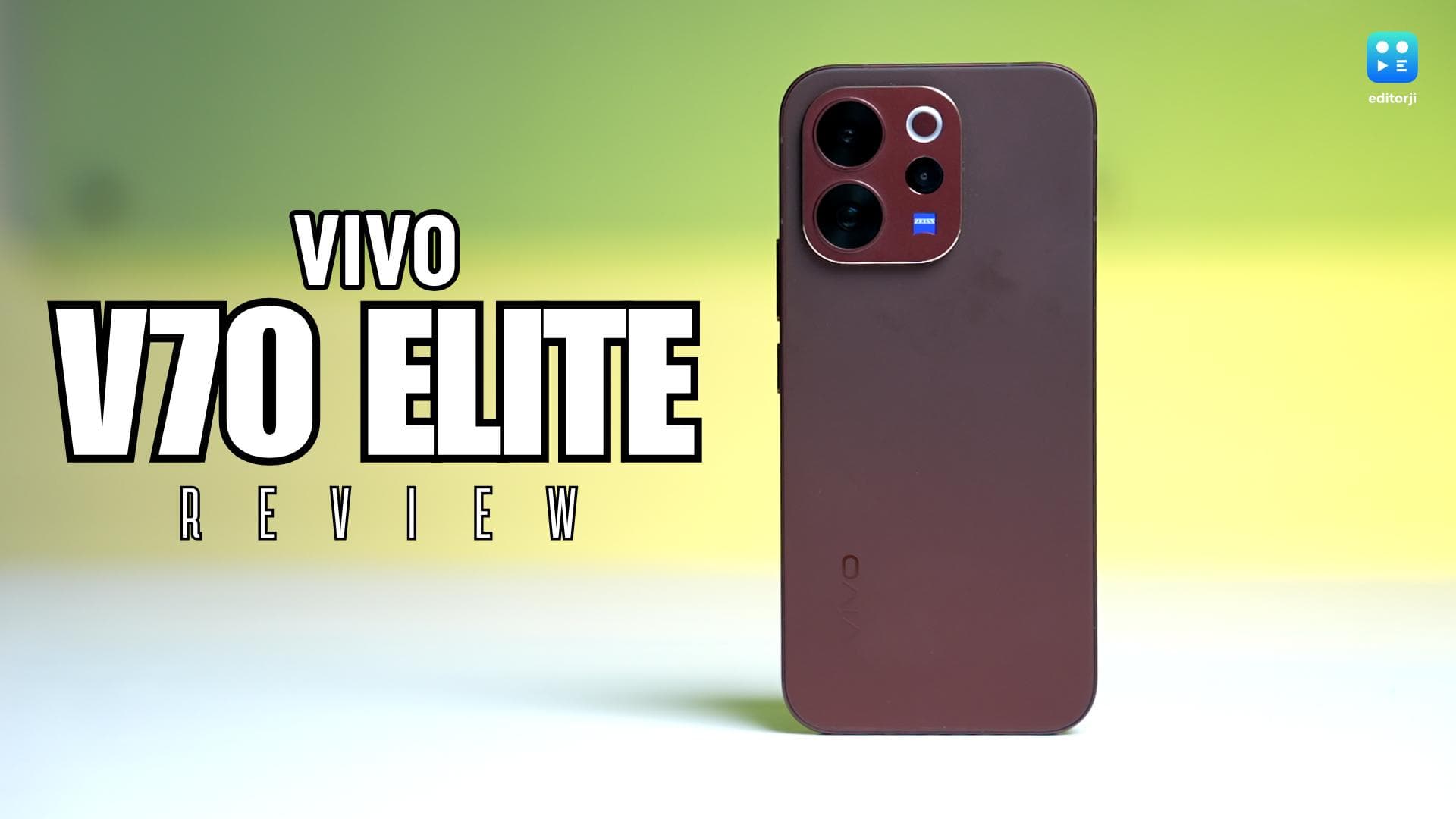
A lot of that comfort comes from the finish. The back has this velvety texture that feels soft yet grippy, almost cushioned without being rubbery. It adds a sense of security when you are holding it casually. The frame helps too. At 7.59mm, it is slim enough to look sleek without chasing extreme thinness. Weighing 197 grams, the phone feels evenly balanced, so it never tips forward or strains the wrist. The Passion Red unit we tested looks bold and premium, though the Authentic Black and Sand Beige variants may differ slightly in weight and dimensions.
The build quality backs up the feel. You get a glass rear panel paired with an aerospace-grade aluminium frame, and together they give the device a solid, refined character. The camera island switches things up with a squarish layout instead of the circular module seen on some other Vivo devices. The 50MP main and 50MP telephoto lenses each sit within their own subtle accent ring, while the 8MP ultrawide, Aura Light, and a small Zeiss logo complete the setup.
Durability is not just cosmetic here. The V70 Elite carries IP68 and IP69 ratings for dust and water resistance, along with an SGS five-star drop resistance certification. It feels sturdy enough for daily life, though it remains a glass build, so basic care still makes sense.
Ports and buttons are laid out sensibly. The dual Nano SIM slot, speaker grille and USB 2.0 Type C port sit at the bottom. Volume controls and the power key are on the right, and there is even an IR blaster placed on top.
Vivo V70 Elite’s display and audio: Premium vibes all around
Displays in this segment have improved massively, so the V70 Elite had to come prepared. It features a 6.59 inch 1.5K AMOLED panel with a 120Hz refresh rate, and the first thing you notice is how seamless the front looks. The bezels are extremely slim, which makes the screen feel expansive and gives the phone a polished, near-flagship appearance.
The specifications back that up. You get HDR10 and HDR10+ support, peak local brightness rated at 5000 nits, and full DCI-P3 colour gamut coverage. On paper, that already sounds serious, and in daily use, it absolutely holds up. HDR content on YouTube and Netflix looks punchy, with strong contrast and controlled highlights. Bright scenes retain detail instead of blowing out, and darker scenes maintain depth without crushing shadows. Colours are vibrant but not exaggerated, striking a good balance between lively and accurate.
The panel is capable of displaying over a billion colours, which strongly suggests a 10-bit display, even though that has not been officially confirmed. Regardless, gradients appear smooth and natural. Games like Honkai Star Rail look rich and immersive, with depth in textures and colour transitions that you do not always see at this price point. The 120Hz refresh rate keeps scrolling fluid and animations clean, adding to the overall premium feel.
Outdoor visibility is reassuringly strong. While we do not have an exact high-brightness mode figure, the display remains readable under harsh sunlight. Text stays sharp, and colours do not wash out easily, making everyday use outdoors comfortable.
The ultrasonic in-display fingerprint sensor is another highlight. It is fast, accurate, and works reliably even when your fingers are slightly sweaty or oily, which is a practical advantage over optical sensors.
Audio performance is solid as well. The stereo speakers get loud enough for casual streaming and gaming, with a decent sense of separation and a noticeable hint of bass. At maximum volume, there can be slight distortion, but for the most part, they stay clear, punchy, and enjoyable for everyday use.
Vivo V70 Elite’s performance: Real-world speed over raw hype
At the heart of the V70 Elite sits the Snapdragon 8s Gen 3. It might technically belong to last year’s silicon cycle, but this is still a 4nm, flagship-grade processor that has plenty of muscle left. Paired with up to 12GB of LPDDR5X RAM and 512GB of UFS 4.1 storage, the hardware setup is undeniably serious and built for heavy use.
In everyday performance, the phone feels quick and confident. Apps pop open without delay, multitasking stays smooth even with multiple background processes, and the UI maintains a consistent fluidity. There is a sense of responsiveness that makes the device feel premium rather than mid-range. Whether it is rapid app switching, scrolling through social feeds, or juggling work apps, it handles it without stutter.
That said, Vivo’s V series has never chased record-breaking benchmark numbers purely for headlines. The focus has always been stable, sustained output, and that philosophy is clear here. Instead of short bursts of peak performance followed by throttling, the V70 Elite prioritises consistency.
The benchmark numbers reflect that balance. It scores around 1.85 million on AnTuTu, which is comfortably high. On Geekbench, it posts 1933 in single-core and 4908 in multi-core tests. In 3DMark’s Wildlife stress test, it maintains 79 per cent stability, suggesting it can sustain performance reasonably well under prolonged load.
In real gaming scenarios, it delivers dependable results. BGMI runs at an average of 88 to 89 FPS over a 20-minute session with no major frame drops. Given the chipset, 120FPS support would have been ideal, but even so, gameplay feels stable. Thermals stay controlled, and heavier tasks like exporting videos in VN are handled smoothly without excessive heating.
Vivo V70 Elite’s software: Polished, playful and future-ready
If you have followed Vivo’s recent phones, the software experience here will feel familiar in a good way. The V70 Elite ships with OriginOS 6 based on Android 16, and it is easily among the cleanest Android skins available right now. This does not feel anything like the older Vivo software many people still remember. The interface has been completely refined and feels far more cohesive.
Vivo has embraced a transparent, liquid-inspired design language that looks glossy and modern without going overboard. There is a hint of Apple-like finesse in the smoothness and layering, but it still feels distinctly Vivo. Lock screen customisation is more flexible than before, with additional layout options and styling tools that are easier to set up. Animations across the system are fluid, and even the dynamic island-style pop-up feels thoughtfully integrated rather than gimmicky. Updated icons and cleaner transitions give the UI a mature, premium character.
What stood out most during my usage was the consistency. Apps open quickly, the ultrasonic fingerprint unlock is instant, and scrolling through notifications or social feeds feels seamless. The redesigned control centre is sharper and better organised, making quick toggles more accessible. Origin Island adds a bit of interactive flair, while phone-to-PC mirroring and cross-device connectivity proved genuinely useful during daily work.
AI features are deeply integrated, many powered by Google Gemini. Tools like AI Creation, AI Search and Circle to Search are built in. The AI Photography Suite adds creative flexibility, letting you adjust moods or themes after capturing a shot. You can give images a winter aesthetic or experiment with beach-style edits, and even try India-specific options like AI Holi Portrait.
Not every feature is essential, but they are enjoyable to explore. Vivo is also promising four major Android updates and six years of security patches, which adds meaningful long-term assurance.
Vivo V70 Elite’s cameras: Practical setup, powerful results
On paper, the V70 Elite does not try to overwhelm you with wild numbers, but it quietly checks all the right boxes. You get a 50MP main camera with OIS, a 50MP 3X optical telephoto with OIS, and an 8MP ultrawide at the back. Up front, there is a 50MP selfie shooter, and yes, it comes with autofocus. It feels less like a spec flex and more like a setup designed for real-world use.
In daylight, the main 50MP sensor produces crisp, lively images without going overboard on saturation. Colours are slightly restrained, which actually helps scenes look more natural. Highlights stay under control, skies do not blow out easily, and dynamic range is handled well. There is plenty of detail for social posts, and even light cropping holds up nicely.
Low light performance is solid, too. The main camera manages exposure well, keeping images sharp and avoiding strange colour shifts. It may not dominate extreme comparisons, but the output is bright, clean and dependable for this price range.
The 50MP 3X telephoto is where things get interesting. In daylight, zoom shots look sharp and detailed, with colours staying consistent. Even stretching to 5X or 10X delivers surprisingly usable results. At night, it still performs confidently, retaining good detail with only minor warmth creeping into certain scenes. If you enjoy shooting from a distance, this lens genuinely expands your creative options.
The 8MP ultrawide is the only area where you notice a slight step down. In good light, it handles landscapes and group shots well, keeping colours fairly aligned with the main camera. In low light, finer details soften a bit, but the images remain shareable.
The 50MP front camera performs reliably, delivering sharp, well-exposed selfies. Autofocus makes a real difference when you are moving. Portrait mode produces clean edge detection with pleasing background blur. Video recording goes up to 4K at 60FPS, offering stable, sharp footage that works well for vlogging and everyday content creation.
Vivo V70 Elite’s battery and charging: Big cell, quick top-ups
The V70 Elite comes with a 6500mAh battery and 90W fast charging. For this price, that is solid, although I cannot help but feel Vivo could have gone even bigger. With rivals like Oppo, iQOO, OnePlus and even Realme pushing 7000mAh and even 7500mAh batteries, Vivo definitely had room to be more ambitious.
Still, real-world endurance is dependable. On heavy days filled with gaming, navigation over mobile data, and long video sessions, the phone easily lasted a full day. On lighter usage, it stretched close to a day and a half before I needed the charger.
The 90W charging is properly fast, taking about 55 minutes to go from nearly empty to full. Wireless charging would have sweetened the deal, but bypass charging does add practical value.
Verdict: A polished premium all-rounder
After spending proper time with the V70 Elite, it is clear that Vivo has crafted a well-balanced device. The design feels refined and comfortable in hand, the display is genuinely impressive for this segment, and the camera setup delivers meaningful versatility.
The 50MP 3X telephoto stands out as a practical addition rather than a numbers game. Performance is smooth and dependable, focusing on stability over flashy benchmark figures.
Battery life easily handles demanding days, and the 90W charging keeps downtime to a minimum. OriginOS 6 further elevates the experience with its polished look and genuinely useful features.
Pricing, though, could have been better. At ₹52,000, expectations are high, and a slightly lower entry point would have made it even more appealing. Features like wireless charging could also have added extra value, especially with the top variant crossing ₹60,000.
That said, if you want a premium mid-ranger that delivers consistency across design, display, cameras and software, the V70 Elite proves itself as a confident and capable choice.