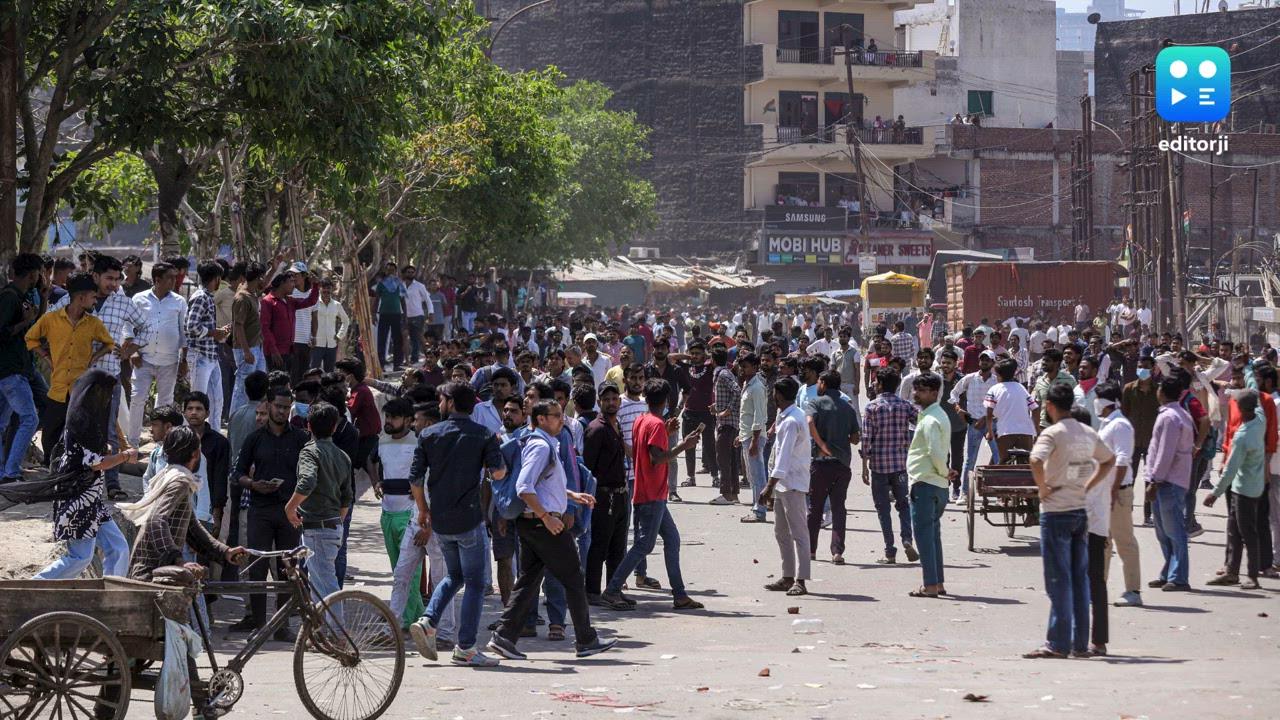
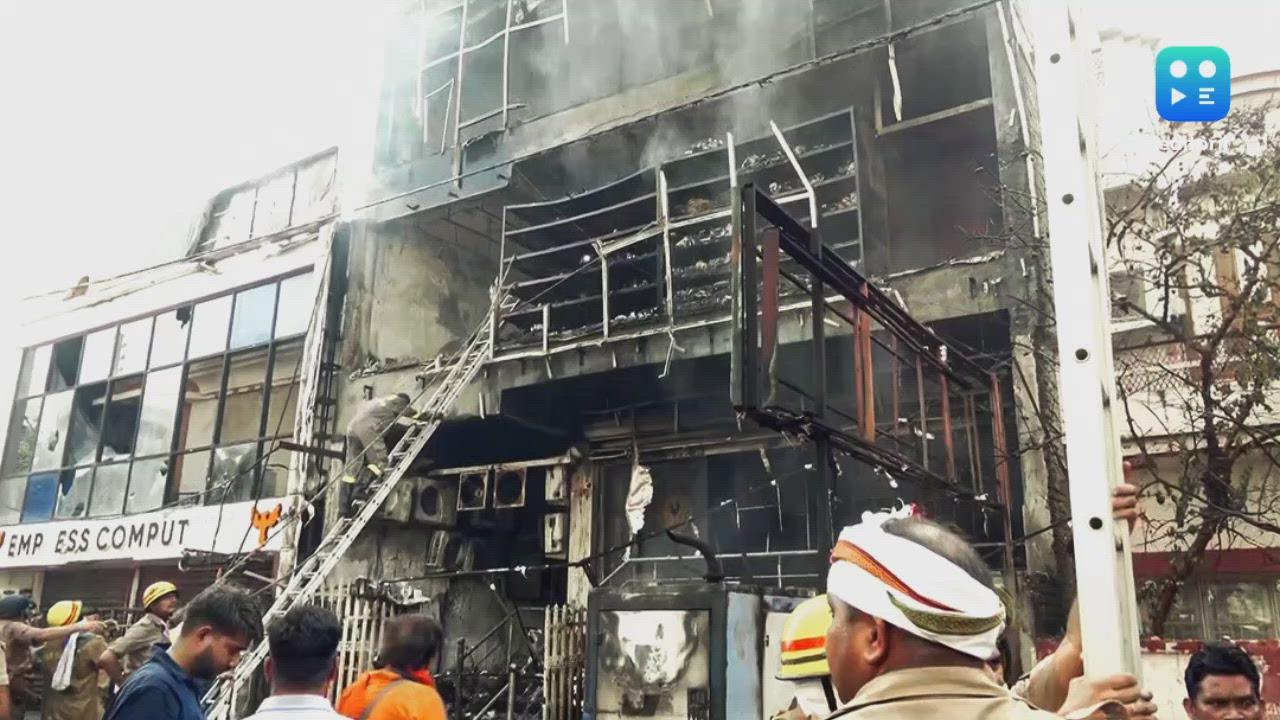
Vehicles, including police SUVs, were torched, public property vandalised and stone pelting reported from factory hubs in Noida as protests by workers demanding a wage hike turned violent on Monday.
The protests paralysed traffic, leaving thousands of commuters stranded on different roads leading to Delhi during the morning rush hour. Queues of vehicles stretching for several kilometres were seen at the Delhi-Noida border.
Officials said a large number of workers from various industrial units in Phase 2 and Sector 60 gathered in the morning to press their long-pending demand for salary revision and raised slogans.
They said the workers are demanding a wage hike on the lines of neighbouring Haryana, among other things.
Similar protests were also reported from Sector 62 and Sector 84, including at a Motherson company unit. Protesters also blocked the National Highway 9 — close to the Ghaziabad border and a key route connecting Delhi and western Uttar Pradesh.
The protests soon spiralled into violence, with some protesters vandalising property, pelting stones and setting vehicles on fire.
Adequate police deployment has been ensured across industrial zones under the Gautam Buddh Nagar Commissionerate, the officials said.
Senior police and administrative officers are present on the ground to monitor the situation. A heavy police force was rushed to the affected areas to bring the situation under control, they said.
“The situation is under control and being continuously monitored. Efforts are being made to counsel the workers and maintain peace. Minimum force is being used wherever necessary to maintain law and order,” police said in a statement.
Authorities also appealed to the public not to pay heed to rumours and assured that normalcy is being restored in the affected areas.
Gautam Buddh Nagar Additional Labour Commissioner Rakesh Dwivedi said the workers were primarily demanding a wage hike on the lines of neighbouring Haryana, along with basic facilities.
“Workers demanded to increase salary likewise Haryana government has increased. Besides, there are other issues as well like overtime, food and others,” he said.
On April 8, the Haryana government increased the minimum wage for unskilled workers to Rs 15,220 per month from Rs 11,274.60. The decision came into effect retrospectively from April 1.
Protesters said low wages and poor working conditions forced them to take to the streets.
A protester said that despite working 12-hour shifts, workers earn between Rs 11,000 and Rs 15,000, making it difficult to sustain a household.
Another protester, Nakul Singh, alleged that companies were not paying overtime in accordance with government norms, leading to resentment among workers.
A woman worker alleged irregularities in wage payments, saying workers are often made to sign for double shifts while being paid for a single duty.
“Working conditions are often very difficult and need improvement,” she said.
Another woman protester said workers’ incomes have not kept pace with rising inflation.
“Everything is becoming expensive, but our salaries remain around Rs 11,000-12,000. They should be increased to at least Rs 20,000-25,000,” she said.
The protesters also demanded an increase in minimum wages, stating that women working 12-hour shifts should be paid at least Rs 15,000 and men at least Rs 20,000 per month.
Asked if workers are aware of the benefits they are entitled to, a protester told reporters, “We only get to know the rules which are put up by our companies at their gates, walls and notice boards.” The violence erupted a day after the Uttar Pradesh government announced a series of measures aimed at strengthening labour welfare, including mandatory double overtime pay and timely wages for workers in Gautam Buddha Nagar.
District Magistrate Medha Roopam on Sunday held meetings with representatives of industrial units and issued key directives to safeguard workers’ rights.
She directed that workers willing to continue their jobs should not face any inconvenience and asked managements to maintain dialogue with employees in line with government norms.
She announced that workers would be paid overtime at double the standard rate without deductions and would be entitled to a weekly off. In case of work on Sundays, double wages would be paid, while bonuses would be provided as per rules.
The administration also directed industrial units to ensure CCTV cameras at factory gates remain functional and set up a control room to address workers’ grievances and maintain law and order.
The officials said industrial units and workers may report any issues they encounter to this control room via the telephone numbers 1202978231, 1202978232, 1202978862, and 1202978702, thereby ensuring prompt remedial action.
Security was tightened along Delhi’s key entry points on Monday.
According to Delhi Police sources, several teams have been deployed at all motorable roads connecting Noida to different parts of the capital, particularly at major border points with Uttar Pradesh, to prevent any spillover of the unrest.
Senior officers said strict vigil is being maintained and thorough checking of vehicles is being carried out to ensure that no anti-social elements enter the city under the guise of the protest.
“Delhi Police is fully alert and vigilant. Adequate force has been deployed at all strategic locations. No one will be allowed to breach law and order,” a senior police officer said.
Barricading has been intensified at key border points and additional personnel, including rapid response teams, paramilitary forces, have been stationed to respond swiftly to any untoward incident.
Police officers said they are monitoring the situation and are in touch with their Uttar Pradesh counterparts.
The protests triggered widespread traffic snarls across Noida and Greater Noida, with key stretches such as Sector 62, National Highway 24, Sector 63 and the Chilla border witnessing severe congestion. Protesters blocked major routes connecting Sector 62 to Sector 16 and NH-9, prompting traffic police to divert vehicles and make efforts to ease movement.
Traffic police later said that movement was gradually being restored at key points, including the Chilla border and the Noida-Greater Noida Expressway, while traffic flow from Sector 62 towards Golchakkar had resumed. Efforts were underway to normalise traffic at other affected locations.
An office-goer, Prashant Shukla, said he was stuck at the DND flyover for hours while heading to Delhi.
“Vehicles were not able to move due to heavy traffic jams caused by the workers’ protest. It took me nearly two hours to reach office,” he said.
Another commuter from Greater Noida said multiple areas, including Sector 62, Phase 2, the Chilla border, and National Highways 24 and 9, were severely affected.
“The entire stretch from Noida Sector 62 towards Sector 51 was impacted, and office-goers were stuck in their vehicles,” he said.
Traffic congestion was also reported from Dadri Main Road, Noida-Greater Noida Expressway, Phase 2 industrial area, and sectors 16, 18, 63 and 64, among other locations.