Highlights

  • As per the Federal Deposit Insurance Corporation, SVB had over $175 billion in deposits as of December 31st 2022

  • On Wednesday, 8th of March, SVB sold $21 billion worth of bond assets at a loss of $1.8 billion.

Latest news

Vivo V70 Review: The refined portrait master

Vivo V70 Review: The refined portrait master

Vivo V70 Elite Review: A familiar yet refined smartphone

Vivo V70 Elite Review: A familiar yet refined smartphone

Nandan Nilekani stresses AI diffusion, says India can lead on use cases

Nandan Nilekani stresses AI diffusion, says India can lead on use cases

AI will employ more workers, not replace jobs, workforce moving to higher-value roles with AI: Tata Chairman N Chandrasekaran

AI will employ more workers, not replace jobs, workforce moving to higher-value roles with AI: Tata Chairman N Chandrasekaran

AI integral to networks, India well positioned to lead with open standards: Sunil Mittal and Adobe CEO Shantanu Narayen

AI integral to networks, India well positioned to lead with open standards: Sunil Mittal and Adobe CEO Shantanu Narayen

Jio with Reliance to invest Rs 10 lakh crore over seven years on AI transformation strategy: Mukesh Ambani

Jio with Reliance to invest Rs 10 lakh crore over seven years on AI transformation strategy: Mukesh Ambani

Leading AI Firms, Governments, and Education Partners Launch Alliance to Scale AI-powered Solutions for Learning in Low- and Middle-income Countries

Leading AI Firms, Governments, and Education Partners Launch Alliance to Scale AI-powered Solutions for Learning in Low- and Middle-income Countries

ODM Educational Group Scripts Another Chapter of Excellence in JEE (Main) 2026

ODM Educational Group Scripts Another Chapter of Excellence in JEE (Main) 2026

Silicon Valley Bank collapse: the timeline & how it happened

The Silicon Valley Bank collapsed within a period of two days. Here's the sequence of events that led to the largest banking collapse since 2008 

Silicon Valley Bank collapse: the timeline & how it happened

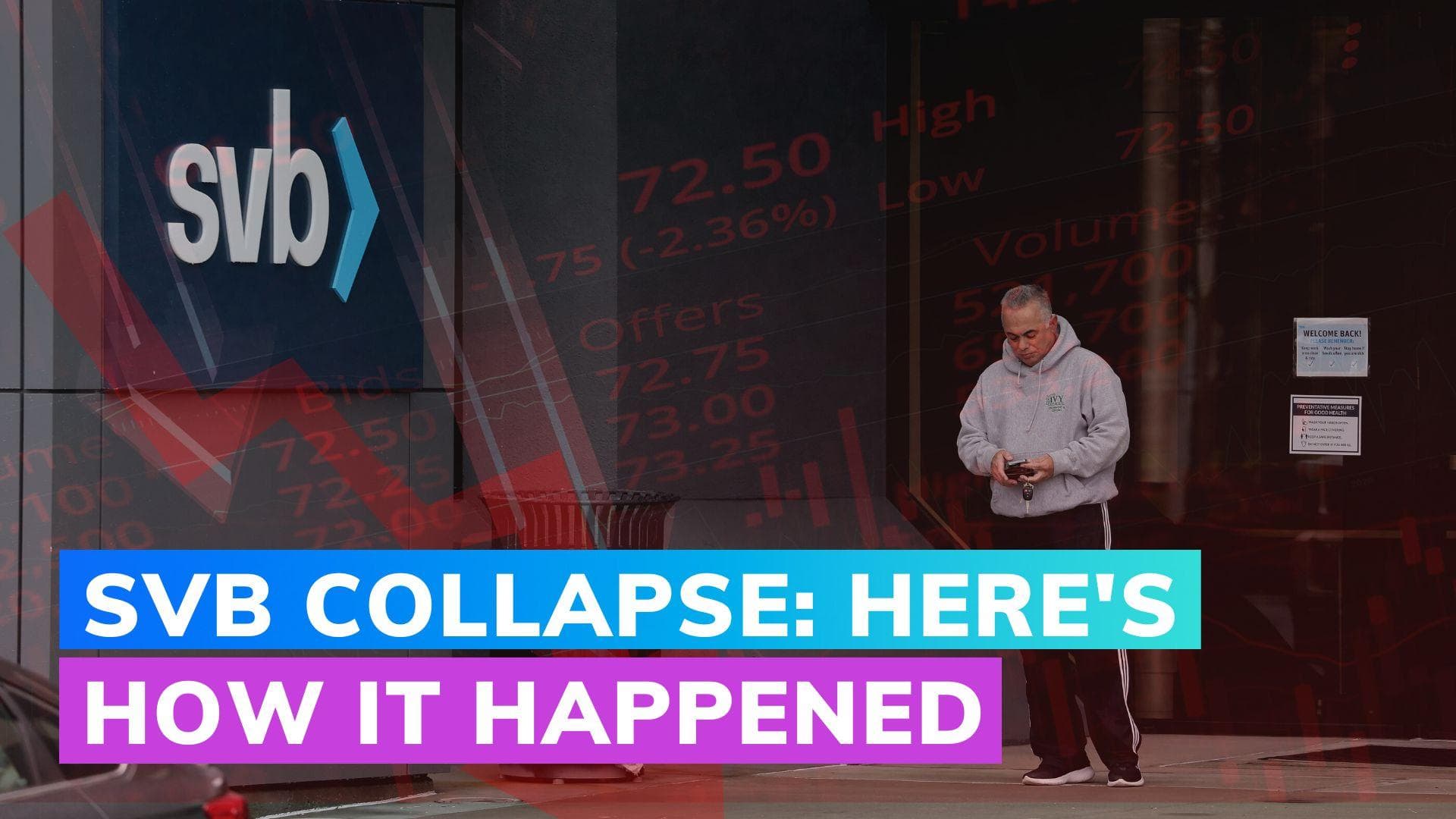
Its perhaps the biggest bank failure since the Global Financial Crisis of 2008. The Silicon Valley Bank (SVB) collapse has sent shockwaves across the globe and has far-reaching ramifications.

So, how did one of the biggest banking collapses in the history of the U.S actually happen?

Silicon Valley Bank amassed huge deposits in 2021. As per the Federal Deposit Insurance Corporation, SVB had over $175 billion in deposits as of December 31st 2022 and over $200 billion in total assets.

SVB invested heavily in bonds which were being issued when interest rates were very low due to the covid pandemic. As per reports, SVB’s balance sheet for 2022-end showed $91.3 billion of securities.

But, as the world emerged out of the pandemic, inflation reared its head, soaring to 8.2% in October 2022. This was the highest inflation that the U.S had seen in over 4 decades. In response, the Federal Reserve began raising interest rates. Fed Chairman, Jerome Powell, made it very clear, that interest rates had to go up, to clamp down on inflation.

As a result of rising interest rates, the value of SVB's bond holdings, which were issued at lower rates, began falling. At the same time, many startups, who were the bank’s customers, began withdrawing deposits to survive, amid a funding crunch. As a result, SVB was forced to sell whatever bonds it could, at a loss.

On Wednesday, 8th of March, SVB sold $21 billion worth of bond assets at a loss of $1.8 billion. The bank also announced that it was conducting a capital raise. Despite this announcement, there was a wave of withdrawals from the bank.

Meanwhile, on the 8th of March, crypto-focussed lender – Silvergate bank said it planned to wind down operations and liquidate because of heavy losses following the collapse of crypto exchange FTX. This caused another wave of fresh withdrawals on Thursday followed by the SVB stock in a downward spiral, crashing over 60%.

As per a regulatory filing, SVB had a negative cash balance of $958 million at the end of business on 9th of March. The filing also said that “despite the bank being in sound financial condition prior to March 9th, investors and depositors reacted by withdrawing $42 billion of deposits, causing a run on the bank”. This massive withdrawal, led to the bank becoming insolvent and unable to payoff its obligations.

On Friday, March 10th, Federal Deposit Insurance Corporation (FDIC) announced that SVB “was closed today by the California Department of Protection and Innovation, which appointed the FDIC as receiver”. FDIC also said that all insured depositors would have full access to their deposits until Monday, March 13th. However, the insured deposits have a cap of $250,000. Anyone who has over $250,000 in their accounts are required to call a toll-free number.

Going forward, FDIC will oversee the sale of the assets of SVB. The uninsured depositors will be paid dividends from the asset sale.

ADVERTISEMENT

Up Next

Silicon Valley Bank collapse: the timeline & how it happened

Silicon Valley Bank collapse: the timeline & how it happened

RBI keeps interest rates on hold after US trade deal boosts outlook

RBI keeps interest rates on hold after US trade deal boosts outlook

RBI proposes to compensate customers up to Rs 25,000 loss due to fraud

RBI proposes to compensate customers up to Rs 25,000 loss due to fraud

RBI raises GDP growth projection of Q1, Q2 of FY27

RBI raises GDP growth projection of Q1, Q2 of FY27

RBI pauses rate cuts, retains interest rate at 5.25 pc

RBI pauses rate cuts, retains interest rate at 5.25 pc

Rupee jumps 122 paise to close at 90.27 against US dollar on India-US trade deal

Rupee jumps 122 paise to close at 90.27 against US dollar on India-US trade deal

ADVERTISEMENT

editorji-whatsApp

More videos

Stock markets cheer India-US trade deal: Sensex, Nifty surge 2.5 pc

Stock markets cheer India-US trade deal: Sensex, Nifty surge 2.5 pc

UPI transactions hit record high of Rs 230 lakh crore in 2025-26 till Dec: Govt

UPI transactions hit record high of Rs 230 lakh crore in 2025-26 till Dec: Govt

Explained: India-US trade deal, tariffs and trade benefits

Explained: India-US trade deal, tariffs and trade benefits

Trade deal with US adds momentum to India's growth ambition: Industry leaders

Trade deal with US adds momentum to India's growth ambition: Industry leaders

Rupee jumps 119 paise to 90.30 against the US dollar on India-US trade deal

Rupee jumps 119 paise to 90.30 against the US dollar on India-US trade deal

President Trump announces US-India trade deal, lowers tariffs from 25 pc to 18 pc

President Trump announces US-India trade deal, lowers tariffs from 25 pc to 18 pc

Stock markets cheer India-US trade deal: Sensex jumps over 5 pc; Nifty nears all-time high

Stock markets cheer India-US trade deal: Sensex jumps over 5 pc; Nifty nears all-time high

Sustaining 7–8% growth top priority to create jobs: FM Nirmala Sitharaman

Sustaining 7–8% growth top priority to create jobs: FM Nirmala Sitharaman

Budget FY27 demonstrates commitment to macro stability: Fitch

Budget FY27 demonstrates commitment to macro stability: Fitch

STT hike on Futures dampen stock market sentiment; Sensex, Nifty crash nearly 2 pc

STT hike on Futures dampen stock market sentiment; Sensex, Nifty crash nearly 2 pc

Editorji Technologies Pvt. Ltd. © 2022 All Rights Reserved.