A NASA spacecraft rammed an asteroid at blistering speed Monday in an unprecedented dress rehearsal for the day a killer rock menaces Earth.
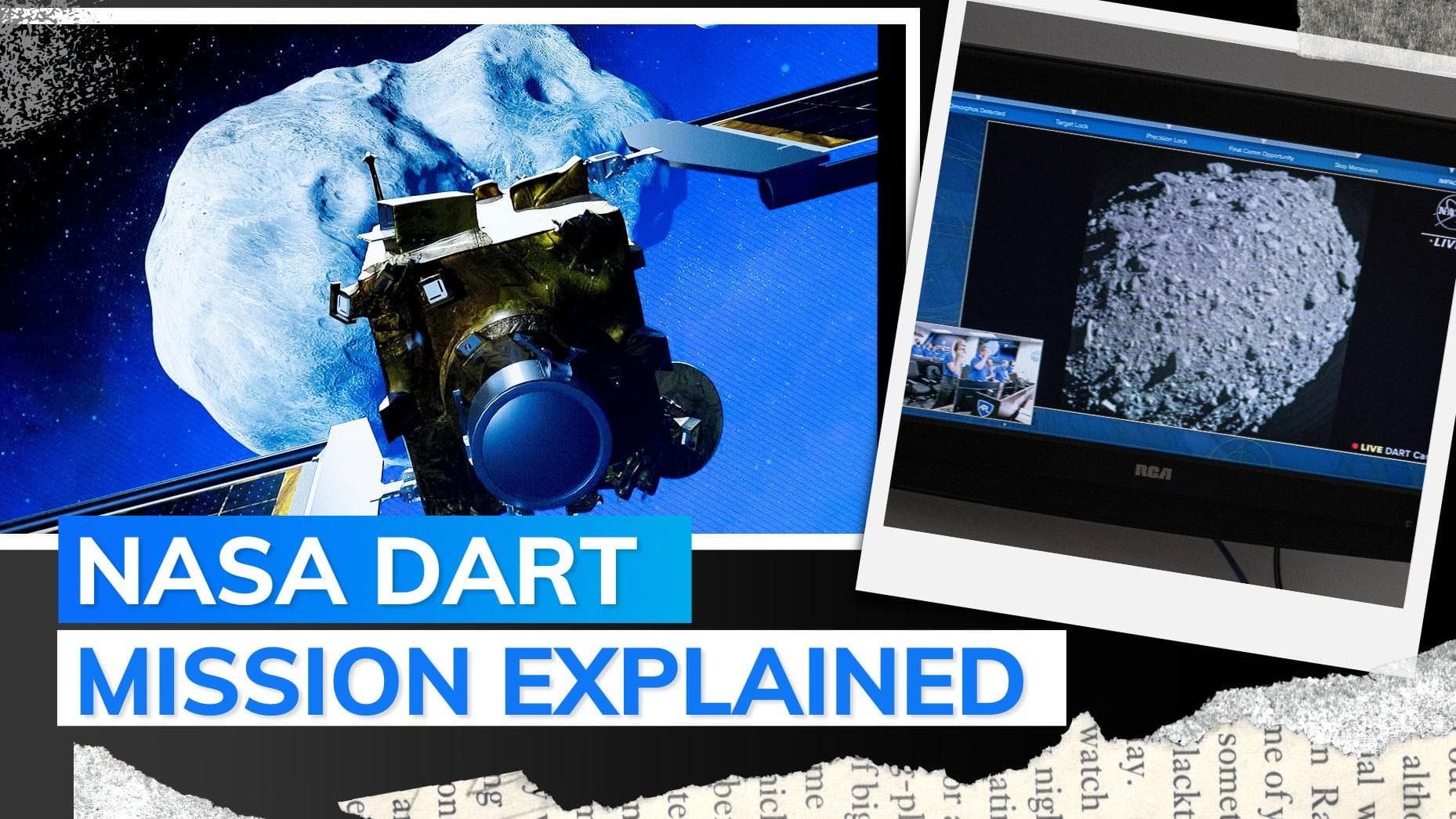
The galactic grand slam occurred at a harmless asteroid7 million miles (9.6 million kilometers) away, with the spacecraft named Dart plowing into the small space rock at 14,000 mph (22,500 kph). Scientists expected the impact to carve out a crater, hurl streams of rocks and dirt into space and, most importantly, alter the asteroid's orbit.
Telescopes around the world and in space aimed at the same point in the sky to capture the spectacle. Though the impact was immediately obvious _ Dart's radio signal abruptly ceased _ it will be days or even weeks to determine how much the asteroid's path was changed.
The $325 million mission was the first attempt to shift the position of an asteroid or any other natural object in space.
"No, this is not a movie plot," NASA Administrator Bill Nelson tweeted earlier in the day. "We've all seen it on movies like 'Armageddon,' but the real-life stakes are high," he said in a prerecorded video.
Monday's target: a 525-foot (160-meter) asteroid named Dimorphos. It's actually a moonlet of Didymos, Greek for twin, a fast-spinning asteroid five times bigger that flung off the material that formed the junior partner.
The pair have been orbiting the sun for eons without threatening Earth, making them ideal save-the-world test candidates.
Launched last November, the vending machine-size Dart _ short for Double Asteroid Redirection Test _ navigated to its target using new technology developed by Johns Hopkins University's Applied Physics Laboratory, the spacecraft builder and mission manager.
Dart's on-board camera, a key part of this smart navigation system, caught sight of Dimorphos barely an hour before impact.
"Woo hoo," exclaimed Johns Hopkins mission systems engineer Elena Adams. "We're seeing Dimorphos, so wonderful, wonderful."
With an image beaming back to Earth every second, Adams and other ground controllers in Laurel, Maryland, watched with growing excitement as Dimorphos loomed larger and larger in the field of view alongside its bigger companion.
A mini satellite followed a few minutes behind to take photos of the impact. The Italian Cubesat was released from Dart two weeks ago.
Scientists insisted Dart would not shatter Dimorphos. The spacecraftpacked a scant 1,260 pounds (570 kilograms), compared with the asteroid's 11 billion pounds (5 billion kilograms). But that should be plenty to shrink its 11-hour, 55-minute orbit around Didymos.
The impact should pare 10 minutes off that, but telescopes will need anywhere from a few days to nearly a month to verify the new orbit. The anticipated orbital shift of 1% might not sound like much, scientists noted. But they stressed it would amount to a significant change over years.
Planetary defense experts prefer nudging a threatening asteroid or comet out of the way, given enough lead time, rather than blowing it up and creating multiple pieces that could rain down on Earth. Multiple impactors might be needed for big space rocks or a combination of impactors and so-called gravity tractors, not-yet-invented devices that would use their own gravity to pull an asteroid into a safer orbit.
"The dinosaurs didn't have a space program to help them know what was coming, but we do," NASA's senior climate adviser Katherine Calvin said, referring to the mass extinction 66 million years ago believed to have been caused by a major asteroid impact, volcanic eruptions or both.
The non-profit B612 Foundation, dedicated to protecting Earth from asteroid strikes, has been pushing for impact tests like Dart since its founding by astronauts and physicists 20 years ago. Monday's feat aside, the world must do a better job of identifying the countless space rocks lurking out there, warned the foundation's executive director, Ed Lu, a former astronaut.
Significantly less than half of the estimated 25,000 near-Earth objects in the deadly 460-foot (140-meter) range have been discovered, according to NASA. And fewer than 1% of the millions of smaller asteroids, capable of widespread injuries, are known.
The Vera Rubin Observatory, nearing completion in Chile by the National Science Foundation and U.S. Energy Department, promises to revolutionize the field of asteroid discovery, Lu noted.
Finding and tracking asteroids, "That's still the name of the game here. That's the thing that has to happen in order to protect the Earth," he said.
Also watch: Artemis moon rocket: NASA is fueling its moon rocket in a leak test