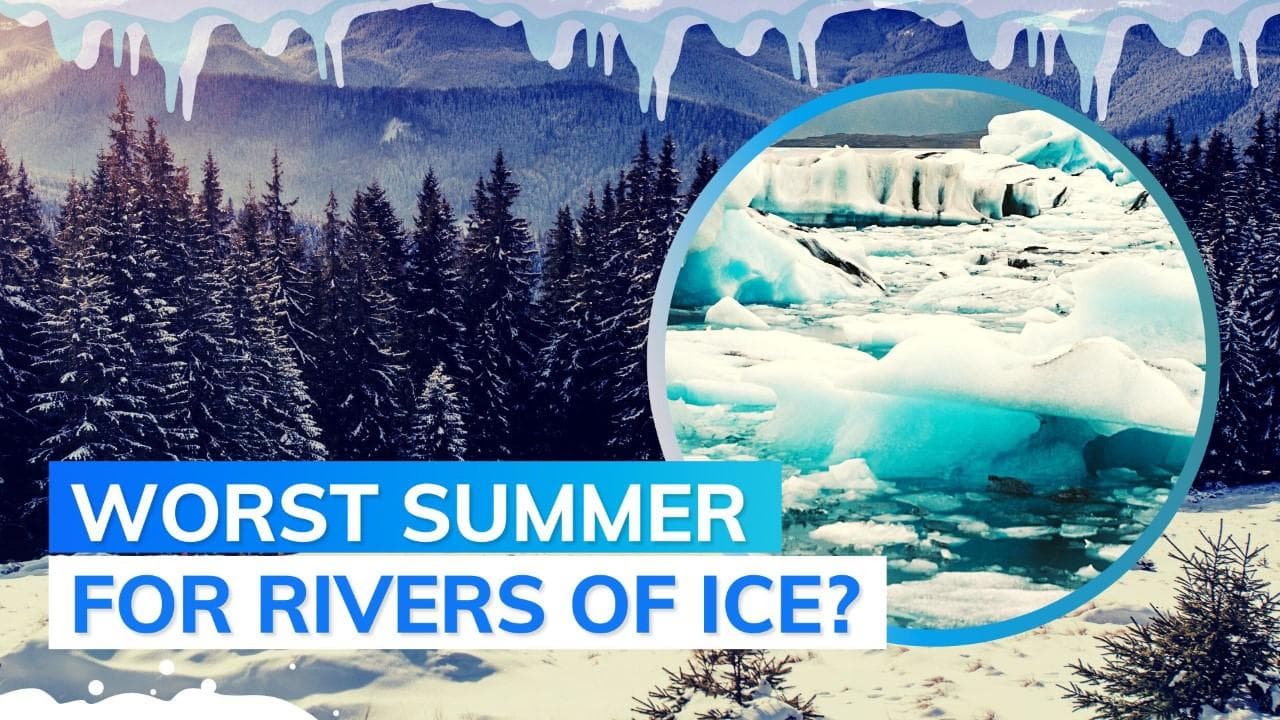
From The Conversation: Finally, after what was arguably the worst summer on record for glaciers, snow has begun to fall in the European Alps. It is much needed.
This year Switzerland’s glaciers have lost an average of 6.2 per cent of their ice – extreme indeed.
The new flurries of snow will form a protective blanket to shield and reflect 90% of the sun’s radiation back into the atmosphere and limits the warming and melting of the ice beneath.
When snow falls over the winter, and then subsequently doesn’t melt over the summer, it adds to the mass of a glacier. Over a few similar years, gravity would take over and glaciers would start to advance downhill.
However over the past century, that has not been the case. The protective layers of snow have not been thick enough to offset the warming summer temperatures and on average glaciers around the world have been wasting away since the end of the little ice age in the mid-late 1800s.
Saharan sand and a huge heatwave Back to this summer. Across the Alps, the preceding winter had very limited snowfall and therefore glaciers were not well insulated against the forthcoming summer melt season.
Spring was particularly harsh as natural atmospheric weather patterns carried Saharan dust to Europe and blanketed the Alpine landscape. Since dust absorbs more solar energy than snow (which is white and therefore more reflective), the now orange-tinted snow melted faster than ever.
Then a major heatwave saw temperature records smashed across Europe, with parts of the UK reaching 40°C for the first time. The Alps were not spared. For instance Zermatt, a famous car-free Swiss village in the shadow of the Matterhorn, recorded temperatures up to 33°C despite being 1,620 meters above sea level.
Glaciers in particular took a beating. By July, the Alps looked like they normally look in September: snow free, with snow and ice-fed rivers flowing at their peak. This was not normal.
The last time glaciers had an extreme melt season was in 2003 when, again, temperatures were very high across Europe, and a heatwave killed at least 30,000 people (more than 14,000 in France alone). That calendar year, 3.8% of glacier ice melted across Switzerland.
This year, for the first time ever, Zermatt closed its summer skiing. Guides stopped leading high mountain expeditions as permafrost – the frozen ground that binds rocks together – was thawing and causing almost constant rockfalls. Mont Blanc was closed.
50 years of data We are able to put this in historical context thanks in part to work by the charitable organisation Alpine Glacier Project which was established in 1972 and, along with the University of Salford where I work, has led scientific expeditions to glaciers near Zermatt every summer for 50 years.
Scores of students have helped to observe the effect of our warming climate through chemically monitoring changes in meltwater, topographically surveying the landscape and by taking photos from the same position over the years. Over the project’s five decades, Gorner Glacier and Findel Glacier have retreated 1,385 metres and 1,655 metres respectively.
In Switzerland these glacial meltwaters are used for hydropower. In fact, water falling on 93% of Switzerland ultimately passes through at least one electric power plant before even leaving the country. So one consequence is that melting glaciers help to compensate for low rainfall in times of drought, filling reservoirs to supply the nations energy supply.
You could argue that not all glaciers were equally affected by this summer’s catastrophic retreat and ice loss. In part, this is true. The extent to which a glacier has melted does depend on the altitude at which it is located, how steep the glacier tongue is, and how heavily it is covered with debris. There may too be localised climate factors.
However, research just published has shown that Austrian glaciers have also lost more glacial ice in 2022 than they have in 70 years of observations and therefore it is quite clear that severe melt has been the norm in 2022.
Visiting and viewing the geography of high mountain environments is a breathtaking experience, but my fear is that the continued ice melt and extreme temperatures seen this year are not an anomaly. Many more glaciers could be lost entirely within a generation.