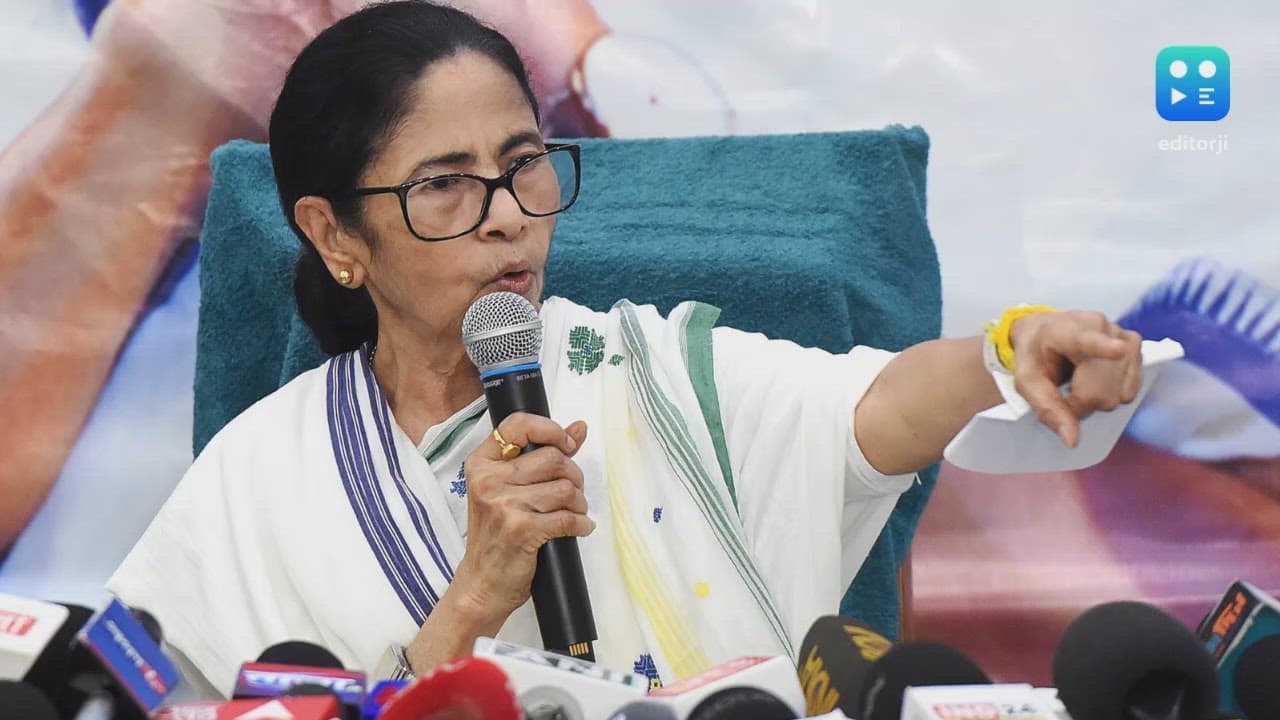
The political rivalry in Nandigram that defined West Bengal’s 2021 assembly polls is set to return to centre stage in a new arena, with Chief Minister Mamata Banerjee locking horns with her protege-turned-adversary Suvendu Adhikari in Bhabanipur, turning the Kolkata seat into the likely epicentre of the 2026 electoral battle.
With the TMC supremo contesting from Bhabanipur and the BJP fielding Leader of Opposition Adhikari against her, the contest has quickly acquired the character of a prestige fight -- not merely for a seat in the Assembly but for political supremacy in a state where the rivalry between the two leaders has come to symbolise the broader TMC-BJP confrontation.
In the 2021 polls, Adhikari stunned Banerjee in Nandigram by a slim margin of 1,956 votes, a defeat that forced the CM to subsequently enter the Assembly through a by-election from Bhabanipur, a seat considered her stronghold.
Five years later, the duel has been relocated to that very bastion.
“This time we will win Bhabanipur with the maximum number of votes,” Banerjee said when asked about the BJP challenge, asserting that the saffron party would see its numbers decline in next month’s election.
Political observers say the BJP’s decision to field Adhikari from Bhabanipur, in addition to his traditional seat Nandigram, is a calculated attempt to convert the constituency into the symbolic battlefield of the election, recreating the psychological theatre of Nandigram but on the chief minister’s home turf.
Bhabanipur has been one of the TMC’s safest urban strongholds since the party came to power in 2011. The constituency houses Banerjee’s residence and has repeatedly returned her to the Assembly.
After her defeat in Nandigram in 2021, senior TMC leader Shovandeb Chattopadhyay vacated the seat to allow Banerjee to contest the by-election. She returned to the Assembly with a commanding margin of more than 58,000 votes and nearly 72 per cent of the vote share.
Yet, in the run-up to the 2026 polls, Bhabanipur has unexpectedly emerged as a constituency under intense political scrutiny.
The SIR of electoral rolls has added a fresh political dimension to the contest. In Bhabanipur, more than 47,000 names have been removed from the voters’ list -- 44,786 at the draft stage and another 2,324 in the next level. Over 14,000 electors remain ‘under adjudication’ pending judicial scrutiny.
The scale of deletions has acquired political significance as it is roughly 11,000 fewer than the over 58,000-vote margin with which Banerjee had won the bypoll in 2021, a comparison already fuelling competing narratives between the ruling TMC and the BJP over the potential electoral impact of the roll revision.
In contrast, around 11,000 names have been struck off the voters’ list in Nandigram, represented by Adhikari.
Banerjee has been a vocal critic of the revision exercise, alleging attempts to manipulate electoral rolls, while BJP leaders argue that the clean-up will make the contest more transparent.
For the BJP, fielding Adhikari from Bhabanipur is as much a psychological move as an electoral strategy.
Having already defeated Banerjee once in Nandigram—a symbolic stronghold of the TMC’s land movement politics—Adhikari’s candidature allows the BJP to frame the election as a direct leadership contest between the state’s two most prominent political figures.
The BJP leadership has also been steadily building a narrative that Bhabanipur could become competitive in the changed political circumstances.
Adhikari and senior BJP leaders, including former state president Sukanta Majumdar, have made repeated visits to the constituency in recent months, signalling the party’s intention to convert the seat into a prestige battle.
The Mamata Banerjee–Suvendu Adhikari rivalry represents one of the most dramatic political fallouts in Bengal’s recent history.
Once among Banerjee’s closest lieutenants and a key architect of the TMC’s rise in the politically volatile Jangalmahal and coastal belts, Adhikari switched to the BJP ahead of the 2021 elections, triggering one of the most high-profile defections in state politics.
His victory over Banerjee in Nandigram became the defining moment of that election, even though the TMC swept the state with a thumping mandate.
The Bhabanipur contest now threatens to revive that narrative, potentially turning a single constituency into a symbolic referendum on the leadership of both camps.
More broadly, the face-off encapsulates the larger dynamics shaping the 2026 West Bengal elections.
The TMC is seeking a fourth consecutive term in office, banking on welfare schemes, organisational strength and Mamata Banerjee’s personal popularity. The BJP, meanwhile, is attempting to revive the aggressive challenger role it played in 2021 by framing the election as a leadership contest against Banerjee.
Polling for the 294-member West Bengal Assembly is scheduled in two phases on April 23 and April 29.
But even before the campaign fully gathers momentum, political attention has already converged on Bhabanipur.
For the TMC, retaining the seat would reaffirm the CM’s political dominance in her own backyard. For the BJP, wresting it would deliver a political shockwave far beyond the boundaries of a single constituency.
Either way, Bhabanipur has become the stage for what many in Bengal’s political circles are already calling the “mother of all electoral battles.”