Highlights

  • Indian student solves 2,500-year-old Sanskrit puzzle
  • Rishi Rajpopat a PhD student at Cambridge University
  • Breakthrough in Panini's grammar rules

Latest news

Govt raises limit for bringing duty-free imported goods to Rs 75,000 under new baggage rules

Govt raises limit for bringing duty-free imported goods to Rs 75,000 under new baggage rules

U19 World Cup: All-rounder Kanishk star in Pakistan rout as India reach semis

U19 World Cup: All-rounder Kanishk star in Pakistan rout as India reach semis

AAP holds Parivartan Sabha in Gujarat's Nizar, welcomes new members ahead of local polls

AAP holds Parivartan Sabha in Gujarat's Nizar, welcomes new members ahead of local polls

AAP leaders released from jail in Gujarat, pledge to continue fight for farmers’ rights

AAP leaders released from jail in Gujarat, pledge to continue fight for farmers’ rights

AAP’s Isudan Gadhvi calls Union Budget 2026-27 'hollow', lacking long-term vision

AAP’s Isudan Gadhvi calls Union Budget 2026-27 'hollow', lacking long-term vision

Firing at filmmaker Rohit Shetty's Mumbai home; five held for suspected Lawrence Bishnoi gang link

Firing at filmmaker Rohit Shetty's Mumbai home; five held for suspected Lawrence Bishnoi gang link

Pakistan to boycott T20WC game against India but compete in tournament

Pakistan to boycott T20WC game against India but compete in tournament

Alcaraz sweeps past Djokovic to win maiden Australian Open title

Alcaraz sweeps past Djokovic to win maiden Australian Open title

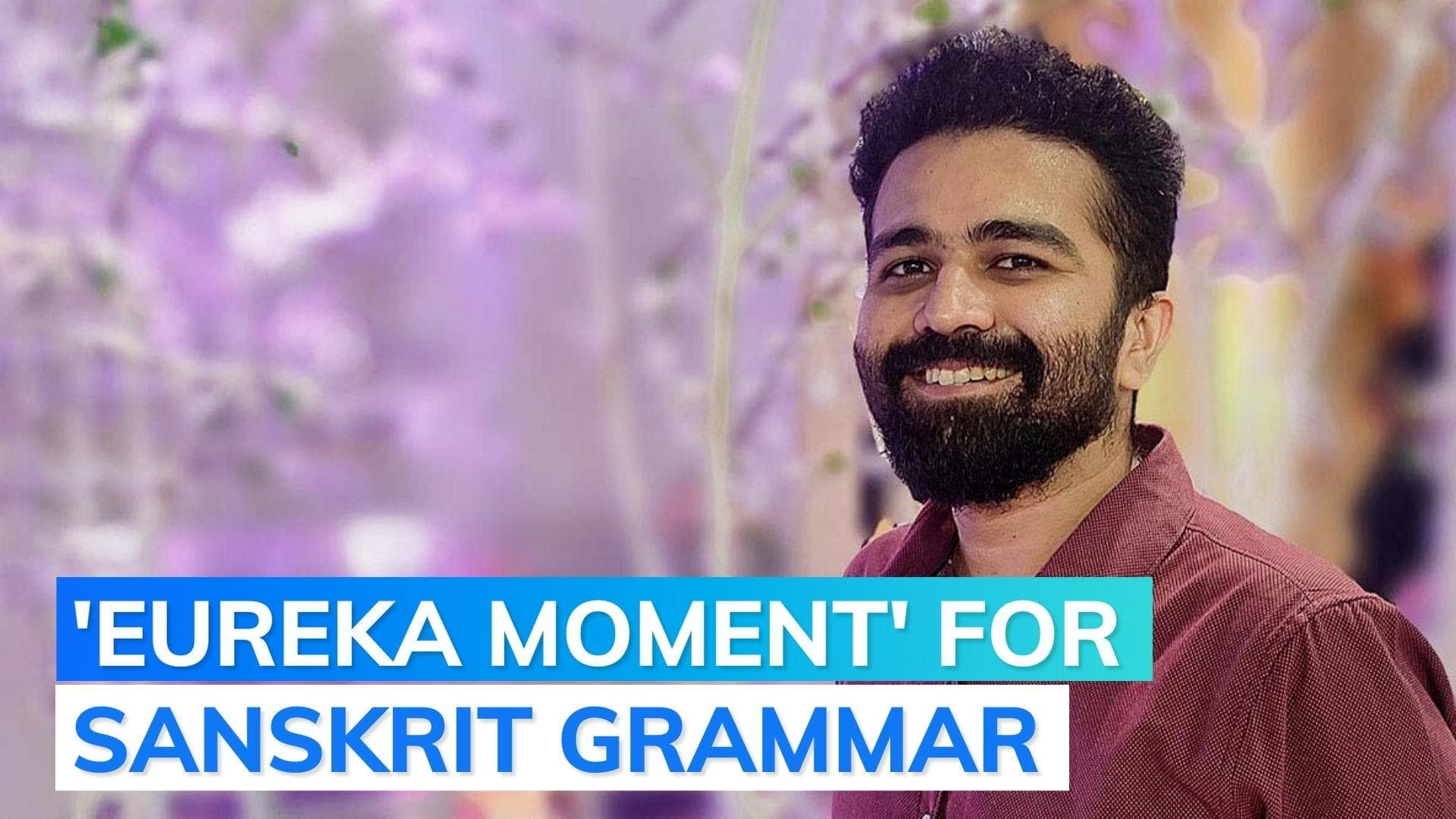
Indian PhD student at Cambridge University solves 2,500-year-old Sanskrit puzzle

Rajpopat’s discovery makes it possible to “derive” any Sanskrit word, to construct millions of grammatically correct words, using Panini’s revered language machine. 

Indian PhD student at Cambridge University solves 2,500-year-old Sanskrit puzzle

A grammatical problem which has defeated Sanskrit scholars since the 5th Century BC has finally been solved by an Indian PhD student at the University of Cambridge, it emerged as his thesis was published on Thursday.

Rishi Rajpopat made the breakthrough by decoding a rule taught by Panini, known as the father of linguistics, and is now encapsulated in his thesis entitled ‘In Panini, We Trust: Discovering the Algorithm for Rule Conflict Resolution in the Astadhyayi’.

According to the university, leading Sanskrit experts have described Rajpopat’s discovery as “revolutionary” and it could now mean that Panini’s grammar can also be taught to computers for the first time.

“I had a eureka moment in Cambridge,” recalls Rajpopat.

“After nine months trying to crack this problem, I was almost ready to quit, I was getting nowhere. So, I closed the books for a month and just enjoyed the summer, swimming, cycling, cooking, praying and meditating. Then, begrudgingly I went back to work, and, within minutes, as I turned the pages, these patterns started emerging, and it all started to make sense. There was a lot more work to do but I’d found the biggest part of the puzzle,” said the 27-year-old scholar.

Over the next few weeks, he was so excited that he couldn’t sleep and would spend hours in the library, including in the middle of the night, to check what he’d found and solve related problems. It would take another two and half years before he would get to the finish line.

“Panini had an extraordinary mind and he built a machine unrivalled in human history. He didn’t expect us to add new ideas to his rules. The more we fiddle with Panini's grammar, the more it eludes us,” says Rajpopat.

The 2,500-year-old algorithm decoded by him makes it possible, for the first time, to accurately use Panini’s so-called “language machine”.

Rajpopat’s discovery makes it possible to “derive” any Sanskrit word, to construct millions of grammatically correct words, using Panini’s revered language machine, which is widely considered to be one of the greatest intellectual achievements in history.

Panini’s system – 4,000 rules detailed in his renowned work, the Astadhyayi, which is thought to have been written around 500 BC – is meant to work like a machine. Feed in the base and suffix of a word and it should turn them into grammatically correct words and sentences through a step-by-step process.

Also watch: India at helm, UN Security Council adopts statement urging nation to curb terrorism

Until now, however, there has been a big problem. Often, two or more of Panini’s rules are simultaneously applicable at the same step leaving scholars to agonise over which one to choose. Solving so-called “rule conflicts”, which affect millions of Sanskrit words including certain forms of “mantra” and “guru”, requires an algorithm. Rajpopat’s research shows that Panini’s so-called language machine is also self-sufficient.

"My student Rishi has cracked it – he has found an extraordinarily elegant solution to a problem which has perplexed scholars for centuries. This discovery will revolutionise the study of Sanskrit at a time when interest in the language is on the rise,” said Professor Vincenzo Vergiani, Sanskrit professor and Rajpopat’s PhD supervisor.

Six months before Rajpopat made his discovery, Professor Vergiani gave him some prescient advice: “If the solution is complicated, you are probably wrong”. A major implication of Rajpopat’s discovery is that now there is the algorithm that runs Panini's grammar, it could potentially teach this grammar to computers.

"Computer scientists working on Natural Language Processing gave up on rule-based approaches over 50 years ago. So teaching computers how to combine the speaker’s intention with Panini’s rule-based grammar to produce human speech would be a major milestone in the history of human interaction with machines, as well as in India's intellectual history," said Rajpopat.

Sanskrit is an ancient and classical Indo-European language from South Asia. While only spoken in India by an estimated 25,000 people today, it has influenced many other languages and cultures around the world.

“Some of the most ancient wisdom of India has been produced in Sanskrit and we still don’t fully understand what our ancestors achieved. We’ve often been led to believe that we’re not important, that we haven’t brought enough to the table. I hope this discovery will infuse students in India with confidence, pride, and hope that they too can achieve great things,” added Rajpopat.

ADVERTISEMENT

Up Next

Indian PhD student at Cambridge University solves 2,500-year-old Sanskrit puzzle

Indian PhD student at Cambridge University solves 2,500-year-old Sanskrit puzzle

AAP holds Parivartan Sabha in Gujarat's Nizar, welcomes new members ahead of local polls

AAP holds Parivartan Sabha in Gujarat's Nizar, welcomes new members ahead of local polls

AAP leaders released from jail in Gujarat, pledge to continue fight for farmers’ rights

AAP leaders released from jail in Gujarat, pledge to continue fight for farmers’ rights

AAP’s Isudan Gadhvi calls Union Budget 2026-27 'hollow', lacking long-term vision

AAP’s Isudan Gadhvi calls Union Budget 2026-27 'hollow', lacking long-term vision

Firing at filmmaker Rohit Shetty's Mumbai home; five held for suspected Lawrence Bishnoi gang link

Firing at filmmaker Rohit Shetty's Mumbai home; five held for suspected Lawrence Bishnoi gang link

India zeroes out Chabahar port outlay, slashes Bangladesh aid in 2026-27 budget

India zeroes out Chabahar port outlay, slashes Bangladesh aid in 2026-27 budget

ADVERTISEMENT

editorji-whatsApp

More videos

Defence outlay raised to Rs 7.84 lakh crore in Budget 2026-27, boost for aerospace sector

Defence outlay raised to Rs 7.84 lakh crore in Budget 2026-27, boost for aerospace sector

Budget 2026 blind to India's real crises: Rahul Gandhi

Budget 2026 blind to India's real crises: Rahul Gandhi

Bengal not mentioned in Budget, govt sees us as 'Bangladeshis': Abhishek Banerjee

Bengal not mentioned in Budget, govt sees us as 'Bangladeshis': Abhishek Banerjee

Totally lacklustre, disappointing: Congress on Union Budget

Totally lacklustre, disappointing: Congress on Union Budget

Budget 2026: Bengal stands to gain from freight corridor, Durgapur industrial node, tourism push

Budget 2026: Bengal stands to gain from freight corridor, Durgapur industrial node, tourism push

Rs 1,102 cr allocated in Budget for ministers' salaries, entertainment of state guests, ex-governors

Rs 1,102 cr allocated in Budget for ministers' salaries, entertainment of state guests, ex-governors

Delhi Police gets Rs 12,503 crore in Budget 2026

Delhi Police gets Rs 12,503 crore in Budget 2026

FM Sitharaman proposes 'East Coast Industrial Corridor', 5 tourism destinations in 'Purvodaya' states

FM Sitharaman proposes 'East Coast Industrial Corridor', 5 tourism destinations in 'Purvodaya' states

Budget 2026-27: Centre allocates Rs 30 crore for Lokpal; Rs 54.56 crore to CVC

Budget 2026-27: Centre allocates Rs 30 crore for Lokpal; Rs 54.56 crore to CVC

Budget 2026: Govt to set up NIMHANS 2.0, exempts 17 cancer drugs from customs duty

Budget 2026: Govt to set up NIMHANS 2.0, exempts 17 cancer drugs from customs duty

Editorji Technologies Pvt. Ltd. © 2022 All Rights Reserved.