Delhi recorded its best air quality on Diwali day in eight years on Sunday, though pollution levels may rise due to burning of firecrackers and low night temperatures.
Delhiites experienced clear skies and abundant sunshine and the city's 24-hour average Air Quality Index (AQI) stood at 218 at 4 pm, the best in at least three weeks.
Delhi recorded an AQI of 312 on Diwali last year, 382 in 2021, 414 in 2020, 337 in 2019, 281 in 2018, 319 in 2017 and 431 in 2016, according to Central Pollution Control Board data.
An AQI between zero and 50 is considered 'good', 51 and 100 'satisfactory', 101 and 200 'moderate', 201 and 300 'poor', 301 and 400 'very poor', 401 and 450 'severe' and above 450 'severe plus'.
Saturday's 24-hour average AQI stood at 220, the lowest for the day before Diwali in eight years.
Delhi's air quality improved sharply just ahead of Diwali this year. The improvement can be attributed to intermittent rainfall on Friday and wind speeds favourable for the dispersion of pollutants.
To put this into perspective, Thursday's 24-hour average AQI was recorded at 437.
The city experienced 'very poor' to 'severe' air quality for two weeks starting October 28 with a suffocating haze lingering over the national capital during the period.
The India Meteorological Department (IMD) had earlier predicted a marginal improvement in the air quality just ahead of Diwali, owing to favourable meteorological conditions, including light rain under the influence of a western disturbance.
Also watch: Diwali rush: chaos at several railway stations, 'stampede' situation
A western disturbance brought rain over most parts of northwest India, including Punjab and Haryana, effectively reducing the contribution of smoke from stubble burning to Delhi's air pollution.
The IMD had also predicted that once the western disturbance passed, the wind speed would increase to around 15 kilometres an hour on Saturday that would help disperse pollutants ahead of Diwali.
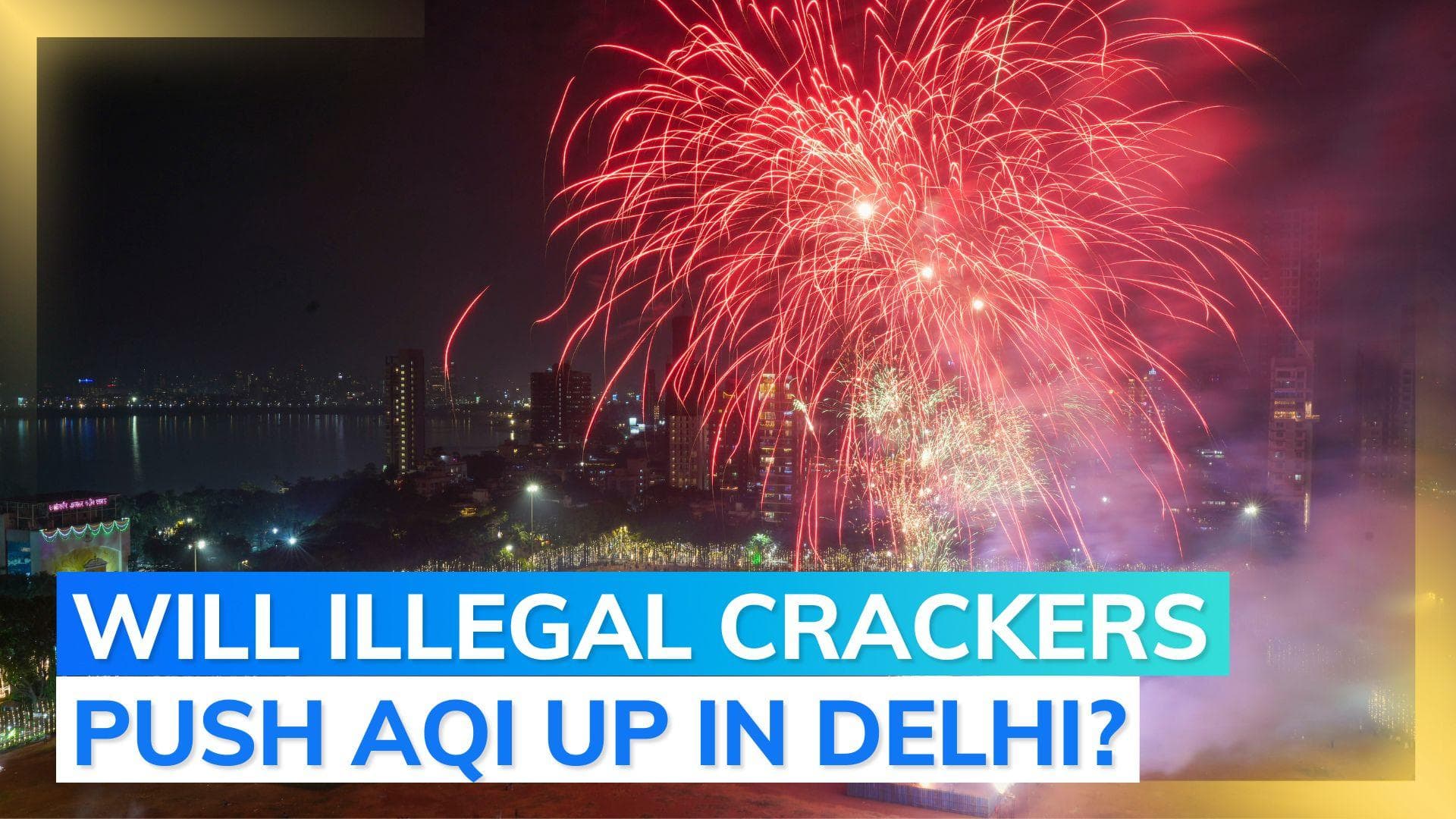
In accordance with the practice of the past three years, Delhi has announced a comprehensive ban on the manufacture, storage, sale and the use of firecrackers within the city.
However, sporadic incidents of firecracker burning were reported on Saturday night and Sunday evening in several parts of the national capital.
Low temperatures and firecracker burning may lead to a rise in pollution levels in Delhi late on Sunday.
Last year, a decrease in stubble-burning incidents, delayed spells of rain, favourable meteorological conditions and an early Diwali prevented the national capital from turning into a gas chamber following the festival of lights.
According to data from the Decision Support System, a numerical model-based framework capable of identifying the sources of particulate matter pollution in Delhi, stubble burning in the neighbouring states, particularly Punjab and Haryana, accounted for 23 per cent of the air pollution in the city on Wednesday. The figure was at 33 per cent on Thursday and 10 per cent on Friday.
Also watch: 22.23 lakh diyas lit as Ayodhya breaks own Diwali record
The data also found that transport -- another major cause of pollution in the city -- contributed 12 to 14 per cent to Delhi's foul air over the past few days.
Vinay Kumar Sehgal, principal scientist at the New Delhi-based Indian Agricultural Research Institute, anticipated a reduction in farm fires in Punjab and Haryana around Diwali due to wet conditions following rainfall.
On Friday, Delhi Environment Minister Gopal Rai said the government had postponed the implementation of the odd-even car rationing scheme as there had been a notable improvement in the city's air quality due to the rain.
He said the government would review the air quality situation after Diwali and a call on the 'odd-even' scheme might be taken in case of a sharp increase in pollution levels.
Rai had earlier said the scheme would be implemented in the city after the Supreme Court reviewed its effectiveness and issued an order.
On Tuesday, the apex court questioned the effectiveness of the Delhi government's car rationing scheme, aimed at curbing vehicular pollution, and referred to it as "all optics".
Anticipating further deterioration of the air quality post-Diwali, Rai on Monday announced that the scheme, which permits cars to operate on alternate days based on the odd or even last digit of their registration numbers, would be enforced between November 13 and 20.
Doctors say breathing the polluted air of Delhi is equivalent to the harmful effects of smoking approximately 10 cigarettes a day.
Prolonged exposure to high levels of pollution can cause or exacerbate respiratory problems such as asthma, bronchitis and chronic obstructive pulmonary disease (COPD) and dramatically raise the risk of cardiovascular disease, they said.
Stringent restrictions mandated under the final stage of the Centre's air pollution control plan for Delhi-NCR -- the Graded Response Action Plan (GRAP) -- have also been implemented in the national capital.
The restrictions under Stage IV of the GRAP, including a ban on all kinds of construction work and the entry of polluting trucks into Delhi, took effect on Sunday after the air quality in the city dropped to 'severe plus' (AQI above 450) levels.
GRAP categorises actions into four stages: Stage I -- Poor (AQI 201-300); Stage II -- Very Poor (AQI 301-400); Stage III -- Severe (AQI 401-450) and Stage IV -- Severe Plus (AQI above 450).
Unfavourable meteorological conditions, combined with vehicular emissions, paddy-straw burning, firecrackers and other local pollution sources, contribute to hazardous air quality levels in the Delhi-NCR during winters.
According to a Delhi Pollution Control Committee analysis, the city experiences peak pollution from November 1 to 15, when the number of stubble-burning incidents in Punjab and Haryana increases.
Delhi's air quality ranks among the worst in the world's capital cities. According to a report compiled by the Energy Policy Institute at the University of Chicago in August, air pollution is shortening lives by almost 12 years in Delhi.