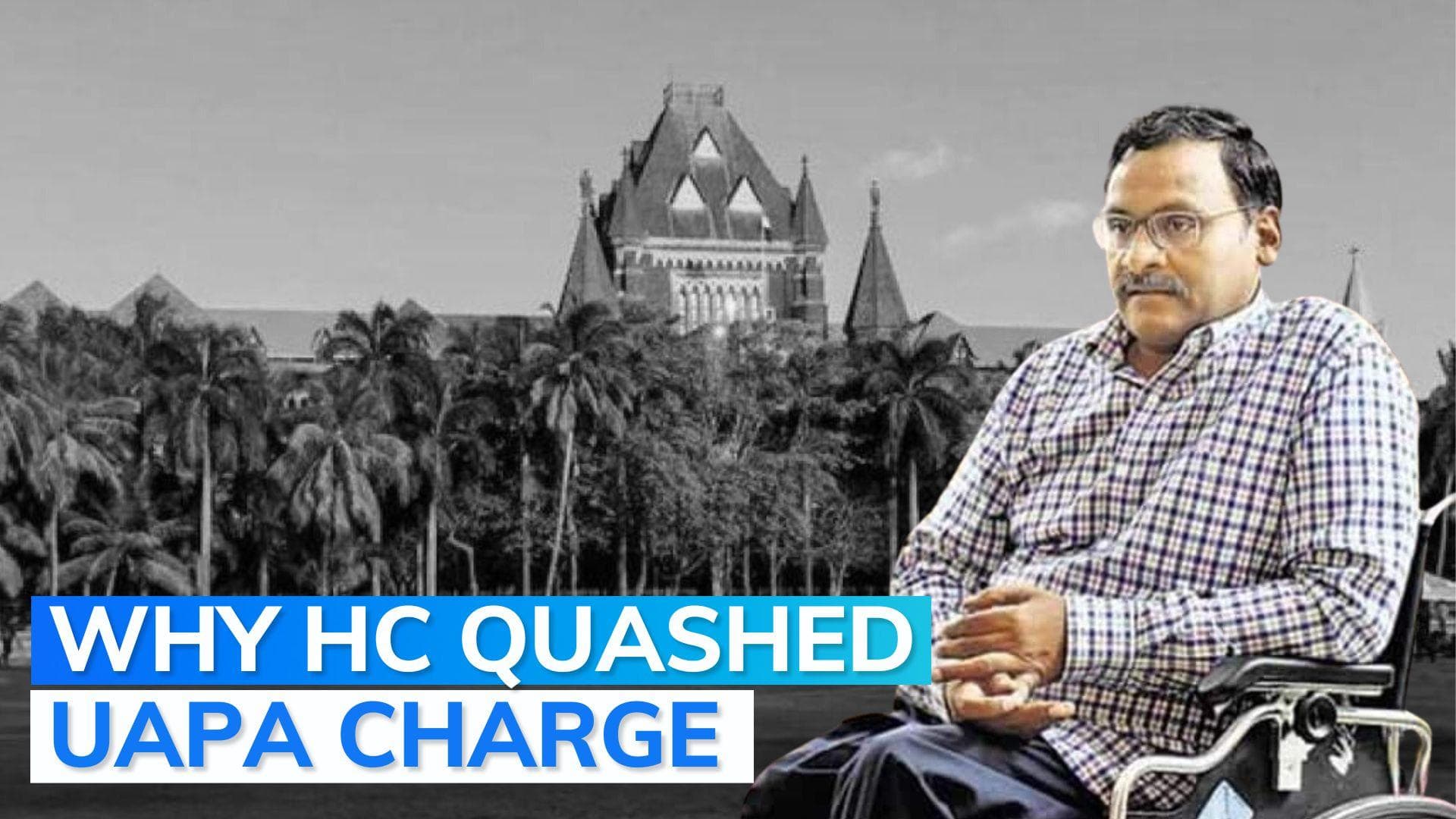
More than eight years after his arrest, the Bombay High Court on Friday acquitted former Delhi University professor G N Saibaba in an alleged Maoist links case, and ordered his release from jail noting that the sanction order issued to prosecute the accused in the case under the stringent provisions of the UAPA was "bad in law and invalid".
The high court's Nagpur division bench of Justices Rohit Deo and Anil Pansare allowed the appeal filed by Saibaba challenging a 2017 order of the trial court convicting him and sentencing him to life imprisonment.
Saibaba, 52, who is wheelchair-bound due to a physical disability, is currently lodged at the Nagpur central prison. He was arrested in February 2014.
In March 2017, a sessions court in Maharashtra's Gadchiroli district had convicted Saibaba and others, including a journalist and a Jawaharlal Nehru University (JNU) student for alleged Maoist links and for indulging in activities amounting to waging war against the country. The court had held Saibaba and others guilty under various provisions of the stringent Unlawful Activities (Prevention) Act (UAPA) and the Indian Penal Code (IPC).
Sanction to prosecute the accused under the UAPA was granted in 2014 against the five accused, who were arrested first, and against Saibaba in 2015.
The bench noted that in 2014 when the trial court took cognisance of the charge-sheet filed by the prosecution, there was no sanction to prosecute Saibaba under the UAPA.
The prosecution had alleged that the convicts were active members of banned terrorist outfit CPI (Maoist) and its frontal organisation Revolutionary Democratic Front.
The court in its judgment noted that the trial court proceedings were "null and void" in the absence of valid sanction under the UAPA and hence the judgment (of the trial court) was liable to be set aside and quashed.
The court held that terrorism poses an ominous threat to national security and vile and abhorrent acts of terror do evoke collective societal anger and anguish.
"While the war against terror must be waged by the State with unwavering resolve, and every legitimate weapon in the armory must be deployed in the fight against terror, a civil democratic society can ill afford sacrificing the procedural safeguards legislatively provided, and which is an integral facet of the due process of law, at the altar of perceived peril to national security," the judgment said.
The bench noted that the legislative imperative is that sanction for prosecution shall be given only after considering the report of the independent authority (appointed under the Act), which shall make an independent review of the evidence gathered during the investigation and make a recommendation.
It added that the report of the appointed authority in the present case renders no aid or assistance to the sanctioning authority, being devoid of reasons or brief summary of the analysis of the review of evidence gathered.
"We unhesitatingly hold that the sanctioning authority paid lip service to the legislative mandate and the report of the appointed authority was sought, and unfortunately given as a ritualistic formality. The transgression of the legislative imperative renders the sanction order bad in law and hence invalid," the court said in its judgment.
It said that any departure from the due process of law fosters an ecosystem in which terrorism burgeons and provides fodder to vested interests, whose singular agenda is to propagate false narratives.
Ideally, the sanction order must be self-explanatory and relevant facts and circumstances on the basis of which sanction is accorded must ordinarily appear on the face of the sanction order, it added.
"We are inclined to hold that every safeguard, however miniscule, legislatively provided to the accused, must be zealously protected," the court said.
The Siren Song that the end justifies the means, and that the procedural safeguards are subservient to the overwhelming need to ensure that the accused is prosecuted and punished, must be muzzled by the voice of Rule of Law, it added.
Sanction is a solemn and sacrosanct act that empowers the Court to take cognizance of offence. Sanction serves the salutary object of providing safeguard to the accused from unwarranted prosecution and the agony and trauma of trial and in the context of the stringent provisions of the UAPA, is an integral facet of due process of law, it said.
Under UAPA, an independent authority is appointed to make an independent review of the evidence in the case and then submit a report recommending if the provisions of the Act can be invoked against the accused.
"The authority claims to have perused the copies of the FIR, panchnama, copies of witness statements and other related documents and then concludes that there is prima facie evidence against the accused under UAPA," the HC said.
This purported report contains the conclusion sans reasoning, the judgment said, adding that the report was just a communication in the form of recommendation.
"In our view, a laconic communication conveying only the recommendation sans summary of analysis of the review of the evidentiary material is not a report which the legislature intended the appointed authority shall submit to the sanctioning authority, and stands on the same footing as absence of report,” the bench added.
Apart from Saibaba, the court acquitted Mahesh Kariman Tirki, Pandu Pora Narote (both farmers), Hem Keshavdatta Mishra (student) and Prashant Sanglikar (journalist), who were sentenced to life imprisonment and Vijay Tirki (labourer) who was sentenced to ten years in jail. Narote died during pendency of the appeal hearing.
The bench directed for the convicts to be released forthwith from jail unless they are accused in any other case.
Also watch: Maoist links case: Bombay HC acquits ex-DU professor GN Saibaba