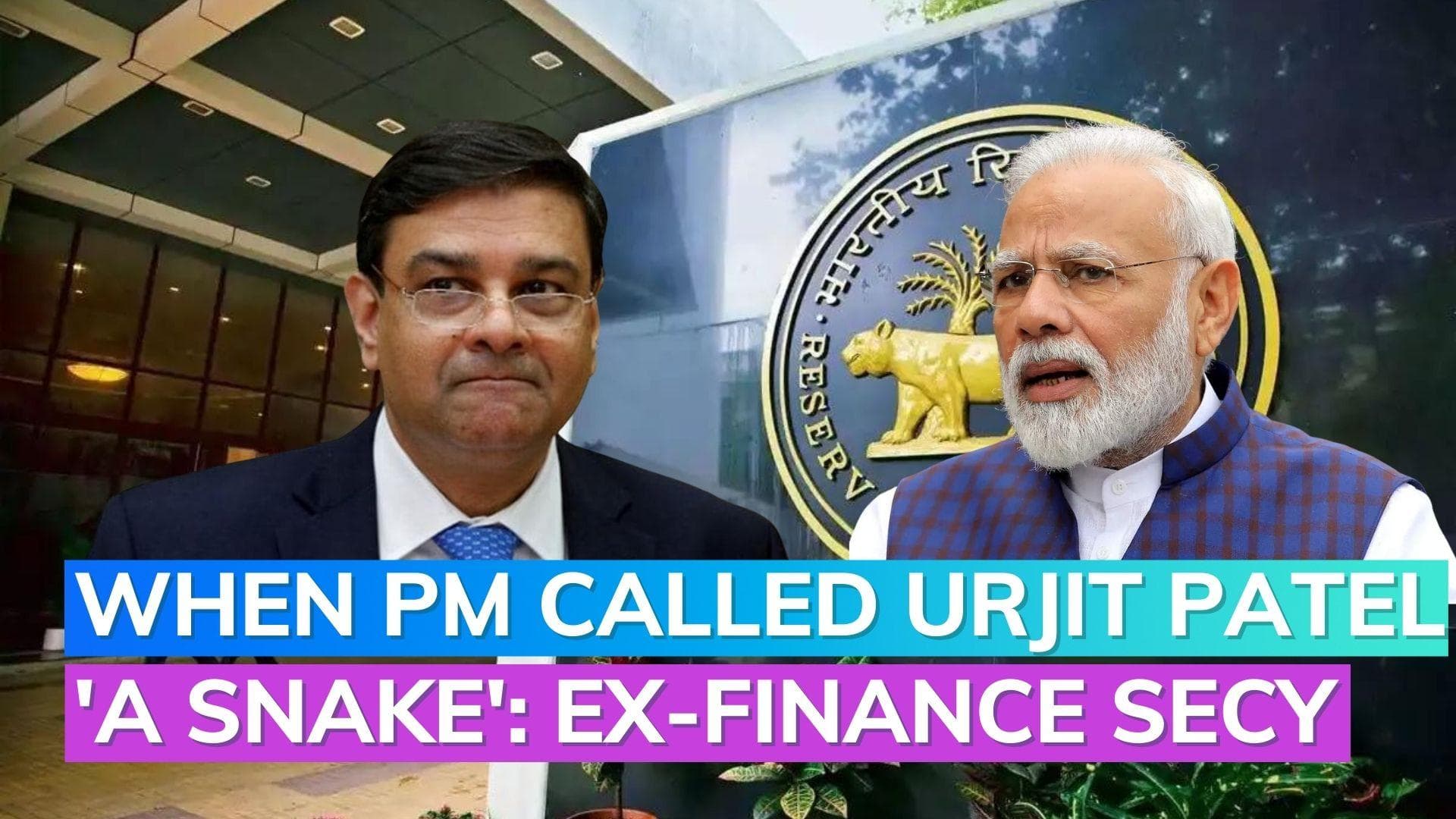
Former Finance Secretary Subhash Chandra Garg in his book, 'We also Make Policy' has claimed that PM Modi compared Former RBI Chief Urjit Patel to 'a snake who sits over a hoard of money'.
The book describes all the event that led to the break down in the relationship between the Central government and the RBI when Urjit Patel was serving as the RBI chief. Excerpts from the book say that by 2018 the government was frustrated with RBI under Urjit Patel.
"By July 2018, the government was frustrated with RBI under Dr Urjit Patel. A big build-up had led the situation to rise to this unfortunate level, a level that had upset even a person like Arun Jaitley", the book says.
Also Read: RBI Monetary Policy: Here's what to expect
The starting point
The book claims that the rift began on 12 February 2018, when RBI Governor Urjit Patel had come out with an extremely severe formulation for dealing with the non-performing loans of the banking sector and taking these defaulters for resolution under the IBC. Power Generation companies faced major problems to acquire bank loans.
Along with this, the Central bank of India also refused to take part in the High-Level Empowered Committee that was constituted under the chairmanship of cabinet secretary. The comittee aimed at resolving the stress in the power sector.
Urjit Patel's speech
Urjit Patel, on 14 March 2018 had delivered a scathing speech at the Centre for Law & Economics at Gujarat National Law University in Gandhinagar. The book quotes his speech and has said that he questioned the government’s inability to shed regulatory authority over nationalized banks. He further went on to say that this inability has left the RBI with inadequate regulatory authority over the PSBs compared to private-sector banks.
Electoral Bonds
The book also mentions that through out March and April 2018, Patel had tried to scamper the government's Electoral Bonds move. He insisted that the bonds be released by only the RBI, that too in Digital mode. Subhash Chandra Garg calls this an 'afterthought' as Patel had first agreed to the proposal of designing and issuing these bonds through the banking system.
Repo Rate Hike
Urjit Patel also hiked the repo rate in India to 6.25% in June 2018. He said that the rate was increased due to potential rise in inflationary pressures to the government’s decision to hike minimum support prices. Again in August 2018, RBI increased the repo rate by another 25%.
Subhash Chandra Garg mentions that the RBI was maintaining a very tight liquidity situation, with banks being forced to continuously borrow from it under the liquidity window. This further pressurised the government to put additional capital in banks.
Communication Gap
Garg in his book has claimed that as the Government's distrust on RBI grew, the Centre wanted to have more discussions. However, the more the government wanted to discuss, the more Urjit Patel became 'intransigent and non-communicative'.
The book mentions that the then Finance Minister Arun Jaitely felt bad about the way RBI, in particular Urjit Patel, was conducting himself. The perception of Urjit Patel wanting to go down the history as as the most independent governor of RBI was also widely growing. The book also says that Arun Jaitely shared those perceptions.
Invoking Section 7 of RBI ACT
All this piled up frustrations, pushed the government to invoke Section 7 of the RBI Act. This section allows the centre to issue directives to the RBI governor following consultations. Following this, PM Modi called for a meeting to review the State of Economy and What the RBI could. Urjit Patel along with his two deputy governors, Viral Acharya and N.S. Vishwanathan attended the meet that was held on September 14, 2018.
From the government side Finance Minister Arun Jaitley, Railways Minister Piyush Goyal, Principal Secretary to the Prime Minister Nripendra Misra, Additional Principal Secretary P.K. Mishra, DFS Secretary Rajiv Kumar and the book's author Subhash Chandra Garg took part.
The book describes the presentation made by Urjit Patel as being alarmist and painted a horrible picture of the then prevailing economic situation. All his recommendations were for the government to take and nothing for RBI to do, besides what it had been doing already.
Prime Minister's Plain-Speak
The book claims that Prime Minister's patience had possibly been fully tested and he was sick of the situation. When he saw no solution emerging at the end of presentation, he assessed that the RBI was unwilling to do anything meaningful to address the economic situation and resolve its differences with the government.At that stage, the PM lost his cool and took on Urjit Patel. That was when he compared Urjit Patel to the snake who sits over a hoard of money, for being unreceptive to putting RBI’s accumulated reserves to any use.
Resignation
The tensions between the RBI and Government grew regarding the stringent framework for handling non-performing loans in the banking sector. This eventually led Patel's resignation as RBI Governor on December 10, 2018, citing policy disagreements with the government.
(With inputs from the Excerpts of the book 'We also Make Policy', published in Financial Express)