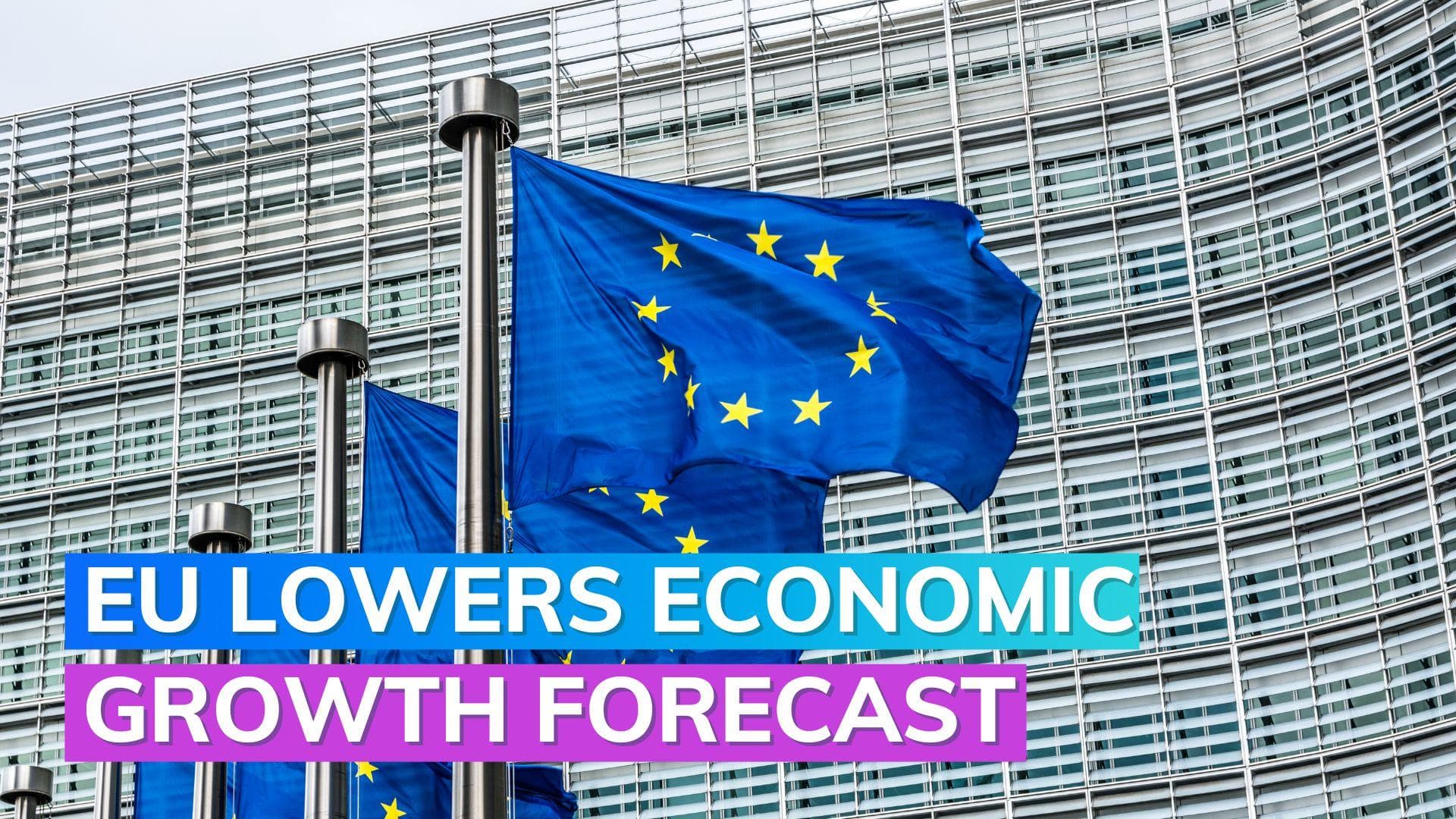
The European Union lowered its economic growthforecast for 2023 and 2024, saying inflation is taking a heavy toll on people's willingness to spend in shops — while higher interest rates are sharply restricting the credit needed for investment and purchases.
The revised forecast Monday from the European Commission, the EU's executive arm, comes as fears of recession grows and as the European Central Bank faces a key decision this week on whether to keep raising rates, which are aimed at getting inflation under control.
The 20 countries that use the euro currency are expected to see growth of 0.8 per cent this year instead of 1.1 per cent projected in the spring forecast, the commission said. For next year, growth expectations were lowered to 1.3 per cent from 1.6 per cent.
For the broader 27-country EU, the forecast also was lowered to 0.8per cent from 1 per cent this year and to 1.4 per cent from 1.7 per cent next year.
"Weakness in domestic demand, in particular consumption, shows that high and still increasing consumer prices for most goods and services are taking a heavier toll than expected," a commission statement said.
EU Economy Commissioner Paolo Gentiloni said at a news conference that “further weakening in the coming months” was foreseen as the economy faces “multiple headwinds.” One source of uncertainty is how far the ECB will go on interest rates — more expensive credit restrains economic growth in some areas such as real estate, but if higher rates succeed in lowering inflation, that would boost consumer spending power.
Recession fears have grown even after the eurozone scraped through the winter without one, recording stagnant growth of 0.1 per cent in the first two quarters of this year.
Surveys of purchasing managers show that economic activity is contracting in all major eurozone economies, according to Alexander Valentin, senior economist at Oxford Economics, data that “add to mounting recession risks.” A key source of weakness has been Germany, whose manufacturing- and export-oriented economy has been hit by higher energy prices and slowing demand in China, a key trade partner.
The commission cut its forecast for Europe's largest economy this year to minus 0.4 per cent.
Germany is the only major economy expected to shrink this year, according to the International Monetary Fund, which foresees a decline of 0.3 per cent.
It will take time for Germany to address its issues with energy costs, Gentiloni said: “You don't solve this in a couple of weeks." But he added that "this is a strong economy with the tools and the possibility to recover.” Despite near-zero growth, the state of the larger eurozone economy doesn't resemble a typical recession, because unemployment is at record lows and wages are gradually catching up to the purchasing power lost to inflation as workers demand and get more.
Energy prices have declined since their brutal spike tied to Russia's war in Ukraine, while food inflation keeps declining. Annual inflation was 5.3 per cent in July, down from the peak of 10.6 per cent in October.
The eurozone suffered twin shocks from the invasion of Ukraine and the COVID-19 pandemic. Russia cut off most of its natural gas to Europe, sending prices skyrocketing and starting a scramble to line up more expensive alternative supplies.
The economic rebound from the pandemic sent consumer prices higher as demand for goods created bottlenecks in supplies of raw materials and parts, which have now mostly eased.
Higher prices spread to food and then services, a broad category ranging from haircuts and hotel stays to medical treatments and car repairs.
Prospects of weakening economic growth have led some economists to predict the European Central Bank may avoid raising interest rates Thursday following nine straight hikes.
ECB President Christine Lagarde has said the decision is open and will be made based on available data.
In just over a year, the central bank has raised its benchmark deposit rate from minus 0.5 per cent to 3.75 per cent, the fastest pace since the euro currency launched in 1999.
The downgrade in the EU forecast comes as the euro trades lower against the US dollar — at USD 1.07, down from about USD 1.12 in late July.
One reason is an ongoing rally in the dollar, which has recorded gains against other major currencies for eight straight weeks as the market increasingly sees economic weakness in China and Europe instead of in the US.
A weaker euro can complicate life for the ECB by increasing the price of imported goods — such as energy — that are priced in dollars. On the other hand, it makes European exports more competitive in price.