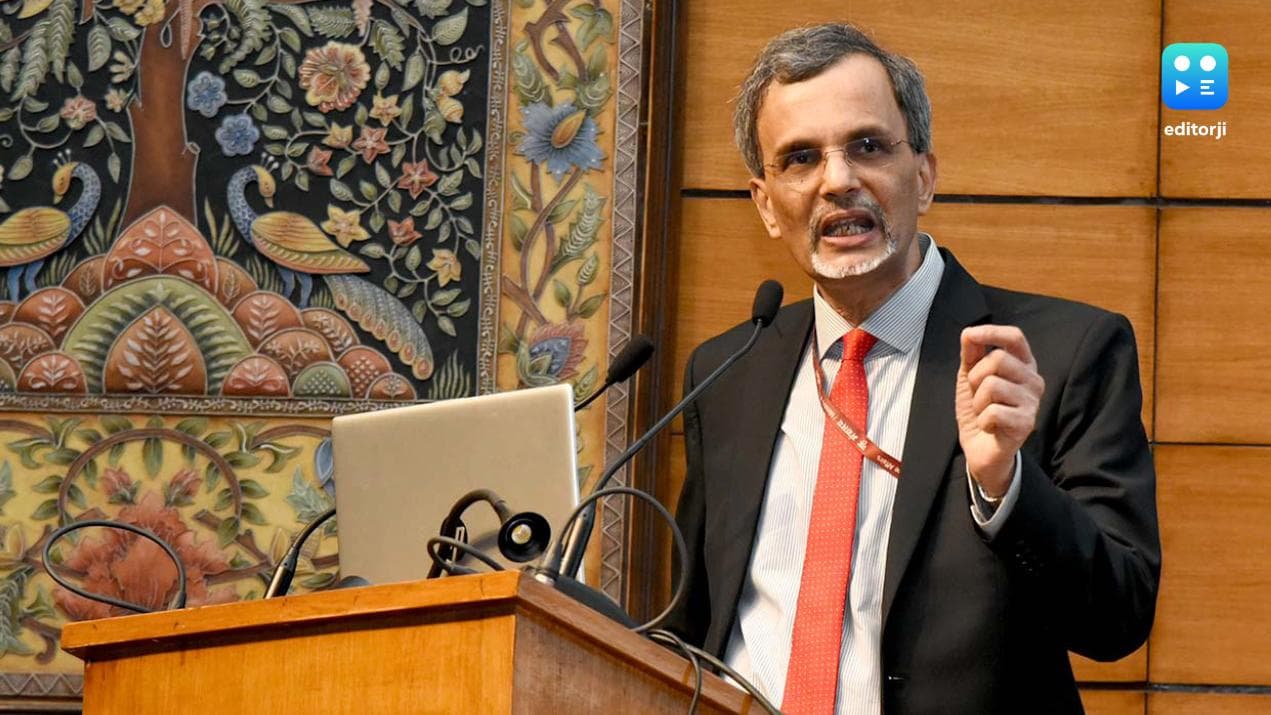
India has to generate 8 million jobs per year at least for the next 10-12 years and raise the share of manufacturing in GDP as it strives to achieve the vision of becoming a developed country by 2047, Chief Economic Advisor to the Government of India V Anantha Nageswaran said.
"We have a vision to achieve a developed India by 2047. The biggest challenge, apart from India's size, is that the external environment is not going to be so benign for the next 10-20 years as one might have had in the last 30 years, starting from 1990 or so,” Nageswaran said here Saturday.
“But within this context - that's a given, you can't choose your external environment beyond a point - we have to generate 8 million jobs per year at least for the next 10 to 12 years...And raise the manufacturing share of GDP, in the context of China having achieved such a tremendous manufacturing dominance, especially post-COVID,” he said.
Nageswaran was addressing the Columbia India Summit 2025 hosted by the Deepak and Neera Raj Centre on Indian Economic Policies at the School of International and Public Affairs at Columbia University.
He outlined that artificial intelligence, technology, and robotics are challenges that some of the developed countries of today do not have to face in their developmental journey.
"But India, with its size, has to navigate this huge, complex challenge, and there are no easy answers. If you look at the number of jobs we need to create, it’s about 8 million jobs a year. And Artificial Intelligence may have a big role in taking away entry-level jobs, or low IT-enabled services jobs may come under threat,” he said.
He added that it is one thing to prepare the population for a world dominated by AI, but it is another thing to ensure that “we find the right balance between labour-centric policies and technology, because technology at the end of the day is not just a choice to be made by technologists. It has to be made by public policymakers.” As India moves towards achieving the vision of ‘Viksit Bharat’ by 2047, the centennial year of its independence, it has to plug Indian businesses into global value chains as well as create a viable small and medium enterprise sector because manufacturing and MSME both go together. “Countries that became manufacturing powerhouses did not do so without having a viable small and medium enterprise sector,” he said.
Nageswaran further said that either investment rates have to rise from where they are or “we have to make sure that we extract maximum possible juice out of existing investments because global capital flows are also going to be affected by ongoing conflicts between nations." He said that, therefore, it is not that external trade is not going to matter.
"It will matter and we need to focus on that because external competitiveness is also a way to boost domestic innovation, domestic potential growth." "But at the same time, we cannot expect that to contribute the way it did in the first decade, when India averaged 8 to 9 per cent GDP growth between 2003 and 2008. Every year, exports contributed 40% to GDP growth in the first decade, especially pre-crisis. In the second decade, that contribution came down to 20%, and in the third decade it might be even lower,” he said.
Nageswaran noted that it is not that India’s export competitiveness does not matter.
"It has to be the driving force. One has to get up one's game on quality, R&D and internally on logistics and last-mile connectivity. But from a policy perspective, it will make sense to assume that it will not be so easily possible to extract growth out of exports as we used to do before,” he said.
He noted that in the last three years post-COVID, India’s growth has averaged more than 8%.
"Obviously, in the current environment, sustaining an 8% growth rate is going to be a very tall order. But if we can maintain growth rates of even 6.5 per cent on a sustainable basis over the next decade or two and look to opportunistically increase it to over 7 per cent by focusing on domestic deregulation, that will be the way to go.” Last week, the UN Trade and Development (UNCTAD) had said India is expected to grow by 6.5 per cent in 2025 on the back of continued robust public spending and ongoing monetary easing, even as the world economy is on a recessionary trajectory, driven by escalating trade tensions and persistent uncertainty.
The day-long event at Columbia was attended by faculty, students, policy experts and economists and the discussion focused on the future of India's economy, innovation and trade.
"The task ahead for India is quite immense in a difficult and challenging global environment, but I think the policy determination and identification of priorities, as we have done with emphasis on deregulation, can enable us to maintain the growth advantage even in this difficult environment,” Nageswaran said.