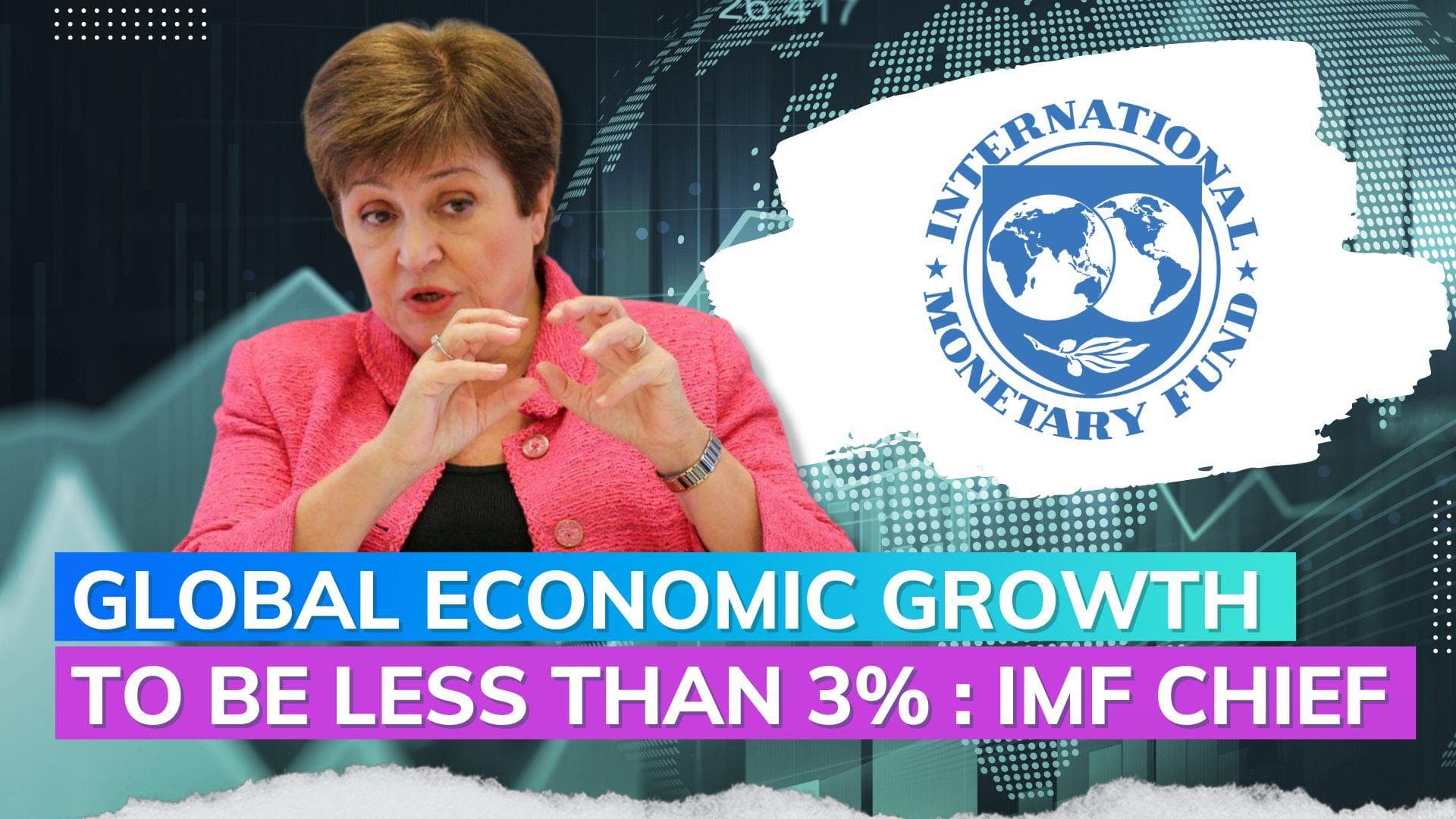
The International Monetary Fund chief said Thursday the world economy is expected to grow less than 3% this year, down from 3.4% last year, increasing the risk of hunger and poverty globally.
Kristalina Georgieva said the period of slower economic activity will be prolonged, with the next five years of growth remaining around 3%, calling it “our lowest medium-term growth forecast since 1990, and well below the average of 3.8% from the past two decades.” Georgieva said slower growth would be a “severe blow," making it even harder for low-income nations to catch up.
"Poverty and hunger could further increase, a dangerous trend that was started by the COVID crisis,” she said.
Georgieva's comments at a Politico event at the Meridian International Centre come ahead of next week's spring meetings of the IMF and its sister lending agency, the World Bank, in Washington, where policymakers will convene to discuss the global economy's most pressing issues.
The annual gathering will take place as central banks around the world continue to raise interest rates to tame persistent inflation and as an ongoing debt crisis in emerging economies pushes debt burdens higher, preventing nations from developing.
Roughly 15% of low-income countries are already in debt distress, and another 45% face high debt vulnerabilities, according to the IMF.
Georgieva said high-interest rates, a series of bank failures in the U.S. and Europe, and deepening geopolitical divisions are threatening global financial stability.
Given the economic projections, non-governmental organisations are calling for the IMF to allocate more funds to low-income countries through Special Drawing Rights, which are an IMF international reserve asset that can be exchanged for hard currency.
More than 50 NGOs, labour unions and civil organisations sent a letter to the U.S. Treasury Department and the White House on Thursday calling for the U.S. representative at the IMF to support a new allocation of Special Drawing Rights for use by low-income countries.
Center for Economic and Policy Research co-director Mark Weisbrot said the funds could be used for food and medicine and to help countries “avoid destructive economic crises." President Joe Biden's budget proposal requests $2.3 billion for contributions to multilateral development banks, including the IMF. Republicans have yet put forth their own budget plan before negotiations start with the Democratic president.
Georgieva said that countries have thus far been “resilient climbers” out of the coronavirus pandemic, which has killed almost 6.9 million people globally, according to the World Health Organisation, and has disrupted global supply chains and exacerbated worldwide food insecurity.
Based on her report, countries see stark differences in the possibility of recession risks. “Asia especially is a bright spot,” she said, as India and China are expected to account for half of global growth in 2023.
Advanced economies face the challenge of high inflation, as 90% of them are projected to see a decline in their growth rate this year.
This all comes as the United States, the European Union and others are rethinking their trade relationships with China.
Tensions with China accelerated after Russia's invasion of Ukraine in February 2022, with Chinese President Xi Jinping pledging a friendship without limits to Russian President Vladimir Putin.
Georgieva warned in her speech: “But the path ahead — and especially the path back to robust growth — is rough and foggy, and the ropes that hold us together may be weaker now than they were just a few years ago.” “Now is not the time to be complacent,” she said.
“We are in a more shock-prone world, and we have to be ready for it.
.
Kristalina Georgieva said the period of slower economic activity will be prolonged, with the next five years of growth remaining around 3%, calling it “our lowest medium-term growth forecast since 1990, and well below the average of 3.8% from the past two decades.” Georgieva said slower growth would be a “severe blow," making it even harder for low-income nations to catch up.
"Poverty and hunger could further increase, a dangerous trend that was started by the COVID crisis,” she said.
Georgieva's comments at a Politico event at the Meridian International Centre come ahead of next week's spring meetings of the IMF and its sister lending agency, the World Bank, in Washington, where policymakers will convene to discuss the global economy's most pressing issues.
The annual gathering will take place as central banks around the world continue to raise interest rates to tame persistent inflation and as an ongoing debt crisis in emerging economies pushes debt burdens higher, preventing nations from developing.
Roughly 15% of low-income countries are already in debt distress, and another 45% face high debt vulnerabilities, according to the IMF.
Georgieva said high-interest rates, a series of bank failures in the U.S. and Europe, and deepening geopolitical divisions are threatening global financial stability.
Given the economic projections, non-governmental organisations are calling for the IMF to allocate more funds to low-income countries through Special Drawing Rights, which are an IMF international reserve asset that can be exchanged for hard currency.
More than 50 NGOs, labour unions and civil organisations sent a letter to the U.S. Treasury Department and the White House on Thursday calling for the U.S. representative at the IMF to support a new allocation of Special Drawing Rights for use by low-income countries.
Center for Economic and Policy Research co-director Mark Weisbrot said the funds could be used for food and medicine and to help countries “avoid destructive economic crises." President Joe Biden's budget proposal requests $2.3 billion for contributions to multilateral development banks, including the IMF. Republicans have yet to put forth their own budget plan before negotiations start with the Democratic president.
Georgieva said that countries have thus far been “resilient climbers” out of the coronavirus pandemic, which has killed almost 6.9 million people globally, according to the World Health Organisation, and has disrupted global supply chains and exacerbated worldwide food insecurity.
Based on her report, countries see stark differences in the possibility of recession risks. “Asia especially is a bright spot,” she said, as India and China are expected to account for half of the global growth in 2023.
Advanced economies face the challenge of high inflation, as 90% of them are projected to see a decline in their growth rate this year.
This all comes as the United States, the European Union and others are rethinking their trade relationships with China.
Tensions with China accelerated after Russia's invasion of Ukraine in February 2022, with Chinese President Xi Jinping pledging a friendship without limits to Russian President Vladimir Putin.
Georgieva warned in her speech: “But the path ahead especially the path back to robust growth is rough and foggy, and the ropes that hold us together may be weaker now than they were just a few years ago.” “Now is not the time to be complacent,” she said.
“We are in a more shock-prone world, and we have to be ready for it.