Highlights

  • Houthi attacks disrupt vital Red Sea shipping routes, impacting global trade
  • Rising war risk premiums escalate expenses, altering import dynamics

Latest news

Future Netwings Solution Enhances Service Delivery with the Business Continuity Policy

Future Netwings Solution Enhances Service Delivery with the Business Continuity Policy

India-UK trade deal likely by May 1; Europe deal expected by year-end

India-UK trade deal likely by May 1; Europe deal expected by year-end

VerSe Innovation Appoints Prasanna Prasad as Chief Product and Technology Officer to Accelerate AI-Led Product and Platform Innovation

VerSe Innovation Appoints Prasanna Prasad as Chief Product and Technology Officer to Accelerate AI-Led Product and Platform Innovation

Changing Aspirations of Premium Homebuyers in NCR

Changing Aspirations of Premium Homebuyers in NCR

Airfloa Rail Technology's FY26 Business Update and Strategic Direction

Airfloa Rail Technology's FY26 Business Update and Strategic Direction

Sanjay Khanna Appointed as Chairman & Managing Director of BPCL

Sanjay Khanna Appointed as Chairman & Managing Director of BPCL

Galgotias University Placement Report: 4700+ Offers Across Top Recruiters in 2026

Galgotias University Placement Report: 4700+ Offers Across Top Recruiters in 2026

"Be the same loving brother you are to me...": Sanjay Dutt pens heartfelt birthday note for Anant Ambani

"Be the same loving brother you are to me...": Sanjay Dutt pens heartfelt birthday note for Anant Ambani

Crisis in Red Sea: This is why there's a red light for ships in the region now

The Red Sea, famed for trade, faces crisis with escalating Houthi attacks, threatening global economic repercussions by disrupting vital shipping routes. The surge in conflict escalates war risk premiums, significantly inflating expenses for transportation 

Crisis in Red Sea: This is why there's a red light for ships in the region now

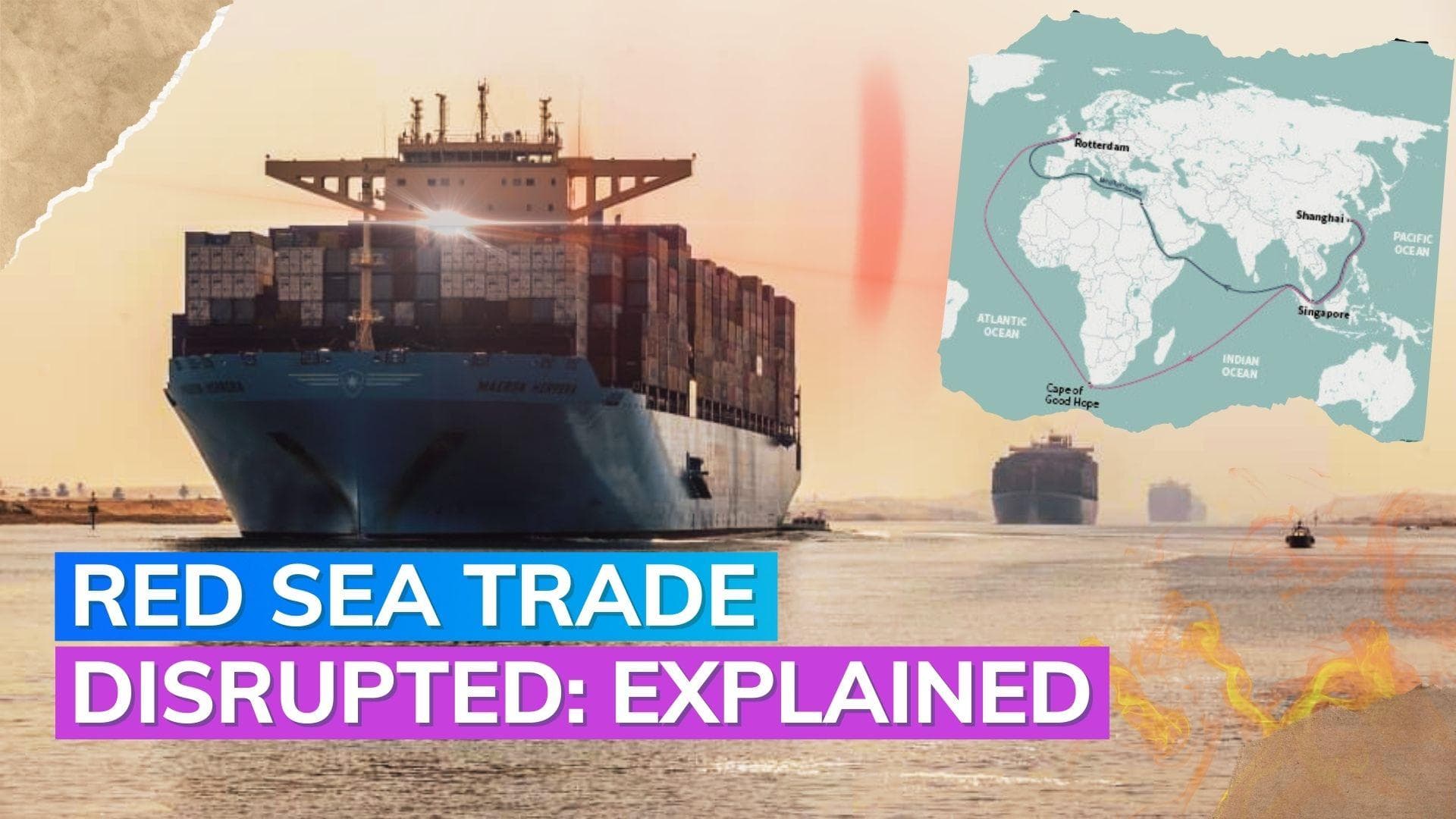
The Red Sea, historically renowned for connecting nations and facilitating trade, is now at the epicentre of a crisis that could have ramifications on the global economy. The escalation of Houthi attacks disrupting vital shipping routes has thrown the region into turmoil. At the heart of the crisis lies the strategic trade corridor of the Red Sea, a crucial passageway that feeds into the Suez Canal—the world's busiest and most pivotal trade artery. This maritime thoroughfare witnesses the daily transit of ships laden with commodities such as oil, grain, and various consumer goods. Any disturbance in this region reverberates across global commerce.

Trade worth $700 billion flows through the route

The staggering economic value associated with the Red Sea route is immense. Approximately $700 billion worth of trade flows through this region on a daily basis. Annually, the Suez Canal accounts for 12% of global trade passing through the Red Sea. The recent surge in Houthi attacks poses a substantial threat. Prolonged conflict leading to a halt in canal usage could result in severe economic losses, disrupting supply chains and impacting industries and consumers worldwide.

Why Houthi are attacking ships?

The intensified attacks by Houthi rebels are intrinsically linked to the ongoing Israel-Hamas conflict. Backed by Iran, the Houthis target vessels they perceive as associated with Israel. These actions stem from geopolitical tensions and a quest for regional influence, transforming the Red Sea into a battleground for power struggles.

Impact on trade routes and consumer costs

The longer and more expensive alternative route around the Good Hope Cape near Africa is an option but is not very viable as vessels travelling from Asia to Israel take a notably longer route around Africa, spanning approximately 7,000 nautical miles and lasting between 10 to 14 days, as opposed to the quicker passage through the Suez Canal. Additionally, this alternative route results in increased fuel expenses

Another issue is rising war risk premiums. Shipping companies, compelled to cover higher risks in conflict zones, impose elevated premiums, subsequently affecting product costs. Consequently, consumers may experience increased prices for goods transported through the canal, thereby altering import-export dynamics.

Normally, ships are required to inform their insurers when navigating through high-risk zones and to make an extra payment as a premium. At the beginning of December, this additional risk premium, paid by shipping companies, stood at a mere 0.07% of a ship's value. However, it has surged to approximately 0.5%-0.7% recently. Recently, a consortium of prominent marine insurers expanded the designated high-risk area in the Red Sea, leading to more vessels being subject to this premium. Consequently, the expenses associated with shipping goods through the Red Sea have escalated by tens of thousands of dollars per week.

The Suez Canal Authority recently announced an increase of 5%-15% in transit fees, taking advantage of the increase in vessel traffic as more ocean carriers avoid the Panama Canal, reported the Freight Waves.

Oil prices experienced a slight surge on December 18 due to clashes in the Suez Canal. The benchmark Brent crude oil rose by 0.8%, reaching $77.18 per barrel, as major shipping companies including BP, Maersk, MSC, Hapag Lloyd announced their decision to avoid the route.

The India Impact

From an Indian perspective, the crisis has implications:

Coal Imports: India imports around 20 million tonnes of non-coking coal via the Red Sea, primarily from the US and Russia. The logistical hurdles caused by the crisis may affect this crucial supply.
Energy Security: India’s energy security relies on stable sea routes. Any disruption in the Red Sea jeopardizes our access to oil and gas. As a growing economy, India closely watches developments in this region.

Also Watch: Red Sea crisis sparks temporary surge in oil prices

ADVERTISEMENT

Up Next

Crisis in Red Sea: This is why there's a red light for ships in the region now

Crisis in Red Sea: This is why there's a red light for ships in the region now

Centre plans to borrow Rs 8.20 lakh cr from market in first half of FY27

Centre plans to borrow Rs 8.20 lakh cr from market in first half of FY27

Reliance denies buying Iranian oil amid US sanctions waiver

Reliance denies buying Iranian oil amid US sanctions waiver

Premium petrol price up Rs 2, industrial diesel up Rs 22; no change in normal petrol, diesel rates

Premium petrol price up Rs 2, industrial diesel up Rs 22; no change in normal petrol, diesel rates

India's GDP expected to register over 8 pc growth in Sep-Dec: Report

India's GDP expected to register over 8 pc growth in Sep-Dec: Report

Govt announces seven measures to help boost exports

Govt announces seven measures to help boost exports

ADVERTISEMENT

editorji-whatsApp

More videos

RBI keeps interest rates on hold after US trade deal boosts outlook

RBI keeps interest rates on hold after US trade deal boosts outlook

RBI proposes to compensate customers up to Rs 25,000 loss due to fraud

RBI proposes to compensate customers up to Rs 25,000 loss due to fraud

RBI raises GDP growth projection of Q1, Q2 of FY27

RBI raises GDP growth projection of Q1, Q2 of FY27

RBI pauses rate cuts, retains interest rate at 5.25 pc

RBI pauses rate cuts, retains interest rate at 5.25 pc

Rupee jumps 122 paise to close at 90.27 against US dollar on India-US trade deal

Rupee jumps 122 paise to close at 90.27 against US dollar on India-US trade deal

Stock markets cheer India-US trade deal: Sensex, Nifty surge 2.5 pc

Stock markets cheer India-US trade deal: Sensex, Nifty surge 2.5 pc

UPI transactions hit record high of Rs 230 lakh crore in 2025-26 till Dec: Govt

UPI transactions hit record high of Rs 230 lakh crore in 2025-26 till Dec: Govt

Explained: India-US trade deal, tariffs and trade benefits

Explained: India-US trade deal, tariffs and trade benefits

Trade deal with US adds momentum to India's growth ambition: Industry leaders

Trade deal with US adds momentum to India's growth ambition: Industry leaders

Rupee jumps 119 paise to 90.30 against the US dollar on India-US trade deal

Rupee jumps 119 paise to 90.30 against the US dollar on India-US trade deal

Editorji Technologies Pvt. Ltd. © 2022 All Rights Reserved.