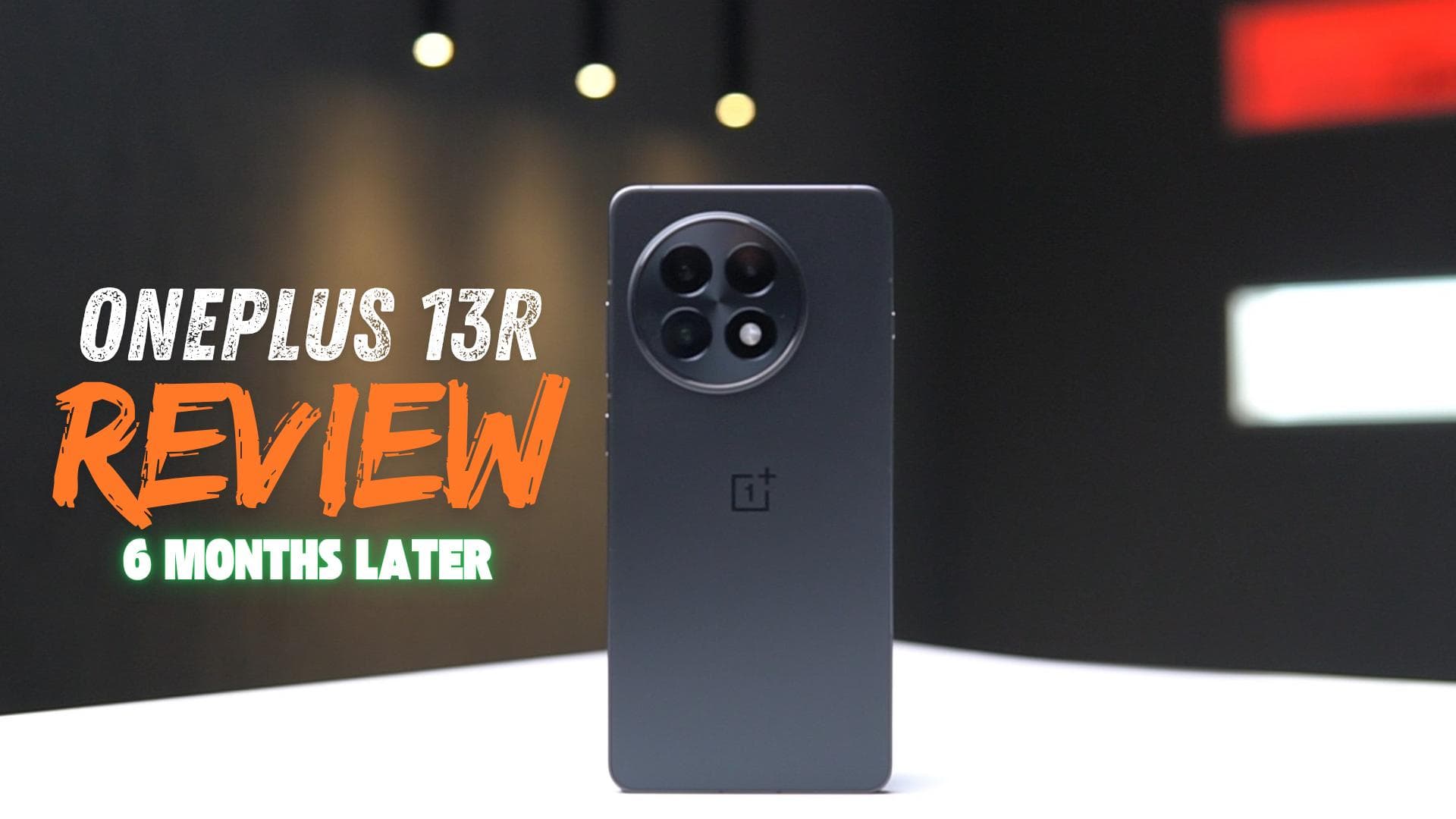
We were impressed with the OnePlus 13R when it launched back in January. Its predecessor, the 12R, was already one of those rare phones that felt like it punched above its weight, and the 13R seemed to take that formula even further.
But six months later, after using it as my daily driver, does the 13R still hold up? Has it improved with updates or started to show its flaws?
And with Amazon Prime Day around the corner, the timing couldn’t be more interesting. The 13R will drop by ₹3,000 during the sale, bringing the price down from ₹42,999 to ₹39,999 — and OnePlus is even tossing in a free pair of OnePlus Buds 3 to sweeten the deal. (By the way, those earbuds are genuinely great.)
So, here’s how the OnePlus 13R has held up after half a year of real-world use.
OnePlus 13R Design, Display & Utility
Let’s talk about the design and display first. If you’re looking for a phone that makes a bold aesthetic statement, this isn’t it. The OnePlus 13R is understated to say the least.
Sure, it borrows the design language of its pricier sibling, the OnePlus 13, but something about it feels dialed down — maybe it’s this muted Nebula Noir colour or the familiar camera module that no longer feels fresh.
But then you turn on the screen… and it all changes. This is, hands down, one of the nicest displays I’ve seen on an upper mid range phone. The 6.78-inch LTPO AMOLED panel doesn’t just look good on paper — with Dolby Vision, silky smooth adaptive refresh rates, and impressive peak brightness — it feelsgood in actual use.
It's a flat display which I absolutely love and the bezels are shockingly thin and uniform, which gives the whole phone a modern vibe. Scrolling through X and instagram feels effortless. Watching HDR content on YouTube or Netflix is a delight, with punchy colors and deep contrast.
If I had to nitpick, I'd say the position of the in-display fingerprint is a tad bit on the lower side but I've learned to live with it. The bigger problem is the way this phone sits in the hand, which feels a little off — not outright uncomfortable, but subtly fatiguing in a way I didn’t expect.
At first, I brushed it off. Most big phones need some adjustment, right? But after a few months of late-night scrolling and loads of gaming sessions, the problem kept creeping back in.
The 13R’s shape just doesn’t melt into your grip the way I want a daily driver to. Instead, it constantly reminds you it’s there, pressing and nudging at your palms like a slightly too-angular book spine.
Maybe it’s those flat aluminum sides — a design choice that feels unmistakably inspired by Apple’s iPhone 16 Pro series and, perhaps unsurprisingly, Oppo’s Find X8 range. (No shock there, considering OnePlus and Oppo operate under the same corporate umbrella).
Together with Gorilla Glass 7i on the front and back, the OnePlus 13R certainly looks the part of a premium device. And after living with it for a few months, I can say this: it’s built like one, too. I’ve fumbled it onto tile floors more times than I care to admit — both with the case and without — and yet, the 13R has held up beautifully.
One thing that still feels like a compromise is the water resistance. The 13R gets an IP65 rating, which is technically an upgrade over the 12R’s IP64 — meaning it can handle splashes and even jets of water. But at this price, it’s hard to ignore the fact that an IP68 rating (the kind that protects against full submersion) is becoming fairly common.
On the flip side, the OnePlus 13R holds on to something I wish the company would never mess with: the iconic alert slider. While the newer OnePlus 13 and Nord models have swapped it out for the so-called Plus Key (their answer to the iPhone’s Action Button), the 13R keeps it classic.
And honestly? I’m glad it does. Some things just don’t need to change. The alert slider is one of those rare features that feels instantly intuitive — a tactile little switch that lets me flip between silent, vibrate, and ring modes without even looking at the screen. It’s fast, it’s reliable, and it’s a reminder of the thoughtful design choices that used to set OnePlus apart.
Also, the stereo speakers are surprisingly loud for this price, and while there’s no Dolby Atmos support, I didn’t really feel like I was missing it.
OnePlus 13R Performance & Software
Here’s what surprised me most about the OnePlus 13R: at no point did it feel like I was using a “watered-down” version of the flagship.
Sure, on paper, this phone runs on the Snapdragon 8 Gen 3 instead of the more powerful Snapdragon 8 Elite that OnePlus puts in the 13, but in everyday use, the distinction is meaningless. Apps fly open while games like BGMI and Genshin Impact run a without a hiccup. Even after a couple of hours of pushing it hard, the phone didn’t flinch or heat up noticeably.
It makes me wonder if we’ve hit the ceiling for smartphone performance — where new chip generations sound impressive but feel irrelevant in day-to-day life. The 13R drives that point home: this isn’t just “good enough for a mid range phone.” It’s good enough, full stop.
What also helps here is that OnePlus didn’t skimp on the supporting specs. The base model comes with a generous 12GB of RAM and 256GB of speedy UFS 4.0 storage — the kind of numbers you’d expect from a more expensive flagship device. Together, they make the 13R feel not just fast today but future-proof for the long haul.
Speaking of longevity, OnePlus is promising four years of software updates and six years of security patches for the 13R. That’s a solid commitment and should keep the phone relevant for most people’s upgrade cycles.
But let’s be honest: in 2025, “solid” isn’t the same as “industry-leading.” Apple has been doing five years of updates for ages, and Google and Samsung are now throwing down seven years of software and security support on their latest devices.
Where OnePlus does stand out, though, is in the day-to-day software experience. OxygenOS 15 built on Android 15 is packed with small, thoughtful touches that made me miss it whenever I switched to other phones, like the Pixel 9. Simple things like being able to swap icon packs without ditching the default launcher or remapping swipe-down gestures feel like quality-of-life wins that other Android skins often forget about.
And then there’s Open Canvas. Borrowed from the OnePlus Open and the Pad 2, it lets you run two apps side by side, separated by a draggable horizontal bar so you can resize them on the fly. I didn’t think I’d use it much, but it turned out to be one of those features I now wish every phone had.
I wouldn’t say the 13R is completely free of third-party apps, but the good news is that anything preloaded can be uninstalled without hassle.
As for the haptics? Perfect. Sharp, precise, and deeply satisfying. Nothing more to add—some things don’t need paragraphs of praise.
Then there’s the AI — and there’s a lot of it. Some features feel like padding, but a few have actually earned a spot in my daily routine. Tools like AI Eraser and Reflection Eraser are great for cleaning up photos, Magic Compose makes messaging a little less robotic, and even the AI Assistant in Notes surprised me by being more than a gimmick when I needed quick summaries and organization.
OnePlus 13R Battery & Charging
The 13R’s massive 6,000mAh battery is one of those features you don’t fully appreciate until you live with it. It’s the kind of battery that gives you real peace of mind — the confidence to leave the house without a charger and not think twice.
Even on my heaviest days, with hours of streaming, navigation, and a few rounds of gaming thrown in, I’m still crawling into bed with around 20 percent left. And on quieter days, where I wasn’t hammering the GPU, the battery barely budged.
Of course, there’s also fast charging. The 13R comes with an 80W charger in the box, and it can charge the huge 6,000mAh battery from zero to 100 percent in under an hour.
But if there’s one thing that feels conspicuously absent from the 13R, it’s wireless charging. I didn’t think I’d miss it at first — after all, the insanely fast wired charging here still feels like magic. But after weeks of casually plopping my other devices onto charging pads around the house, I kept catching myself doing the same with the 13R… only to realize nothing was happening.
It’s a small omission, but in 2025, wireless charging feels less like a luxury and more like table stakes for a phone that gets so much else right.
OnePlus 13R Camera Performance
The OnePlus 13R packs a triple-camera array: a 50MP main sensor, a 50MP 2x telephoto, and an 8MP ultrawide. After using this phone for several months — and sitting through a couple of system updates along the way — I haven’t noticed any significant changes to photo processing. The imaging experience today feels almost identical to day one, for better or worse.
The main 50MP camera is the clear workhorse here. It consistently delivers sharp, high-contrast photos with slightly warmer tones that lean more towards “Instagram-ready” than clinical accuracy. OIS and EIS work together to keep shots steady, even in tricky lighting, and I rarely found myself fighting with focus or exposure.
The 2x telephoto lens is very good. Portrait shots look crisp and natural, with pleasing subject separation that’s miles ahead of what you get from digital zoom.
The ultrawide is fine, but that’s about it. It doesn’t match the main sensor’s dynamic range or color accuracy, and the drop in quality is obvious in low light. It’s handy for squeezing more into the frame, but I wouldn’t rely on it for your best shots.
On video, the 13R holds its own with 4K 60fps support on the main camera. Stabilization is decent, and footage from the primary lens has good detail and color. The ultrawide, however, is capped at 1080p 30fps and feels like an afterthought — serviceable in bright conditions but lacking the sharpness and stability of the main shooter.
As for selfies, the 16MP front-facing camera performs reliably in good light, rendering skin tones well and capturing enough detail for social media. In dimmer environments, though, you’ll want to stick close to a light source for the best results.
OnePlus 13R Long-Term Review: Verdict
Six months later, the OnePlus 13R still feels like one of the smartest midrange buys you can make. Its stellar performance, gorgeous display, excellent battery life, and thoughtful OxygenOS touches make it easy to forget you’re not using a flagship. The cameras hold their own as long as you stick to the main and telephoto sensors, and the haptics are genuinely best-in-class at this price.
Sure, there are trade-offs. Wireless charging is missing, the ultrawide camera is underwhelming, and the software support — while improved — still doesn’t match the industry leaders. But these aren’t deal-breakers.
At ₹39,999 during Prime Day (with a free pair of OnePlus Buds 3) the 13R feels like an even stronger value today than when it launched. If you want a phone that nails the fundamentals and stays fast for years, this one is very hard to beat.