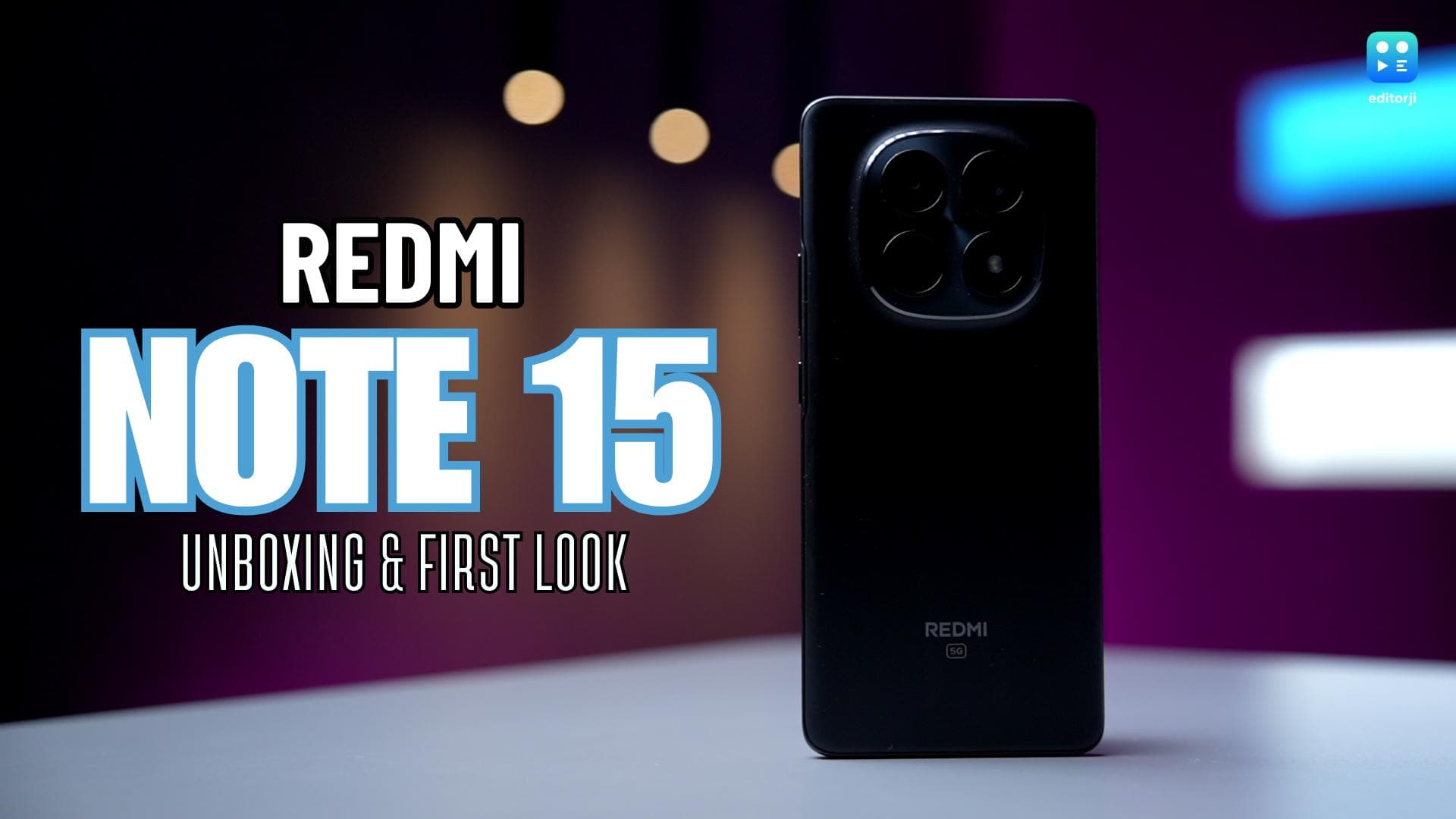
The Redmi Note line has long aimed to balance price and polish, and that philosophy becomes clear the moment the Redmi Note 15 5G comes out of the box. The idea is familiar: offer features that feel aspirational without crossing into flagship pricing. That does not mean this phone is trying to compete with high-end devices, though. The Snapdragon 6 Gen 3 at its core is firmly a mid-range chip, built for efficiency and stability rather than raw flagship power.
Still, several aspects immediately stand out as upgrades over earlier Note models. The curved AMOLED panel, the noticeably slimmer body, and the overall visual refinement give the phone a more premium presence than expected. Pricing begins at ₹20,000 for the 8GB + 128GB configuration, which places it squarely in the upper mid-range bracket.
What comes inside the retail box
Redmi keeps things simple with the packaging. Inside, you get the handset, a clear protective case, standard documentation, a 45W fast charging adapter, and a USB-A to USB-C cable. There is nothing unexpected here, but the inclusion of a fast charger remains a welcome sight, especially as more brands continue to drop it from the box.
Design and how it feels in the hand
Picking up the phone for the first time, the slim profile is immediately noticeable. Measuring just 7.35mm thick and weighing 178 grams, this is one of the lightest Redmi Note devices to date. For someone who prefers a slightly heavier phone, it can almost feel unusually light at first. That said, it is extremely comfortable to hold, well balanced, and easy to use over long periods.
Visually, the phone looks far more refined than older Notes. The curved rear panel blends smoothly into the curved display, giving it a cohesive and modern appearance that does not scream “budget.” The black variant I have here uses a matte finish that looks elegant but attracts fingerprints very easily. Both the back and frame are plastic, as expected, while the camera layout appears inspired by the Note 14 Pro series, a design choice that fits well here.
Durability is also a focus this year. The phone comes with IP66-rated protection and reinforced internals. While I have not tested its toughness yet, the specifications suggest it should handle everyday wear better than before.
Screen quality and sound performance
Once the display lights up, it quickly becomes one of the phone’s highlights. The 6.67-inch curved AMOLED panel supports a 120Hz refresh rate and peaks at 3200 nits of brightness. In brief outdoor use, it looks vibrant, bright, and high-contrast. Despite common concerns with curved screens, I have not experienced accidental touches so far. The in-display optical fingerprint scanner has also been fast and reliable in early use.
Audio is handled by stereo speakers with Dolby Atmos support. Volume levels are strong and clear, although the vibration feedback feels weaker than ideal.
Bankable performance at this price point
The Snapdragon 6 Gen 3 is paired with 8GB of LPDDR4X RAM and either 128GB or 256GB of UFS 2.2 storage. There is also support for microSD cards up to 1TB. During setup and general app usage, the experience has been smooth, with no visible slowdowns.
Redmi claims an AnTuTu score exceeding 850,000, although my benchmark run completed without generating a final score. In early gaming tests with BGMI, there is no 90FPS mode available, but the game maintained a stable 60FPS during my sessions.
Software experience with HyperOS 2 in 2026
Out of the box, the phone runs Android 15 with HyperOS 2. While Android 16 would have been ideal at launch, Redmi has committed to four years of Android updates and six years of security patches.
You also get a range of AI-driven features, including Circle to Search, Google Gemini integration, and AI-powered call noise reduction.
Camera setup and the Master Pixel branding
Photography is clearly a key focus here. The main camera uses a 108MP sensor with optical image stabilisation, which Redmi is calling the Master Pixel edition. It is joined by an 8MP ultra-wide camera and a 20MP selfie camera.
I have only taken a handful of shots so far, but the early results are encouraging. That said, the camera system needs more time before any firm judgments can be made. The rear camera also supports 4K video recording at 30FPS with OIS.
Battery size and charging speeds
Powering the phone is a 5,520mAh silicon-carbon battery, paired with 45W fast charging. Given how thin and light the device is, this capacity feels well judged. Redmi has clearly chosen not to chase oversized battery figures, instead prioritising a slimmer design.
First impressions so far
Based on this early hands-on experience, the Redmi Note 15 5G seems to be built around three priorities: a slim and lightweight body, an extremely bright curved display, and a strong focus on the main camera and durability. I will be spending more time testing performance, cameras, battery life, and everyday usability. A full review will follow once that deeper testing is complete.