The Redmi Note series has always had a distinct purpose. It was supposed to give people a taste of something premium, without asking them to pay the premium tax.
Previous Redmi Note phones delivered this through aggressive specs. The Redmi Note 15 5G, though is clearly chasing a different idea of value: how the phone feels, and how it looks.
That approach makes sense in 2026. From the moment I picked it up, it didn’t feel like a typical Redmi Note phone. It feels lighter, it feels different, and that is where the real conversation starts.
Design
One of the first thins that you’ll notice is that the phone is unexpectedly slim and feels incredibly lightweight. At just 7.35 mm thick and 178 grams, it is noticeably lighter than most phones in this segment. This is one of those devices that you forget you have been holding. This is both, a compliment as well as a a mild criticism, depending on your preference.
If you like phones that feel dense and reassuring, this might feel a little too light. Personally, I noticed it most when switching over from a heavier phone, which is my primary device.
That said, it is undeniably comfortable. Weight distribution is excellent, and the curved edges make it easy to hold for long periods. Whether you are doom-scrolling, reading, or watching videos, it never feels awkward or tiring.
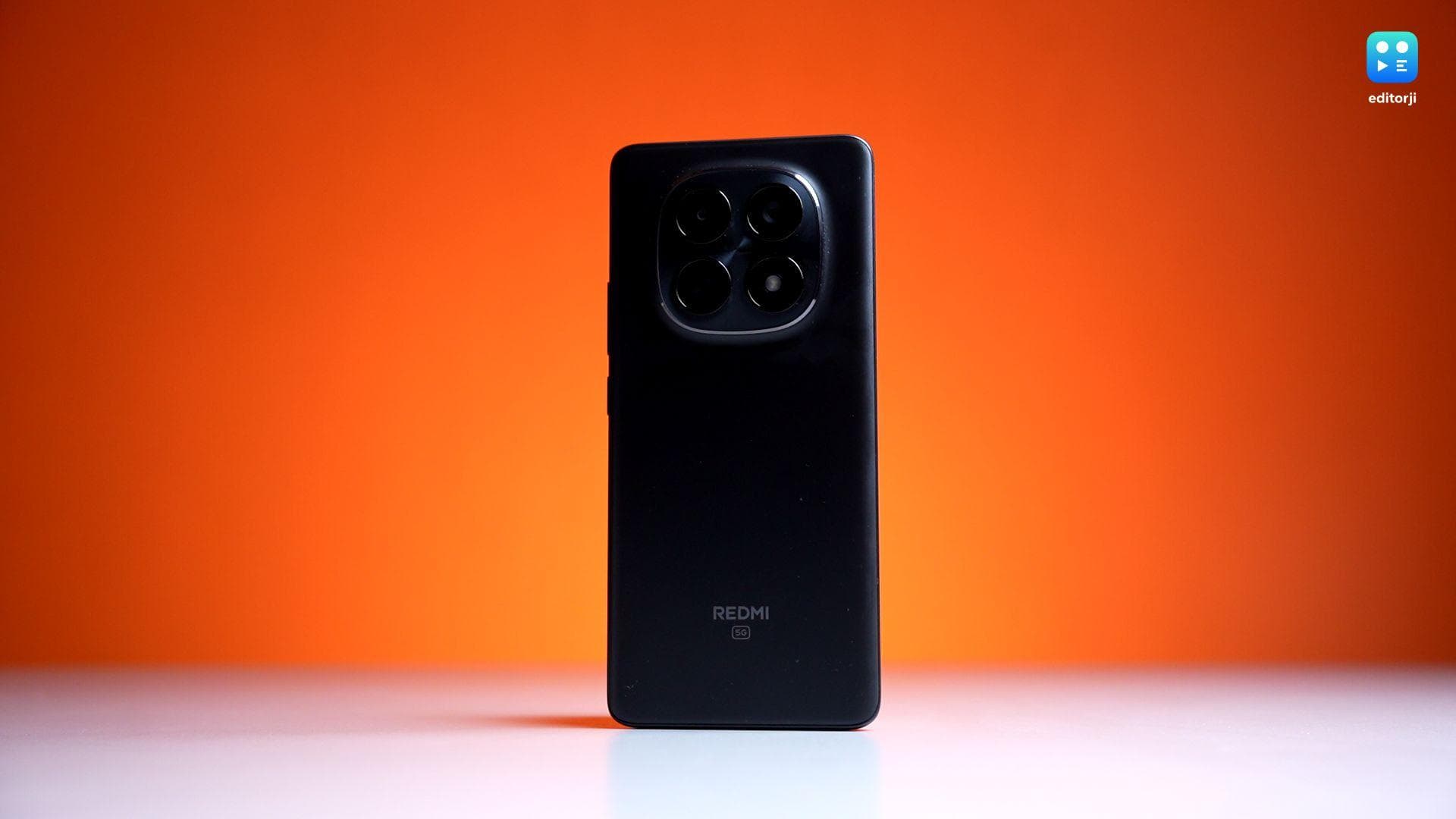
Design-wise, Redmi has not gone completely wild, but it has not played it completely safe either. The matte black finish looks clean and understated, though it is definitely a fingerprint magnet. Keeping it spotless is a losing battle.
The silver accents around the camera module add a bit of flair, and while both the back and frame are plastic, the finish does not scream “budget.” It feels intentional rather than cheap.
Button placement is sensible and familiar. The volume rocker and power button sit on the left and are easy to reach. There is an IR blaster at the top, which is a small but appreciated addition.
At the bottom, you will find the USB-C port, speaker grille, and the dual SIM tray. There is no headphone jack, which feels like a design-driven sacrifice rather than cost-cutting, but nonetheless, is it a bit disappointing if you rely on wired audio.
For protection not only do you get an IP66 rating, you also get reinforced internals. Now, Xiaomi hasn’t explicitly claimed what front glass they are using for the Note 15. However, the device has been tested against MIL-STD-810H, so we’re guessing it uses some sort of Corning Gorilla Glass.
Display
Speaking of displays, the Redmi Note 15 5G does not try to impress with outrageous claims or or headline-grabbing battery numbers. Instead, it leans heavily on the quality of this display, and this is where the phone really justifies its price.
The 6.77-inch curved AMOLED 120Hz panel immediately changes how the phone is perceived. It looks premium in a way that flat panels at this price often do not. The curve is subtle and well executed, and I did not face any issues with accidental touch.
Colours are also vibrant thanks to the 12-bit panel, because of which you get a a100 per cent coverage of the DCI-P3 colour space. While text looks sharp and clean thanks to the FHD+ resolution.
Watching content on this display is genuinely enjoyable. Netflix, YouTube, or endless reels all look great.
Brightness is another strong point. Redmi claims that the display has a peak brightness of 3200nits, and we have good reason to believe them, as the outdoor visibility is genuinely excellent. Even under harsh sunlight, the screen remains readable.
You also get 3840Hz PWM dimming which helps keep things comfortable during night usage. Add TUV Triple Certified Eye Protection 2.0 and you have a display that’s actually less stressful to your eyes
Unlocking the phone is handled by an in-display optical fingerprint scanner. It is fast, reliable, and has not failed me so far, and has been very consistent. Coming to the audio setup, we get a set of stereo speakers with Dolby Atmos and MiSound dual tuning. The speakers get pretty loud, and can easily fill a room. However, because of the slim design and thing built, the speakers lack bass or any meaningful character. Still, considering what the phone costs, I am not really complaining.
Performance & Software Experience
The Snapdragon 6 Gen 3 is a mid-range chip, so, its better if we get into this with our expectations in check.
Day-to-day usage is smooth. Apps open quickly, scrolling feels fluid, and multitasking does not feel stressful. It is not the kind of phone that makes you think about performance at all, which is actually a good thing.
You get decent gaming performance, but clearly that was not the focus here.
BGMI runs at 60fps but it is quite stable. Still, If you are a competitive gamer, chasing higher frame rates, this is not the phone for you. For casual gaming sessions, though, it works just fine.
Benchmarks were a bit odd. AnTuTu completed its run but did not display a final score for reasons unknown, no matter to what network we were connected to. Geekbench worked as expected and gave a clearer idea of where the chip stands. During testing, the phone warmed up slightly, but it never became uncomfortable.
On the software side, the phone ships with Android 15 and HyperOS 2. Ideally, Android 16 would have been nicer to see out of the box, but Redmi’s promise of four years of Android updates and six years of security patches is reassuring. AI features, mainly powered by Gemini are pretty useful in small, practical ways. There is some preinstalled bloatware, but most of it can be removed without much effort.
You also get a tonne of Xiaomi’s interconnectivity features, and from my limited testing, they work really well. We also get Xiaomi Share, which works similarly to Quick Share, making transferring files and photos between devices simple and reliable.
Battery
Battery life reflects a clear design decision by Redmi. AT a time when almost every new phone gets a 6000mAh battery or more in phones under ₹20,000 Redmi is using a 5520mAh silicon-carbon battery. It definitely falls short of current standards, especially when other mid-range phones are pushing massive capacities here.
But then, that is the trade-off for the slim and lightweight design. In everyday use, the phone easily lasts a full day, and you can push it to go a day and a half. Heavy camera usage does drain it faster. I noticed around a four percent drop in about half an hour, though that could also have been influenced by cold environmental conditions.
Charging is reliable and quick. The 45W fast charger takes the phone from roughly 15 percent to nearly full in about an hour. You also get 18W wired reverse charging, which is a nice bonus to have.
Cameras
The Note 15 comes with a 108MP main camera with OIS, and an 8MP ultrawide, even though the camera module would suggest that its packing some serious hardware.
Nonetheless, The “Master Pixel” main camera well in daylight. Photos are sharp, colourful, and pleasing to look at. Detail retention is good, and shots between 1x and 2x remain consistent. Dynamic range could be better, and occasionally the areas around the subject do not look quite right, but overall, the main camera delivers dependable results.
Portraits are a strong point, especially for human subjects. Edge detection is clean, and the bokeh effect looks natural.
Selfies from the 20MP front camera, however, are underwhelming. Skin tones often look washed out, and texture processing can feel artificial at times.
Video performance tops out at 4K 30fps and is average at best. There is noticeable grain, and stabilisation does not fully live up to quality OIS standards. Video quality, in particular, feels like an area where Redmi still has room to improve.
Verdict
Redmi understands what the boundaries are for the Note 15 5G and does try to pretend being something its not. It’s not going after its competition based solely on specs. Priced at under ₹20,000, it focuses on the things that matter in everyday use: a slim and comfortable design, an excellent display, stable performance, and a capable main camera.
At an expected price of around ₹20,000, it is not an the default recommendation, especially with strong alternatives like the Nothing Phone 3a and the Motorola Edge Fusion 60 offering better solutions. However, if design, display quality, and day-to-day comfort, if the user experience matters more to you than raw specs, the Redmi Note 15 5G makes a solid case for itself.