The Realme P4 Pro 5G lands in the under ₹25,000 space as another tempting option in a segment that’s already crowded with heavy hitters.
On paper, it borrows a lot from its pricier sibling, the Realme 15 Pro — the Snapdragon 7 Gen 4 is here, so is the massive 7,000mAh battery. But Realme wants this one to stand out for performance.
The pitch is a new dual-chip setup called Hyper Vision AI, designed to push the display harder and even unlock up to 144fps in games.
The question, of course, is whether that extra silicon actually changes the experience or if it’s just Realme’s latest buzzword.
Realme P4 Pro Review: Performance & Hyper Vision AI Chip
Let’s start with performance because the P4 Pro wastes no time showing off. Inside, it runs the Snapdragon 7 Gen 4, paired with up to 12GB of LPDDR4X RAM and 256GB of UFS 3.1 storage.
On benchmarks, it does exactly what you’d hope: 1088469 million on AnTuTu and a 98.2 percent stability score in 3DMark’s Wild Life stress test.
Numbers aside, the phone just feels fast. Apps open in a blink, multitasking is smooth, and even when you throw a dozen things at it, the P4 Pro doesn’t break stride. That’s the baseline. What makes it stand out, though, is the new Hyper Vision AI Chip.
Think of it as a visual co-processor, a piece of silicon dedicated to making games and videos look better. We’ve seen similar hardware in pricier devices like the iQOO Neo 10, but Realme is bringing it down to a friendlier price bracket.
The results are hard to ignore. Take BGMI, which normally tops out at 90fps. With the AI Hyper Motion feature switched on, the P4 Pro pushes gameplay all the way to 144fps.
It’s essentially using AI frame generation to multiply the output of the CPU and GPU, and it doesn’t just work on one game—Realme says over a hundred titles are supported, including heavy hitters like Genshin Impact.
What’s even more impressive is how it does it. Most phones cheat a little by dropping resolution to 720p in order to chase high frame rates. Not here.
Realme claims the P4 Pro is the first phone that can handle BGMI at 1.5K resolution and 144fps at the same time. From our tests, it really does deliver, which is wild for a phone in this bracket.
All of that power would typically make a device run hot enough to toast bread, but the P4 Pro’s 7000mm² vapor chamber cooling system keeps it in check.
Long sessions of COD Mobile, BGMI, or Genshin Impact didn’t trigger throttling or noticeable frame drops. Just smooth gameplay and a phone that never once felt like it was about to melt in my hands.
Realme P4 Pro Review: Design & Utility
The Realme P4 Pro 5G feels like a phone punching above its weight. It’s slim at 7.68mm and surprisingly light at 189 grams, yet it still squeezes in a 7,000mAh battery. That combination alone is impressive.
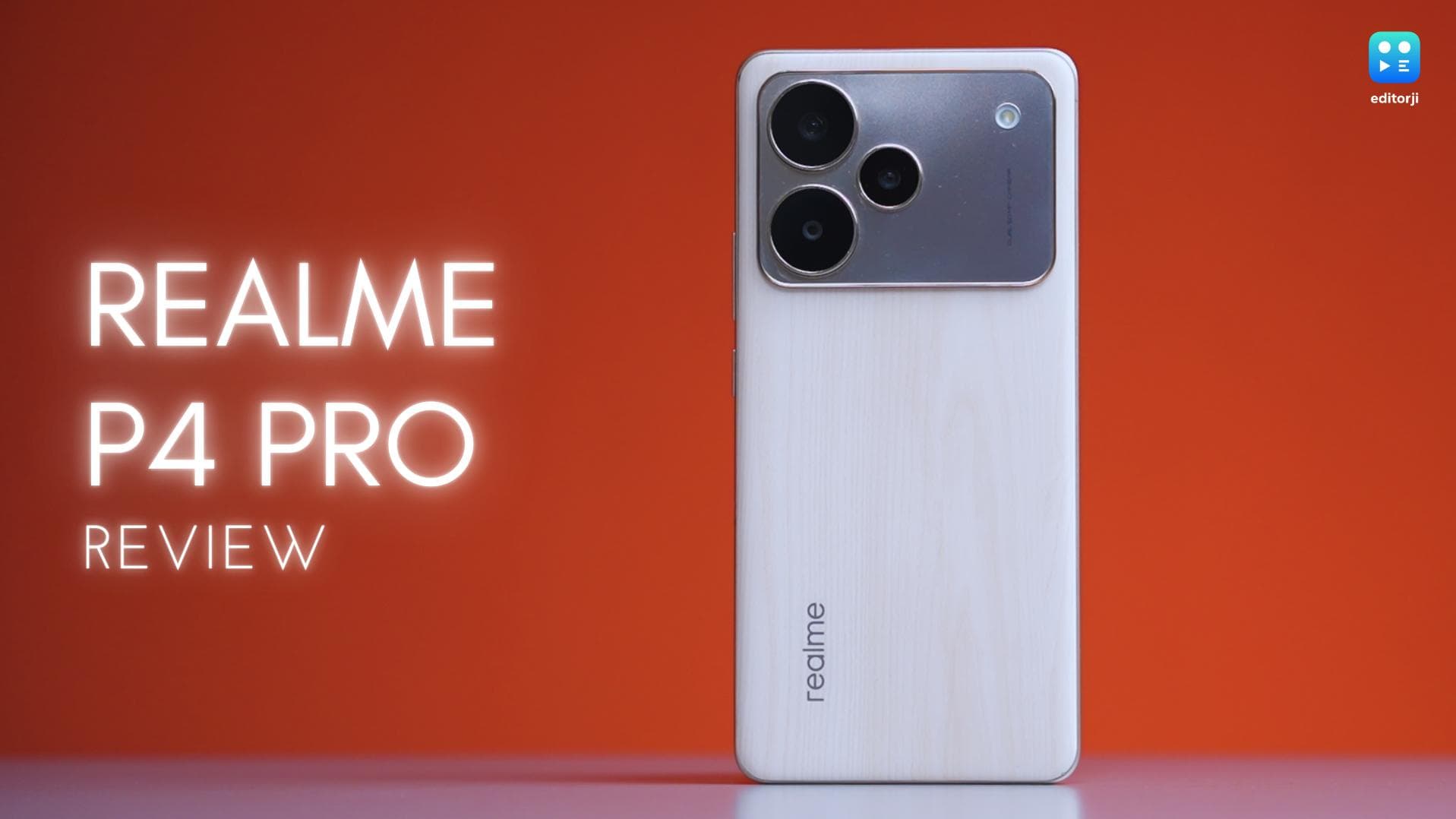
Realme offers it in three finishes: Birch Wood, Midnight Ivy, and Dark Oak Wood. I’ve been using the Birch Wood version; honestly, that’s the one to get.
It looks unique and adds the kind of personality that most mid range phones desperately lack. The vibe reminds me a lot of the Moto Edge 50 Ultra from last year, and that’s a good thing.
Yes, it’s technically plastic, but the execution is excellent. The texture is subtle, the wood grain looks convincing, and it avoids that “cheap glossy plastic” look that plagues so many phones at this price.
Around the back, the stretched-out camera island runs across the width of the phone — something we’re going to see a lot more of once the iPhone 17 Pro drops later this year. The only problem is that the individual camera rings still protrude, which makes the phone wobble on a desk.
On the durability front, the curved front panel gets Corning’s Gorilla Glass 7i, and the device carries an IP65/66 rating. That’s solid for splashes and dust, but it’s technically a step down from the Realme P3 Pro, which went as far as IP69.
Everything is laid out conventionally for ports and buttons: power and volume on the right, dual SIM slot and USB-C at the bottom alongside the primary mic and loudspeaker.
Up top, you’ll find a second mic, another speaker vent, and yes — an IR blaster, which is still one of those rare but surprisingly useful extras.
Realme P4 Pro Review: Display
The P4 Pro comes with a 6.8-inch 1.5K 4D curved AMOLED display, and Realme clearly wants you to notice it. It pushes up to 144Hz refresh rate, though that full speed only shows up in a few apps like Calculator (yes, your math will look extra smooth) while most of the UI hangs around at 120Hz.
Colors pop right out of the box with 100% DCI-P3 coverage, and you can tinker between Vivid, Natural, and Pro modes—or go all-in with Cinematic and Brilliant if you like your display extra punchy.
You’re covered with HDR10 on Netflix and full HDR playback on YouTube. The Hyper Vision AI chip also does a bit of behind-the-scenes trickery, upscaling SDR content into HDR so even an old video looks like it got a glow-up.
The difference was striking when I lined up the new Avatar trailer on the P4 Pro next to the Moto Edge 60 Fusion. The Realme pushed out playback that felt crisper, smoother, and more alive, almost like we were streaming at a higher bitrate.
Brightness isn’t an issue either: the panel can hit a claimed 6,500 nits peak with 1,800 nits reserved for outdoor high-brightness mode—so legibility under the sun is solid. Add in stereo speakers that easily handle Netflix binges, and the whole setup feels premium.
Realme P4 Pro Review: Camera Performance
The Realme P4 Pro keeps things straightforward in the camera department: two usable lenses on the back, and one for selfies. The star here is the 50MP main OIS camera with Sony’s IMX896 sensor, paired with an 8MP ultra-wide that’s more about convenience than quality.
There’s also a depth sensor hanging around, but that’s really just there to pad out the spec sheet. Up front, you get another 50MP sensor for selfies, which sounds a little overkill but actually pays off.
Both the main rear shooter and the selfie camera can record at 4K 60fps, which is nice to see at this price.
You also get the option to pick between two photo styles — “Vibrant” and “Crisp.” One pushes colors warmer, the other leans toward sharpness. I stuck with Crisp during testing, and for the most part, the results felt balanced: good color, solid white balance, and dynamic range that holds up.
That said, there are quirks. Bright skies have a habit of blowing out, reds lean toward neon, and textures look a bit unrealistic if you zoom in too far. Low-light performance is serviceable, with Night mode pulling in extra light while keeping most of the noise under control.
There’s even a 2x zoom toggle in the app — it’s all digital, since there’s no telephoto lens, but the results are fine as long as you don’t pixel-peep. Portrait mode is surprisingly solid, and even at 2x it delivers images that feel polished enough for social feeds.
The 8MP ultra-wide, unfortunately, doesn’t match the main shooter. It’s handy for group shots or landscapes, but the edges distort and the sharpness just isn’t there.
The 50MP selfie camera, on the other hand, redeems things. Selfies have plenty of detail, pleasing skin tones, and a natural depth effect that makes them pop.
Video quality holds up well, with no noticeable overexposure issues. Stability, though, is noticeably better at 4K 30fps than at 60fps.
Realme P4 Pro Review: Software
The Realme P4 Pro ships with Realme UI 6.0 on top of Android 15, and it's fun to interact with. Animations are smooth, the control center is quick to pull up, and there’s enough customization here to keep tinkering types happy.
Realme has also leaned into the AI buzz with things like AI Edit Genie inside the Gallery app — you can throw it a text or voice prompt, and it does a surprisingly decent job at cleaning up your photos.
But then comes the part every Realme user knows too well: the bloatware. The phone greets you with a buffet of duplicate apps — two browsers, two galleries, two app stores, even two game hubs. Half from Google, half from Realme, and all of them fighting for attention on your homescreen.
It’s a classic case of “because we can” software design, and it clutters what could have been a clean Android 15 experience.
On the bright side, the Realme P4 Pro is set to get three major Android OS updates and four years of security fixes. That means you’re covered all the way to Android 18, with patches running until around 2029.
Realme P4 Pro Review: Battery & Charging
The phone comes with a massive 7000mAh battery, same as the Realme 15 Pro. I’ll admit, I was a little doubtful about how slapping an extra chip in there would affect endurance, but it actually works in the phone’s favor. With two chips splitting up tasks, the CPU and GPU don’t get overworked, resulting in better stamina than I expected.
In my usage, which included 4K video recording, a few rounds of high-graphic gaming, and plenty of multitasking, it still pushed through about a day and a half without needing a top-up.
Charging is handled by 80W SuperVOOC, which takes it to 50% in 35 minutes and 100% in about an hour and 15 minutes. You also get 10W reverse charging for topping up other devices, plus some clever tricks like cap charging at 80% for battery health, and bypass charging when gaming so the heat doesn’t fry the cell.
Realme P4 Pro Review: Price & Variants
The Realme P4 Pro starts at ₹24,999 for the base variant, which offers 8GB of RAM paired with 128GB of storage. Moving up the ladder, you get an 8GB RAM option with double the storage at 256GB for ₹26,999.
For those who want the most powerful configuration available, the top-end model comes with 12GB of RAM and 256GB of storage, priced at ₹28,999.
Realme P4 Pro Review: Verdict
The Realme P4 Pro is one of those mid-range phones that feels like it’s reaching a tier higher than its price suggests.
The dual-chip magic isn’t just a gimmick; it really does give games and video a lift. Battery life is another highlight — a big 7,000 mAh cell that comfortably lasts more than a day, even if you’re leaning on it for streaming or long gaming runs.
The display is bright, sharp, and smooth, making it easy to enjoy whether you’re indoors or outdoors. The cameras won’t win any awards, but they’re dependable for social media and casual photography.
Realme’s software still comes with a bit of extra baggage, though regular updates soften that blow. For under ₹25,000, the P4 Pro stands out as one of the most performance-driven options you can buy right now.