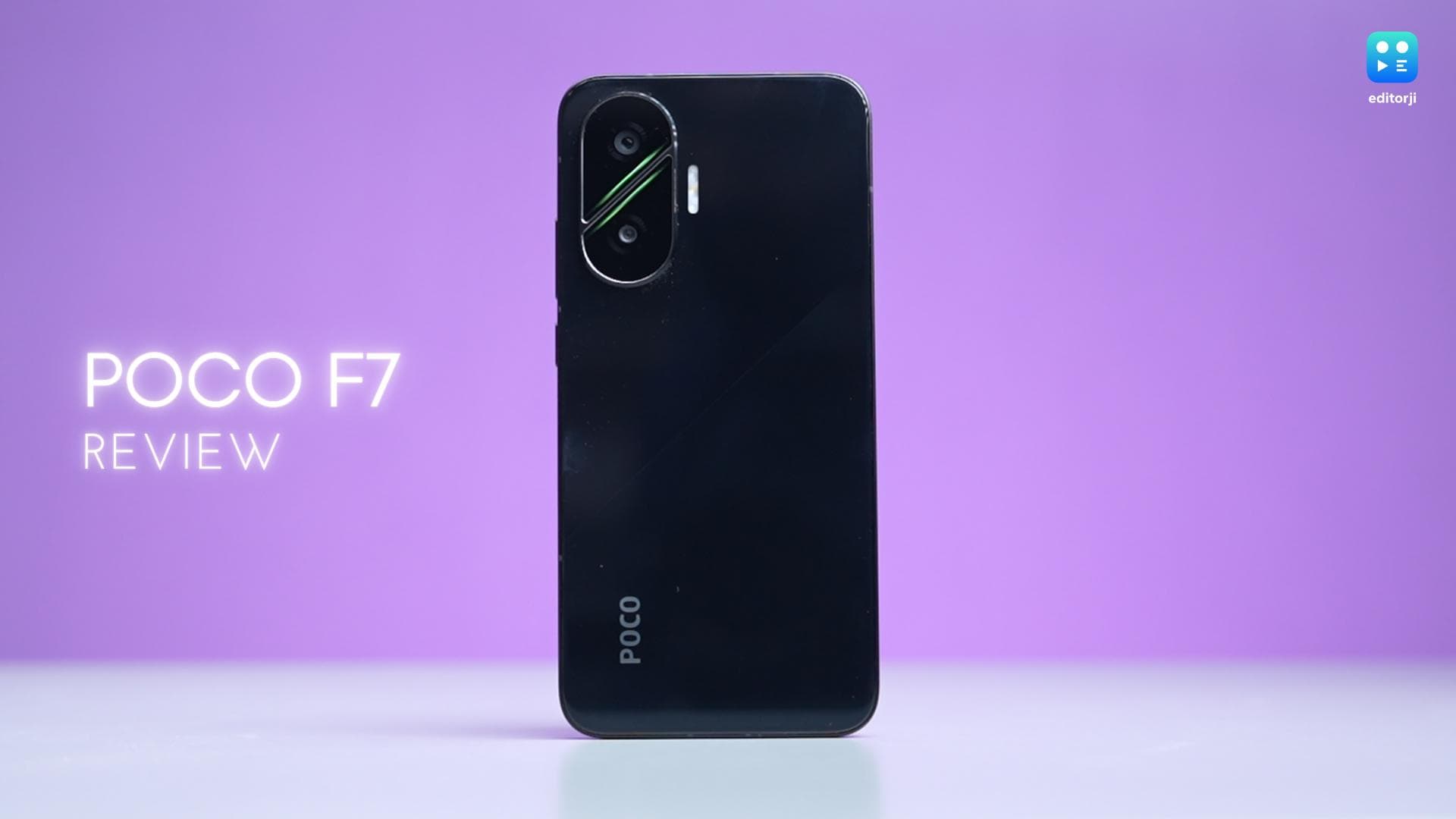
The Poco F7 is gunning for the performance crown in the sub-₹30K space, and honestly, it’s bringing some serious heat. From the moment I unboxed it, this thing felt premium — a metal frame, glass back, and a design that’s anything but subtle. It’s powered by the Snapdragon 8s Gen 3, packs up to 12GB RAM, and even flexes a 1.5K OLED display with Dolby Vision.
Starting at ₹31,999 (without launch day offers) Poco is clearly aiming this at gamers and power users, but it also sneaks in creature comforts like a solid 7550mAh battery, and a surprisingly smooth software experience. So, what’s the catch? Well, that’s what we try to find out.
Poco F7 Review: Design
The first thing I noticed the moment I picked up the F7 was how hefty it felt. This phone’s got some serious presence in the hand — it’s well over 215 grams and has a chunky 8.2mm profile. But to be fair, that weight comes with a sense of sturdiness. It feels like something built to last, not a plasticky budget phone trying to act tough.
The metal frame paired with a glass back really adds to the premium vibe. Honestly, I didn’t expect this kind of build quality at this price. It feels solid, not flashy-for-the-sake-of-it.
Now, about those colours — Poco clearly wanted to stand out. The Phantom Black version I had came with a dual-tone finish and a loud silver Poco logo on the back. Not my thing, but I get the appeal. There’s also a wild, limited edition silver variant that really leans into that flashy aesthetic. Even the Frost White one, which tries to play it cool, has these green accents on the camera bump. So yeah, subtlety is definitely not the F7’s strong suit.
Speaking of the camera bump, it’s shaped like a pill and holds two sensors separated by a metal frame with green highlights. Visually bold? Definitely. Clean? Not quite, but it makes a statement.
What truly impressed me, though, was just how tough this performance-centric phone is. With IP66, IP68 & IP69 ratings, plus Gorilla Glass 7i on the front as well as the back, the F7 is basically a tank. Moreover, because it has flat sides, and a flat display, its easy to grip. The F7 may be flashy on the outside, but seriously tough underneath.
My only complaint would be the fact that the back panel is a fingerprint magnet, so unless you’re planning to use this phone without a case, be prepared to wipe it down every time you pick it up.
Poco F7 Review: Display
I’ve tested a bunch of mid-range performance-oriented phones this year, and eventhough the the F7’s display may not be the brightest, it easily held its own.
Here, we’ve got a 6.83-inch, 1.5K pOLED panel, with a 120Hz refresh rate — all the essentials you’d expect. It’s even certified for Dolby Vision and HDR10+, so yeah, the specs check out.
Now, it’s not the brightest display out there, but honestly? I didn’t care. I was daily driving this thing for a week, and at no point did I find myself wishing it were brighter. Whether I was binge-watching Netflix or watching 4K HDR videos on YouTube, the experience was solid. Colours looked rich, contrast was on point, and motion felt super fluid. Plus, its got a really solid set of stereo speakers which get pretty loud, and have a solid bass.
The bezels are another win here — slim, uniform, and barely noticeable, which really helps when you’re deep into a show or game. The flat screen with the metal frame just adds to that whole premium vibe, and it feels way more expensive than it actually is.
The in-display fingerprint scanner is also super quick and reliable. During my tests, I didn’t struggle with it once. For the price, the F7’s display absolutely delivers — both on paper and in daily use.
Poco F7 Review: Cameras
When it comes to cameras, I didn’t have high expectations from the Poco F7 — most performance-first phones in this price range tend to treat photography as an afterthought. And honestly, that’s kinda the case here too.
The main camera’s a 50MP Sony sensor, paired with an 8MP ultrawide. Daylight shots are vibrant and punchy, but it does underexpose sometimes. Portrait mode works fine, but don’t expect perfect edge detection like you’d get on a camera-centric flagship.
The 20MP selfie camera did fairly well. It actually keeps details intact and doesn’t make your face look like a wax statue, which I really appreciate.
For videos, the rear cam lets you shoot in 4K at 60fps. Colours look solid, and the stabilisation is alright — not gimbal-level, but good enough for casual use.
What’s weird is that the front cam maxes out at 1080p 60fps. Bit of a bummer for content creators. But hey, at least there’s a built-in teleprompter.
Poco F7 Review: Performance & Software
Poco’s clearly going all in with the F7 as a performance-first phone, especially for gamers — and I have to say, it doesn’t disappoint. Under the hood, you’ve got a Snapdragon 8s Gen 3 paired with up to 12GB of LPDDR5X RAM and 512GB of super-fast UFS 4.1 storage. For the price, that’s a solid combo.
Sure, in some benchmark tests, it trailed behind the iQOO Neo 10 and the GT 7. But the F7 still clocked over 2 million on Antutu, which is no small feat. On the 3DMark Wildlife Extreme Stress Test, it landed a 77.9% stability score — that’s seriously impressive for a phone in this segment. What stood out to me even more was how well it handled thermals. It didn’t overheat, and performance stayed consistent across long gaming sessions without heavy throttling, thanks to its 3D IceLoop cooling system, and AI-based temperature management.
In day-to-day use, the difference between this and its rivals is barely noticeable. I fired up BGMI at Extreme+ settings and the F7 didn’t flinch — zero stutters, no dropped frames, even after an hour of pushing it hard. The device did get slightly warm to the touch, but not to the point where it would be alarming, or performance took a hit.
On the software side, it runs HyperOS 2 based on Android 15. There’s some bloatware out of the box, mostly pre-installed games, but nothing that can’t be uninstalled. You also get all the usual AI perks — AI subtitles, AI live translation, Circle to Search, AI writing tools, and those animated AI Dynamic Wallpapers for a bit of flair.
Update-wise, you are looking at 4 years for OS and 6 years for security patches. For wireless connectivity, we have WiFi 7 and Bluetooth 6.
Long story short: if you’re looking for a reliable, solid performer and don’t want to spend a bomb on it, the F7 makes a strong case.
Poco F7 Review: Battery
Battery life is hands-down one of the Poco F7’s biggest wins. The Indian unit packs a massive 7550mAh battery — way bigger than the 6500mAh cell on the global model.
For me, it easily powered through a day and a half of heavy usage, without breaking a sweat. That’s with gaming, scrolling, bingeing shows — the whole deal. And on lighter days, it even stretched to two full daysWhen it’s finally time to juice up, there’s a 90W fast charger in the box that brings it back to life super quick. Bonus points for the 22.5W reverse charging feature too — it came in clutch when I needed to top up my earbuds and didn’t have another charger handy.
Poco F7 Review: Verdict
The Poco F7 gets a lot right. You get a sturdy build, an IP68/IP69 rating, Gorilla Glass 7i, and a gorgeous flat 1.5K OLED display with Dolby Vision. It looks premium, feels solid, and will definitely turn heads.
Performance-wise too, it handles everything you throw at it with ease. Sure, in benchmarks, it trails behind the Neo 10 and GT 7 slightly, but in day-to-day usage and gaming, you’re not going to notice. The battery life is excellent, easily stretching to two days for light users.
All said and done, the F7 delivers a flagship-lite experience that leans hard on endurance, design, and raw usability. For a device that falls ₹35K, the F7 is one of the most well-rounded phones you can think of.