I’ve been trying to make sense of the Nothing Phone 3a Lite, and it has honestly left me a little unsure. When I look at it in isolation, it feels like a genuinely good package. For ₹20,999, the overall experience holds up well, whether it is the performance, the design, or the software polish Nothing is known for.
The confusion starts the moment I compare it to the CMF Phone 2 Pro. That phone matches the 3a Lite almost part for part. The display feels the same, the software behaves the same, and the cameras on the CMF option are clearly ahead. When two products under the same larger brand start overlapping this tightly, it makes me wonder what the actual plan is.
So I am now trying to understand who the 3a Lite is really meant for and whether it genuinely deserves a spot next to a much stronger sibling.
Nothing Phone 3a Lite’s Design: Still turning heads
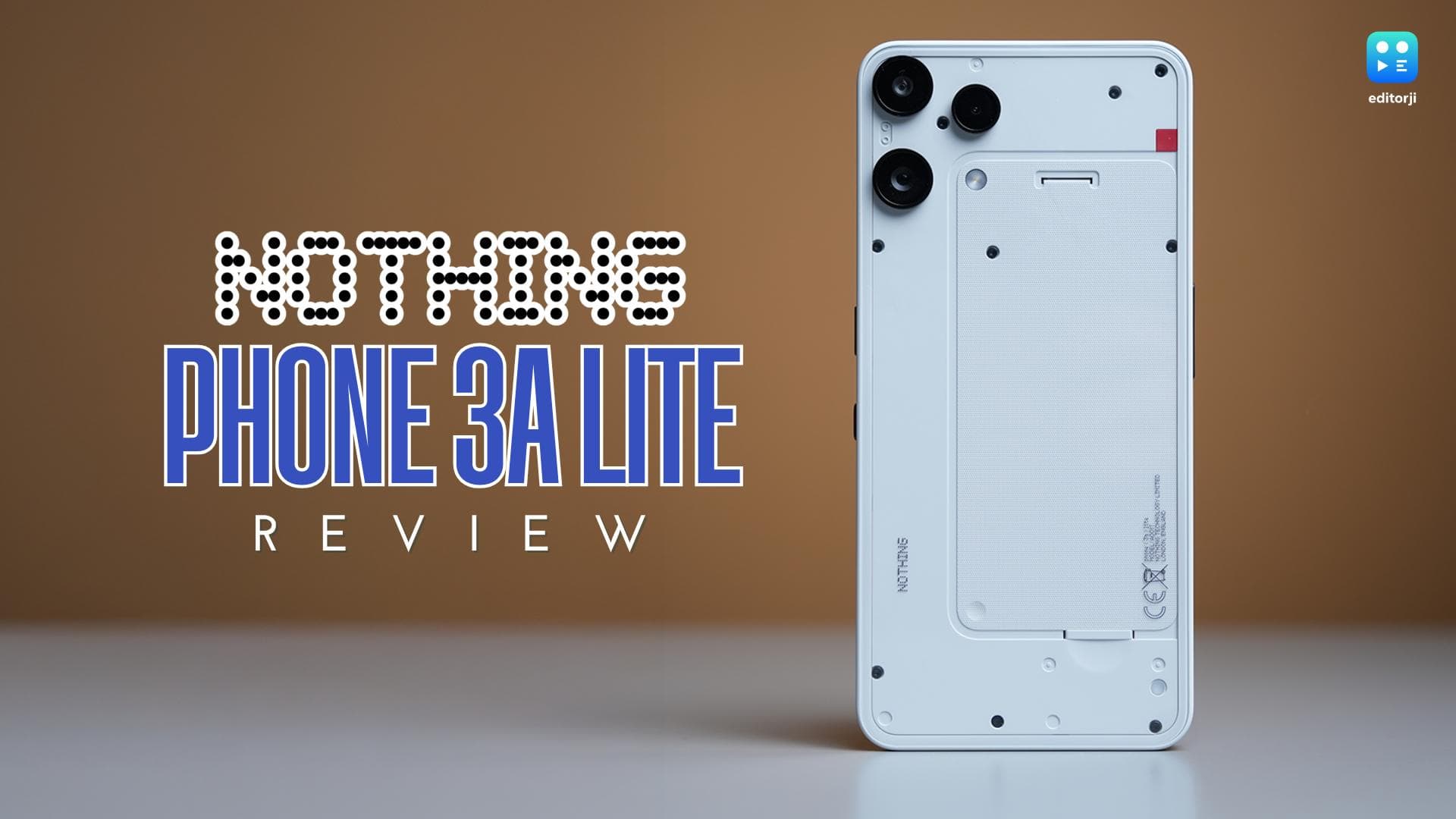
The Nothing Phone 3a Lite grabbed my attention from the moment I unboxed it, which honestly didn’t surprise me. Nothing has always had a way of making phones that stand out, and this one follows that tradition. Even if someone isn’t familiar with the brand’s transparent, industrial look, this design has enough visual character to make them stop and take a closer look. It carries the familiar Nothing flavour, but there is a tiny bit of novelty in the way it has been executed.
I have always seen Nothing’s design language split opinions. Some people love the whole exposed-tech, slightly futuristic vibe, while others think it goes a bit over the top. Personally, I appreciate that the company never plays it safe. Their phones always have personality, and the 3a Lite is no exception. My white review unit highlights this even more. The exposed screws pop nicely, the small red accent draws your eye without trying too hard, and the entire back looks premium without needing to shout about it.
There is a new design detail here called the Battery Simulation layout on the rear panel. It adds a retro feel that instantly reminded me of old remote controls. It is quirky in a way that feels intentional, and I actually find it fun. At the same time, I do feel Nothing is starting to rely a little too heavily on the same visual formula. After eight phones that broadly look like variations of the same theme, I am hoping 2026 is when they attempt something riskier.
While using the phone, the build impressed me more than I expected. Its 8.3 mm thickness and 199 gram weight give it a dense, confident feel. It sits well in the hand and feels more premium than its price would suggest. The front and back both use Panda Glass, while the frame is plastic. The back picks up fingerprints faster than I would like, so for me, going without a case is not practical. Thankfully, Nothing includes a clear case in the box, which helps immediately.
There is an aluminium mid-frame on the inside that keeps everything solid and reassuring. You also get IP54 protection, which may not sound like much, but plenty of phones in this bracket skip any form of rating, so I definitely see it as a positive.
The rear camera arrangement is one area I am a little unsure about. The three lenses sit directly on the surface with no traditional camera island, which gives them a floating look. I am still deciding whether I like it or not.
And despite Carl Pei hinting at a future beyond the Glyph system, the 3a Lite still keeps it alive. There is a single Glyph strip at the bottom that handles countdowns, alerts and basic notifications. It is subtle but still gives the phone that Nothing identity.
The last design element is the Essential Key under the power button. It has a slightly curved shape, but the moment you put a case on, both buttons feel almost identical. I kept mixing them up until I eventually started checking before pressing anything.
Nothing Phone 3a Lite’s Display: Smooth, sharp and mostly impressive
The Nothing Phone 3a Lite uses a 6.77-inch FHD+ flexible AMOLED panel, and the moment it lights up, it feels far more premium than what you usually get at this price. The screen is crisp, colours look rich without going overboard and the 120Hz refresh rate genuinely lifts the experience. Whether I am scrolling through socials or watching YouTube, everything feels fluid and clean. Nothing says this is the same panel used on the 3a and 3a Pro, and based on how refined it looks, I do not doubt that for a second.
Because this is a flexible AMOLED screen, the bezels are slim on all four sides, giving the phone a more polished look. Viewing angles hold up well, touch response feels snappy and overall, it performs at a level that reminds me of phones that cost much more. Black levels are exactly what you expect from OLED, and the colour tuning feels tasteful.
The compromises start to show once you dig deeper. This is not an LTPO panel, so the refresh rate cannot drop down to 1Hz when you enable Always On Display. That means the phone keeps running at a higher refresh rate even when it does not need to, which is not ideal for long-term battery efficiency.
Brightness is also where I noticed the first real limitation. HDR peaks are impressive at 3000 nits, but the 1300 nits outdoor brightness is just about fine. On a sunny day, the glossy glass on top makes reflections more noticeable. Nothing OS’s high-contrast UI helps a bit, but there were still plenty of moments where I had to shift angles just to see things clearly.
Audio, unfortunately, is the biggest disappointment. A mono speaker on a phone costing over ₹15,000 in 2025 simply feels outdated. It gets loud, but it has no depth or fullness, and the bottom-firing setup gets blocked far too easily when I am holding the phone. It is passable for quick clips, but not something I would trust for long movies or gaming sessions.
Nothing Phone 3a Lite’s Cameras: Capable, but clearly limited
The Nothing Phone 3a Lite technically arrives with three cameras, but in real-world use, only one of them truly feels meaningful. The 50MP primary sensor with EIS is the workhorse here and carries almost the entire shooting experience. The other two cameras are an 8MP ultrawide and a 2MP macro, and I will say it straight: the macro lens adds nothing of value. Even one of Nothing’s own executives publicly criticised the industry trend of adding filler macro sensors, and this feels like exactly that kind of decision.
The main camera, thankfully, performs well enough to hold the setup together. In daylight, it captures solid detail, gets colours fairly accurate and handles dynamic range with confidence. There are times when the processing becomes a little too intense, especially in scenes with a lot going on. Some photos look slightly over-processed, but not to a point where the image becomes unusable.
At 2X zoom, which is just a crop from the main sensor, you do lose a bit of sharpness and consistency in colour. Even then, for a phone at this price, the results are acceptable and sometimes surprisingly decent. The ultrawide camera is serviceable but clearly limited by its 8MP resolution. It often produces slightly darker images, and while sharpness is fine in the centre, finer details quickly fall apart. It is usable, but it never really impresses.
Low-light photography is where things start falling apart. Both the main and ultrawide sensors struggle to control noise, and 2X zoom becomes very grainy. You can get okay results when there is enough ambient light, but once the lighting becomes challenging, noise becomes difficult to ignore.
For video, the Phone 3a Lite records up to 4K at 30fps, which is reasonable at this price. Colours look good, dynamic range is handled well and EIS keeps footage fairly steady. There is also a 1080p 120fps option for slow motion.
The 16MP selfie camera turned out to be a pleasant surprise. It delivers good detail, natural skin tones and surprisingly clean portraits. Overall, the camera system is fine for casual use, but there are clearly stronger options available if photography is your priority.
Nothing Phone 3a Lite’s Performance: Surprisingly strong for the segment
The Nothing Phone 3a Lite runs on MediaTek’s Dimensity 7300 Pro, the same chip used in the CMF Phone 2 Pro. Because of that, I went in expecting solid everyday performance, and the phone delivered exactly that. It feels smooth in day-to-day use, apps open quickly and moving between tasks never really slows it down.
The bigger surprise showed up in the benchmark tests. I assumed the phone would pull in a fairly standard score for this segment, but the AnTuTu result climbed to almost 9.6 lakh. That instantly got my attention, especially because the phone barely warmed up during the run. Geekbench results were just as reassuring, with 1015 for single-core and 2942 for multi-core.
My review unit came with 8GB of RAM, and Nothing also gives you the option to add virtual RAM through their RAM booster feature. Storage options include 128GB and 256GB, and there is even a microSD card slot that supports up to 2TB. It is rare to see expandable storage on phones in 2025, so I genuinely appreciate this flexibility.
I spent a fair amount of time gaming on it as well. For casual and moderately demanding titles, the experience was smooth, and BGMI ran well enough for me to play comfortably. Still, the Dimensity 7300 Pro is not built for serious competitive gaming. It cannot fully utilise the 120Hz display in heavy titles, and you will notice the limitations if you push it too far. For anyone who plays casually, though, the 3a Lite performs better than expected for the price.
Nothing Phone 3a Lite’s software experience and UI: Clean, but some unhappy changes
My time with the Nothing Phone 3a Lite started on a slightly uneven note. It runs Nothing OS 3.5 based on Android 15, and while the interface looked familiar and clean, the first two days were not perfectly smooth.
Apps like Chrome and the Play Store sometimes refused to open or would shut down halfway through loading. A small update arrived almost immediately, and once I installed it, the phone settled into the stable, polished behaviour I normally expect from Nothing. Animations felt consistent again, and the UI regained that clean rhythm that has become one of the brand’s strengths.
Nothing is said to be working on a major design overhaul for early 2026, but the 3a Lite sticks to the current blueprint. I have seen a few early hints of Nothing OS 4.0, and some of those ideas do not sit well with me yet. Lock Glimpse is the clearest example. It cycles through curated wallpapers and short pieces of content on the lockscreen, and the first thing I thought of was Glance. I have never liked the idea of turning the lockscreen into a space that seeks engagement, and while Nothing’s approach is much more toned down right now, I hope they do not lean further into this direction.
There is also a small but noticeable shift in the amount of pre-installed apps. Facebook and Instagram now come bundled with the phone. I use both, so it does not bother me personally, and you can uninstall them without any trouble. Still, it does feel like a departure from the original promise of keeping the software as clean as possible.
Once those concerns are out of the way, the good parts shine through. Nothing OS still has one of the most cohesive visual identities in the Android world. The widgets feel polished, the menus are tidy and the stock apps have a simple, thoughtful design. I genuinely prefer their gallery app over Google Photos when I want to browse images quickly.
In terms of updates, Nothing promises three years of OS upgrades and six years of security patches. Since the phone launches with Android 15 and Android 16 is already on the horizon, this effectively means two major platform upgrades. The Essential Key, Essential Space and Essential Search continue to be genuinely useful tools and round out the experience in a practical way that I appreciate in daily use.
Nothing Phone 3a Lite’s battery life & charging: Reliable for daily use
The Nothing Phone 3a Lite’s 5,000mAh battery has been dependable in my usual day-to-day use. I can get through a full day without worrying about charging, and even on heavy days, the phone does not leave me anxious. The 33W fast charging helps a lot, although some rivals now offer larger batteries at similar prices.
A quick 20-minute top-up gets the phone close to the halfway point, and a complete charge finishes in just under an hour. There is also 5W reverse wired charging, which I find useful for quickly powering smaller accessories when I need it.
Verdict: Does the Nothing Phone 3a Lite hold its ground?
The Nothing Phone 3a Lite is actually quite easy to appreciate. The screen feels premium, day-to-day performance is steady, and Nothing OS still delivers that clean, minimal vibe that makes the brand stand out. The cameras won’t amaze you, but for casual photography they’re perfectly capable. Add dependable battery life, and the fundamentals are all in place.
The problem starts when you look at the price tag.
At ₹20,999 without any launch deals, the 3a Lite walks straight into the territory of the Phone 2 Pro. And that’s where the equation tilts. The 2 Pro simply offers a stronger overall package, especially with its better camera setup, and that naturally makes buyers think twice.
Then there’s the India-specific angle. CMF has become a massive part of Nothing’s strategy here, and the CMF Phone 2 Pro sits extremely close to this device in both pricing and performance — while still offering clear hardware advantages. That creates unavoidable overlap.
So the 3a Lite isn’t a weak product. It’s just running into competition from its own family. If someone genuinely likes Nothing’s design language, the UI, and the overall aesthetic appeal, the 3a Lite will absolutely fit their taste. But for most buyers, it may take a strong launch offer or a very specific preference for the phone to stand out as the better pick.