Highlights

  • US stock market switches to T+1 trade settlement system after 100 years
  • Transition aims to reduce financial system risk but poses international and logistical challenges

Latest news

ASUS India Brings AI-Powered ExpertBook Business Laptops to Flipkart Big Bang Diwali Sale 2026

ASUS India Brings AI-Powered ExpertBook Business Laptops to Flipkart Big Bang Diwali Sale 2026

Logitech MX Master 4 Developer Edition Launched In India At ₹20,699

Logitech MX Master 4 Developer Edition Launched In India At ₹20,699

Logitech MX Keypad Review: A Smarter Shortcut Panel For Modern Work

Logitech MX Keypad Review: A Smarter Shortcut Panel For Modern Work

Sony LinkBuds Clip Review: Earbuds That Let Your Ears Breathe 

Sony LinkBuds Clip Review: Earbuds That Let Your Ears Breathe 

Ai+ Nova 2 Power 5G Review: Marathon Battery Life Meets Everyday Value

Ai+ Nova 2 Power 5G Review: Marathon Battery Life Meets Everyday Value

Xiaomi Mijia Smart Air Purifier 6 Review: A Capable Choice For Big Rooms

Xiaomi Mijia Smart Air Purifier 6 Review: A Capable Choice For Big Rooms

Shokz OpenRun Pro 2 Review: Great Sound Without Shutting Out The World

Shokz OpenRun Pro 2 Review: Great Sound Without Shutting Out The World

Jabra Evolve3 85 Review: A ₹75,000 Headset Built For The Noisy Workday

Jabra Evolve3 85 Review: A ₹75,000 Headset Built For The Noisy Workday

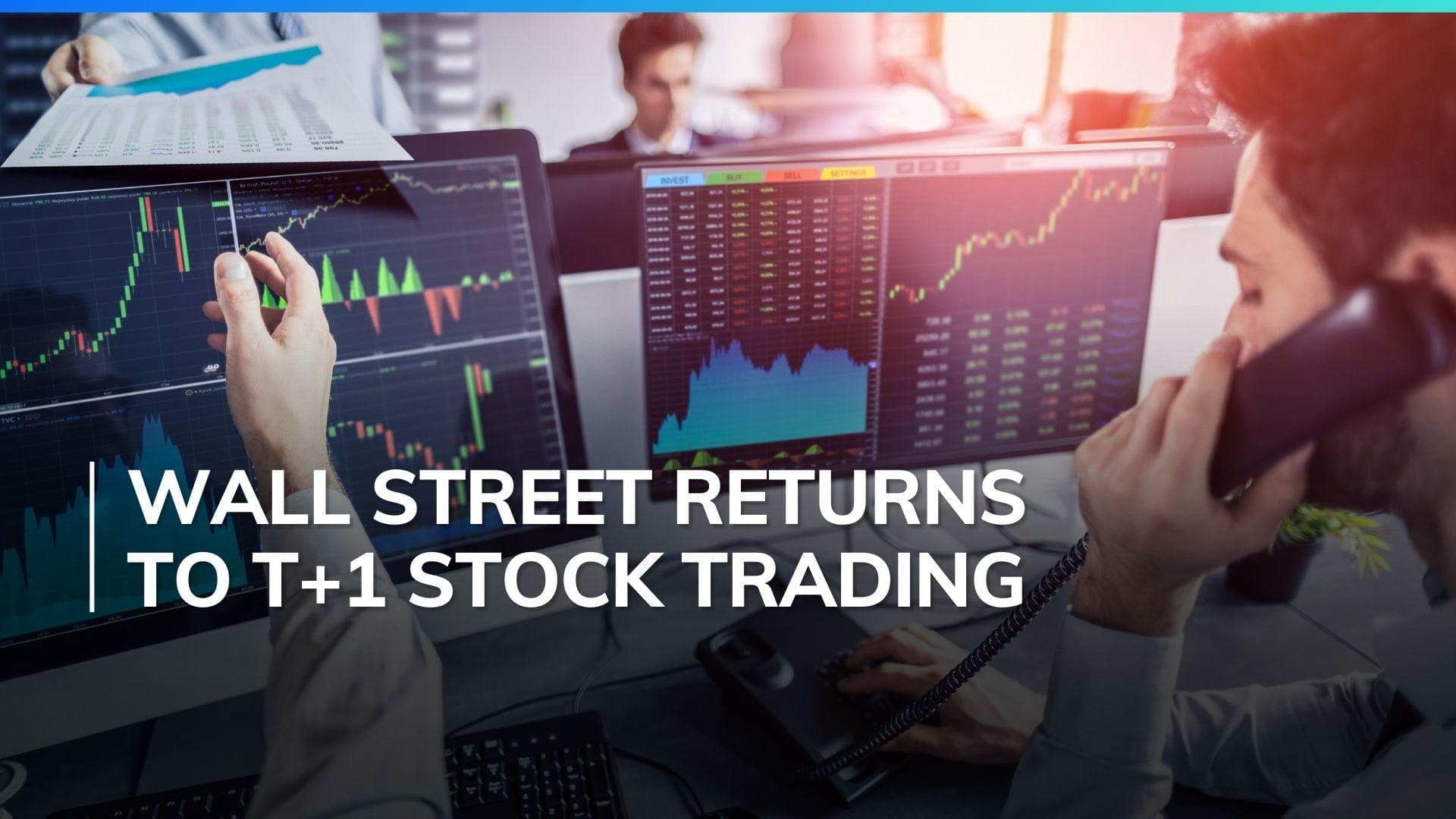
Trades on Wall Street will settle in one day for the first time in 100 years

The US stock market has adopted the T+1 trade settlement system to reduce financial risks, posing international and logistical challenges. Firms are preparing for potential settlement issues and liquidity adjustments during this transition

Trades on Wall Street will settle in one day for the first time in 100 years

The US stock market has finally moved back to single day trade settlement after 100 long years. Under the new Securities and Exchange Commission rules, from Tuesday, the share trades in New York will have T+1 stock trading system.

Fast trade settlement

The change has now halved the time it takes to complete every transaction and has occured in jurisdictions including Canada and Mexico on Monday. The T+1 transaction settlemet system was abandoned earlier as volumes became too heavy. As per Bloomberg the switch is made now to reduce risk in the financial system.

However concerns such as sourcing dollars on time by international investors, global funds moving at different speeds to their assets and less time to fix errors remain. The Bloomberg report also quoted the US Securities and Exchange commission that said said last week that the transition may lead to a “short-term uptick in settlement fails and challenges to a small segment of market participants.”

Meanwhile, Securities Industry and Financial Markets Association, has instigated what it calls the T+1 Command Center to identify problems and coordinate a response.

Transition to T+1 settlement

As per Bloomberg, firms across the spectrum have been preparing for months, relocating staff, adjusting shifts and overhauling workflows, and many say they’re confident in their own readiness. The worry is whether every other counterparty and intermediary is similarly organized.

“There’s a lot of dependencies within the industry and there may be some rough patches with individual firms,” Tom Price, managing director and head of technology, operations, and business continuity for Sifma told Bloomberg. “But I’m encouraged that firms are staffing up. They’re making sure folks are not at the beach over the transition period but in the office.”

Challenges Ahead

As per Bloomberg, Industry experts have voiced out that the T+1 transition would be the most challenging, even as Wall street had undergone transitions before.

In 1920, the era that was famously dubbed as “the roaring ’20s” had T+1 transition system. However, this ended because the manual nature of transactions meant it was impossible to keep up with surging trading activity. The settlement time was eventually pushed out as far as five days.

This was then reduced to three days in the wake of the 1987 Black Monday crash, and then to two days in 2017 to better reflect the modern market.

However, the cut to just one day is more challenging due size and scale of the market today, the complexity of investment across borders, and the fact the US is leaving many other jurisdictions behind.

“There will likely be an adjustment in liquidity requirements towards the end of the FX trading day and shortly after — between 3 p.m. and 7 p.m. in New York,” Michael Wynn, head of execution services for the securities services arm of Citigroup Inc told Bloomberg. “Over the medium to long term, we expect that liquidity will improve as we get into a normal course of business.”

The immediate tests for this transition include Wednesday’s double settlement day, where T+2 trades from Friday come due at the same time as Tuesday’s T+1 transactions. Then MSCI Inc.’s index rebalancing at the end of the week, when funds around the world tracking its gauges will be reshuffling holdings at the same time

Also watch: SEBI introduces T+1 settlement cycle, to shorten time span for share transactions

Frequently Asked Questions

The US stock market switched to a single day trade settlement on Tuesday as per new Securities and Exchange Commission rules.

ADVERTISEMENT

Up Next

Trades on Wall Street will settle in one day for the first time in 100 years

Trades on Wall Street will settle in one day for the first time in 100 years

How Does a Critical Illness Policy Work? Coverage, Claims & Benefits Explained
How Does a Critical Illness Policy Work? Coverage, Claims & Benefits Explained

Sensex Falls 252 Points, Nifty Slips as Crude Oil Tops $106
Sensex Falls 252 Points, Nifty Slips as Crude Oil Tops $106

Sensex Jumps Over 1,100 Points, Nifty Gains 1.6% as IT Stocks Rally
Sensex Jumps Over 1,100 Points, Nifty Gains 1.6% as IT Stocks Rally

Sensex falls 429 points, Nifty slips 173 points after RBI rate hike

Sensex falls 429 points, Nifty slips 173 points after RBI rate hike

RBI raises repo rate by 25 bps to 5.50%, shifts policy towards tightening

RBI raises repo rate by 25 bps to 5.50%, shifts policy towards tightening

ADVERTISEMENT

editorji-whatsApp

More videos

GST rates likely unchanged as 57th Council meeting focuses on reforms
GST rates likely unchanged as 57th Council meeting focuses on reforms

Sensex gains 685 points, Nifty rises 220 points to cross 22,700
Sensex gains 685 points, Nifty rises 220 points to cross 22,700

Sensex gains 473 points, Nifty rises 134 points as markets stage recovery

Sensex gains 473 points, Nifty rises 134 points as markets stage recovery

India To Grow 7% In FY27, Next Growth Phase Hinges On Infra, Deeper Capital Markets: S&P Global
India To Grow 7% In FY27, Next Growth Phase Hinges On Infra, Deeper Capital Markets: S&P Global

Sensex Falls 49 Points, Nifty Slips 96 As Selling Pressure Returns
Sensex Falls 49 Points, Nifty Slips 96 As Selling Pressure Returns

Sensex falls 243 points, Nifty slips 64 points as foreign outflows and crude prices weigh

Sensex falls 243 points, Nifty slips 64 points as foreign outflows and crude prices weigh

India launches anti-dumping probes into 7 Chinese products, including key pharma ingredients
India launches anti-dumping probes into 7 Chinese products, including key pharma ingredients

Sensex crashes 1,124 points, Nifty falls 1.56% as crude surges above $107
Sensex crashes 1,124 points, Nifty falls 1.56% as crude surges above $107

Sensex Rises 315 Points, Nifty Gains 77 as Markets Recover After Sharp Sell-Off
Sensex Rises 315 Points, Nifty Gains 77 as Markets Recover After Sharp Sell-Off

Sensex Crashes 1,248 Points, Nifty Falls 1.64% Amid Global Cues

Sensex Crashes 1,248 Points, Nifty Falls 1.64% Amid Global Cues

Editorji Technologies Pvt. Ltd. © 2022 All Rights Reserved.